An observation becomes evidence through a careful inference
Evolutionary biology uses several kinds of evidence, each with a different strength and limitation. Fossils preserve a time-ordered but incomplete record; comparative anatomy reveals structural relationships; embryology compares development; and molecular comparisons examine similarities in biological sequences. No single resemblance supplies a complete family tree. Ask what was observed, what inference follows, and what additional evidence would make that inference stronger.
This guide extends beyond the allele-frequency and selection mechanisms in the existing [evolution and natural selection guide](/neet-ug/biology/evolution-and-natural-selection). Its learning goal is to distinguish evidence types, read divergence from common ancestry, and keep examples of adaptive radiation and human evolution in chronological context.
Fossils provide a sequence, not a complete movie
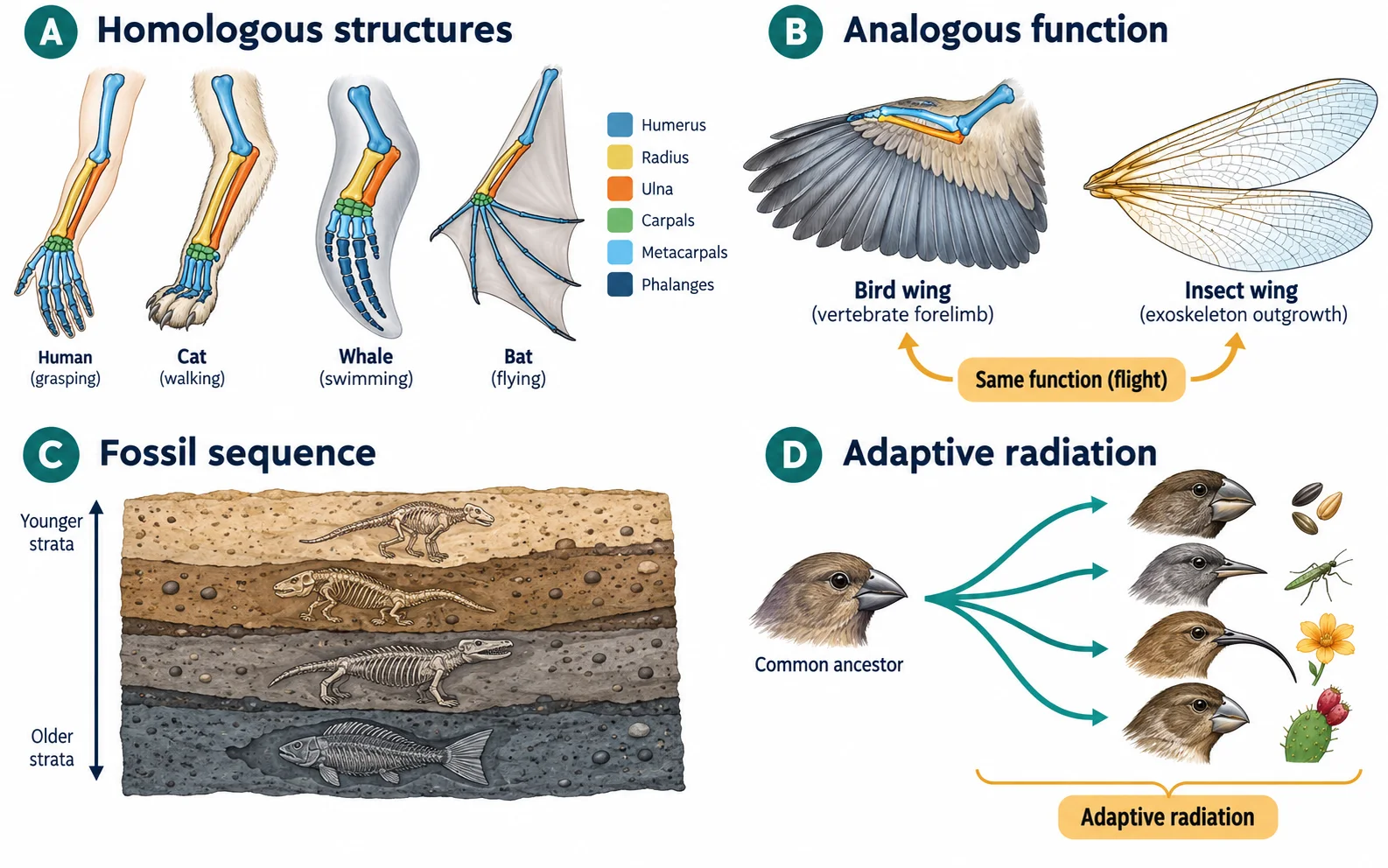
Fossils are preserved remains or traces of past organisms. Their position in geological strata can help establish relative order: in an undisturbed sequence, lower layers are generally older than layers above them. Fossil evidence can document forms that lived at different times and reveal changes in groups, but preservation is selective. Soft-bodied organisms and many environments leave fewer accessible remains, so gaps are expected.
A fossil's age, its anatomical features and its position among other fossils answer related but different questions. Stratigraphic order is not by itself an exact numerical date, and a resemblance does not prove that one fossilised individual directly produced another. A defensible explanation describes a sequence of related forms and the evidence used to place them, rather than drawing an unbroken line from one specimen to the next.
For example, if a hypothetical lower layer contains a fish-like fossil and a higher layer contains a tetrapod fossil, the order is consistent with a historical sequence. It does not alone establish the exact ancestor-descendant pair or the date of a transition. Those stronger claims need additional anatomical, geological and comparative evidence.
Keep the evidence separate from the story built from it
A fossil sequence, a homologous structure and a molecular comparison are different observations. Their value increases when they converge on a compatible explanation, but none should be made to prove more than it actually measures.
This guide summarises textbook-level evolutionary evidence for study. It does not rank living populations or present evolution as a ladder toward a predetermined endpoint.
Evidence type and the inference it can support
State the observation first, then limit the conclusion to what that evidence can support.
| Evidence | What is compared | Useful inference | Limit to remember |
|---|---|---|---|
| Fossils | Preserved remains or traces across strata | Historical forms and relative sequence | Record is incomplete; order alone is not direct ancestry |
| Homologous anatomy | Shared structural plan with modified functions | Common ancestry and divergence are supported | Shared function is not required |
| Analogous structures | Similar function with different structural origin | Convergent similarity | Function alone does not establish homology |
| Embryology | Developmental features across organisms | Can add evidence of relationship | Temporary resemblance is not a full family tree |
| Molecular | DNA or protein sequence features | Comparative relatedness under a defined method | Similarity does not prove direct descent between living species |
| Adaptive radiation | Related descendants using different ecological opportunities | Branching diversification from an ancestral lineage | A diagram is not proof of a specific mutation cause |
Homology and analogy answer different comparison questions
Homologous structures share an underlying structural plan or evolutionary origin, even when their present functions differ. Vertebrate forelimbs illustrate this: the same broad arrangement of upper limb, paired lower elements and distal bones is modified for grasping, walking, swimming or flight. Homology supports divergent evolution, in which related lineages become different under different histories and contexts.
Analogous structures perform similar functions but do not share the same structural origin in the relevant comparison. A bird wing is a modified vertebrate forelimb; an insect wing is an outgrowth of the exoskeleton. Both can enable flight, but matching function does not make their construction homologous. Convergent evolution describes independent acquisition of similar functions or features under comparable demands.
A common mistake is to classify any pair with the same job as homologous. Instead compare internal construction and origin first, then function. If the structures share the underlying plan despite different uses, homology is the stronger inference. If function is alike but construction and origin differ, analogy is the better description.
Developmental and molecular comparisons add independent evidence
Embryological comparison can reveal shared developmental features among groups, although similarities may be temporary and must not be overstated as identical adult anatomy. The useful inference is that patterns of development can provide evidence of relationship when interpreted alongside other observations. A single embryonic resemblance is not a complete proof of direct ancestry.
Molecular evidence compares DNA or protein sequences. More shared sequence features can support a closer relationship under an appropriate comparison, but the genes, organisms and method need to be specified. Sequence similarity is evidence to interpret, not a synonym for identical species or proof that one living species descended from another living species.
The evidence types complement one another: fossils add temporal context, anatomy compares structures, embryology examines development, and molecular data compare sequences. A strong synthesis asks whether distinct evidence sources are consistent, while acknowledging that they sample different parts of evolutionary history.
Adaptive radiation branches from an ancestral lineage
Adaptive radiation is the diversification of a lineage into forms associated with different ecological opportunities. The familiar finch example shows how descendants of a common ancestral population can diverge in traits such as beak form as they use different food resources. The branching pattern matters: the example is not one modern finch changing its beak during life, nor is each beak automatically a separate species without further evidence.
Darwin's finches are an example of adaptive radiation, while Australian marsupials are another classic pattern used in NCERT. The central inference is diversification from a common ancestral stock in a region or ecological setting, not simply the existence of many species. Connect the branches to variation and environmental context, but do not collapse this historical pattern into a single selection event.
Suppose four descendants occupy different feeding niches and show distinct beak shapes. The diagram supports a branching hypothesis if shared ancestry and divergence are independently justified. It does not establish that a particular food directly caused a mutation. Variation arises, and ecological conditions can affect which inherited variants leave more descendants over generations.
Human evolution is a branching history with evidence at each step
Human evolution belongs within primate and hominin history; it should not be represented as a ladder with modern humans at the inevitable top. Fossils, anatomical comparisons and molecular evidence contribute to reconstructions of relationships. Different lineages can coexist in time, and a named fossil group should not automatically be treated as the direct ancestor of every later group.
In the NCERT overview, the sequence of examples includes early hominins, forms associated with increasing brain capacity and tool use, and later members of the genus Homo. Learn the broad sequence presented in the textbook, while distinguishing the evidence-based reconstruction from a claim that every stage forms a simple straight chain. Exact dates and disputed classifications can change with new evidence and are not needed to make the core inference here.
This is an educational account of biological history, not a statement about the worth or ranking of present-day populations. Human variation does not divide living people into evolutionary grades. A careful answer describes populations and lineages, the evidence considered, and the limits of an inference.
Use an evidence-to-inference grid
Build a four-column grid from memory: observation, evidence type, inference supported, and limitation. Put a fossil sequence in the first row, homologous forelimbs in the second, an embryological comparison in the third, and a molecular sequence comparison in the fourth. Add adaptive radiation and human evolution as applications that require multiple lines of evidence rather than isolated labels.
Then contrast this guide with [population genetics](/neet-ug/biology/population-genetics), which calculates allele frequencies under stated assumptions, and [organisms and populations](/neet-ug/biology/organisms-and-populations), which covers interactions and population attributes. Revisit [chromosomal basis of inheritance](/neet-ug/biology/chromosomal-basis-of-inheritance) for the source of heritable variation that can be acted on across generations.
A three-question evidence check
- What was directly observed: a fossil, a shared structure, a developmental feature or a sequence?
- Does the comparison support common ancestry, similar function, temporal order or population change? Do not swap these conclusions.
- What is the limit: incomplete preservation, temporary developmental similarity, or a comparison that does not establish direct descent?
A 15-minute retrieval routine
Spend five minutes drawing the four evidence types as separate boxes. Spend five minutes placing homologous and analogous structures on different branches, with one sentence explaining each. Spend the last five minutes sketching adaptive radiation from a common ancestor and listing two reasons the human-history picture is a branching reconstruction rather than a ladder. NCERT anchor: Class 12 Biology, Chapter 6, Evolution, Reprint 2025-26; compare the current NEET-UG 2026 syllabus, Unit 7, for its stated evidence categories and evolutionary topics.
Common confusions to check
- Similar function alone does not establish homology; compare structure and origin.
- A fossil's position can support relative sequence but does not alone prove direct ancestor-descendant status.
- A beak or other adaptive feature is not produced because an organism needs it; explain inherited variation and differential reproduction across generations.
Worked inference: same job, different structure
An invented comparison describes a bird wing as a modified forelimb with the vertebrate limb-bone plan, and an insect wing as an exoskeletal outgrowth. Both support flight, but the shared job is not the same as shared structural origin. The useful classification is analogous function, not homologous wings.
The common wrong answer is 'both wings fly, so they are homologous'. Replace it with the evidence: compare construction and origin, then name function. For a separate fossil claim, a specimen in a lower undisturbed stratum supports older relative placement, not a direct parent-child relationship with a specimen above it. NCERT anchor: Class 12 Biology, Chapter 6, Evolution; the current NEET-UG 2026 Unit 7 also lists paleontological, comparative-anatomy, embryological and molecular evidence.
Editorial note and disclaimer
Written by: DongFeng. Published by: MedQGo. Last updated: October 10, 2026.
Disclaimer: This guide is a revision aid for NEET-UG aspirants and does not constitute medical advice. For clinical or health-related queries, consult a qualified medical professional.
References
Related revision guides
How to use this guide
Read the relevant NCERT chapter first. Then redraw the relationships or process described here from memory, compare your version with the textbook, and correct only the gaps. This is an independent revision aid, not official NCERT, NTA, or NEET material.