Evolution is a population change across generations
Evolution is not a change that one individual organism chooses during its lifetime. In population genetics, evolution is described as a change in allele frequencies in a population over generations. The unit that changes is therefore the population, while natural selection acts through differences among individuals.
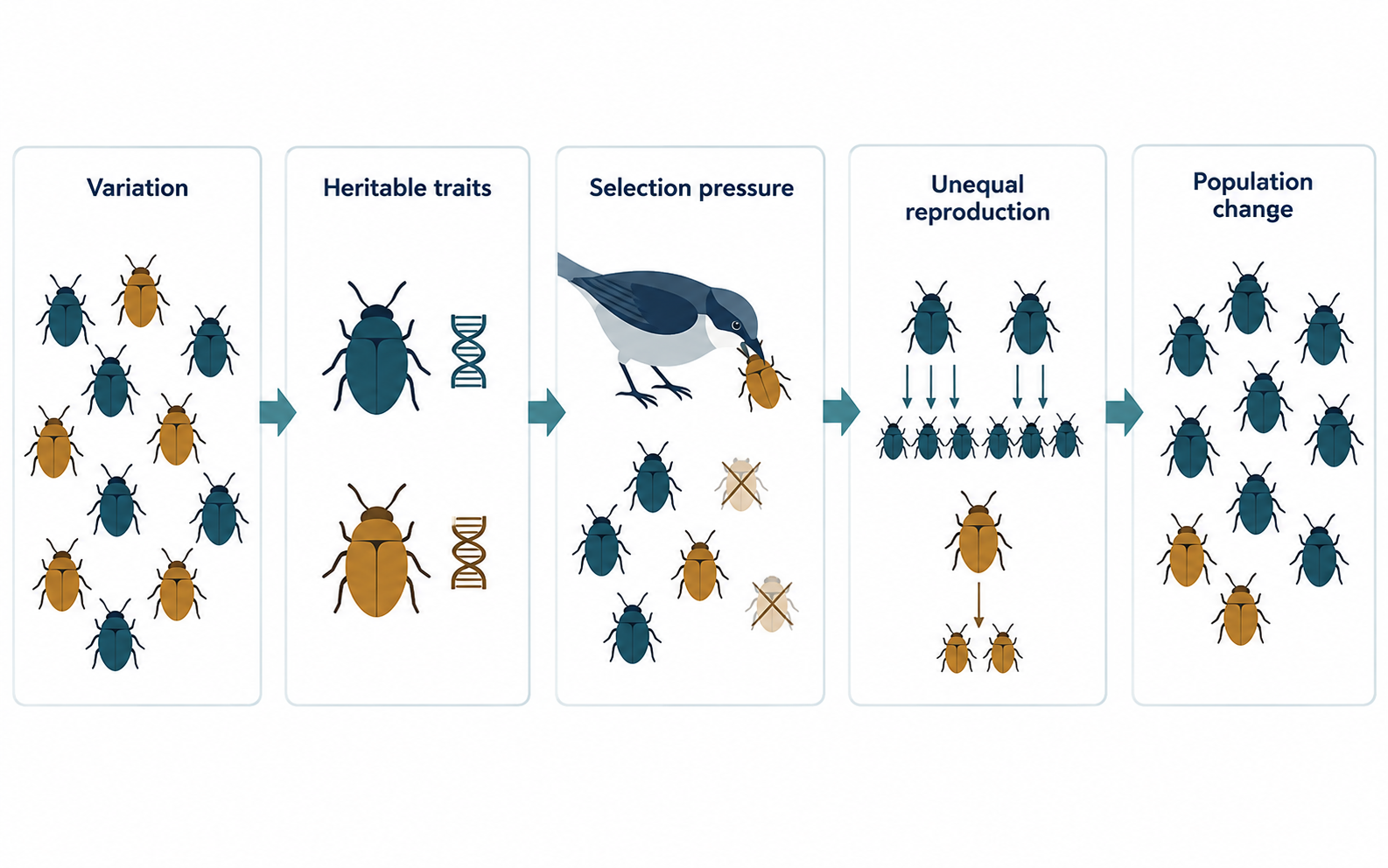
Start with variation. Individuals in a population can differ in traits, and some of those differences can be inherited. If an environment makes one heritable variant more likely to contribute offspring than another, the representation of that variant can increase in later generations. That change in representation is the evolutionary outcome to track.
Natural selection has a cause-and-consequence route
The route can be written as variation, heritability, environmental context and unequal reproductive success. A trait is not selected because it is morally better, more complex or more advanced. Its effect depends on the conditions in which organisms live, survive and reproduce.
Selection pressure is a feature of the environment that changes the relative success of variants. It can involve resources, predators, climate or another ecological condition. The important comparison is between reproductive contribution, not merely which individual survives for a short time. A variant becomes more common only when it is inherited and contributes disproportionately to later generations.
The generation-and-frequency check
Keep the individual-level event and the population-level result in the same explanation, but do not treat them as the same thing.
- Individuals vary, but evolution is described as a change in allele frequencies within a population over generations.
- Natural selection requires heritable variation and differential reproductive success in a stated environment.
- Genetic drift changes allele frequencies by chance and can be especially influential in small populations.
- Evolution does not imply a fixed direction toward complexity, progress or perfection.
Do not make an individual evolve inside the diagram
Natural selection can look like a story about one organism changing to meet a challenge. The crucial scientific step is different: heritable variation already exists, and the relative contribution of variants to the next generation differs.
A clear answer always includes the generation boundary. It explains why a trait can become more common in a population without claiming that every individual changes in the same direction.
Population change: mechanism, evidence and wrong shortcut
Use the cause of the allele-frequency change to separate selection from chance and movement between populations.
| Mechanism | What shifts | Key condition | Wrong shortcut |
|---|---|---|---|
| Natural selection | Frequency of heritable variants | Variants differ in reproductive success in a stated environment | Calling every surviving individual an adaptation |
| Genetic drift | Allele frequencies by chance | Sampling effects, often stronger in small populations | Assuming an advantage is required |
| Gene flow | Alleles enter or leave a population | Individuals or gametes move between populations | Calling it a mutation |
| Mutation | DNA sequence can create a new allele | A sequence change occurs | Treating every mutation as automatically advantageous |
Selection, drift and migration change populations in different ways
Natural selection is one mechanism of evolutionary change, but it is not the only one. Genetic drift is a change in allele frequency caused by chance, especially noticeable in small populations. Gene flow occurs when individuals or gametes move between populations and introduce or remove alleles. Mutation supplies new genetic variation by changing DNA sequence.
A useful question is whether the explanation requires an advantage. If an allele becomes common because carriers leave more offspring under stated conditions, selection is relevant. If a small group happened to carry a different sample of alleles, chance and drift may be the better explanation. Do not use 'adaptation' as a substitute word for every population change.
A change in frequency is not the same as a larger population
Consider a hypothetical diploid population of 100 individuals: 36 are AA, 48 are Aa and 16 are aa. There are 200 copies of this autosomal locus. The number of A copies is twice 36 plus 48, or 120, giving an A frequency of 0.60. Counting the 84 individuals with at least one A allele would answer a different question.
If a later generation of 100 has 49 AA, 42 Aa and 9 aa, the A frequency is 0.70. Population size stayed fixed while allele frequency changed. The counts alone do not prove natural selection: evidence about reproductive differences, migration and chance is needed to identify the mechanism. This is why an evolutionary explanation needs more than the observation that one colour has become common.
Hardy-Weinberg equilibrium supplies a comparison baseline
For two alleles, write p + q = 1. Under the idealised equilibrium assumptions, the genotype frequencies are p squared, 2pq and q squared. Using p = 0.60 and q = 0.40 gives 0.36, 0.48 and 0.16. Random mating, a very large population and absence of selection, mutation and migration are part of the model; the equation is not a claim that all real populations satisfy those conditions.
For a fully recessive phenotype in a population assumed to be at equilibrium, a frequency of 0.09 corresponds to q squared, not q. Thus q = 0.30, p = 0.70 and the expected heterozygote frequency is 0.42. State the equilibrium assumption before using this shortcut. The formula cannot identify which evolutionary force acted merely because observed frequencies differ.
Separate the origin of variation from the environment selecting it
A mutation is not generated because a population needs a useful trait. Selection can increase an existing heritable variant when its carriers contribute more descendants in a particular environment. A bottleneck, by contrast, can alter frequencies because the survivors happen to be an unrepresentative sample. The same final proportion could therefore result from different histories.
Evidence also needs a precise comparison. Homologous structures share an evolutionary origin even when their present functions differ; analogous features can perform similar functions despite different origins. Neither resemblance nor complexity alone proves that one living species is the ancestor of another. Close the guide by explaining what evidence would distinguish advantage-driven reproduction from chance sampling in the hypothetical population above.
Draw one generation boundary before you reason
Draw two rows of simple organisms, labelled generation one and generation two. In the first row, use two heritable colour variants. Add one environmental condition between the rows, then draw more descendants from the variant that has higher reproductive success in that condition. The second row should show a changed proportion, not a transformed individual.
For a final recall check, answer four questions without notes: What is the population-level measure that changes? What makes a trait relevant to natural selection? How does drift differ from selection? Why is evolution not a ladder of progress? The answers should rely on population and generation language.
Common confusions to check
- Natural selection acts through individuals but evolutionary change is measured in populations over generations.
- A trait must be heritable and linked with differential reproduction to change in frequency by natural selection.
- Evolution is not a statement that every change is progress, purpose or increased complexity.
Editorial note and disclaimer
Written by: DongFeng. Published by: MedQGo. Last updated: September 18, 2026.
Disclaimer: This guide is a revision aid for NEET-UG aspirants and does not constitute medical advice. For clinical or health-related queries, consult a qualified medical professional.
References
Related revision guides
How to use this guide
Read the relevant NCERT chapter first. Then redraw the relationships or process described here from memory, compare your version with the textbook, and correct only the gaps. This is an independent revision aid, not official NCERT, NTA, or NEET material.