Inheritance questions begin with alleles entering gametes
Mendelian crosses are not ratio-recitation exercises. Start with the genotype of each parent and ask what alleles can appear in its gametes. An individual with genotype Aa carries two alleles for the same gene, but a gamete receives only one of them after segregation.
This is the practical meaning of the law of segregation: paired alleles separate during gamete formation, so each gamete carries one allele of a gene. Fertilisation then brings one allele from each parent together in an offspring. Build this route before drawing any Punnett square.
Genotype, phenotype, dominant and recessive answer different questions
A genotype is an allele combination, such as AA, Aa, or aa. A phenotype is the observable expression associated with that genotype in the stated inheritance pattern. With complete dominance, AA and Aa can share a phenotype even though their genotypes differ; aa expresses the recessive phenotype.
Do not use dominant to mean common, stronger, healthier, or more important. In a standard Mendelian context, it describes which allele is expressed in a heterozygote. The allele frequency in a population is a separate question.
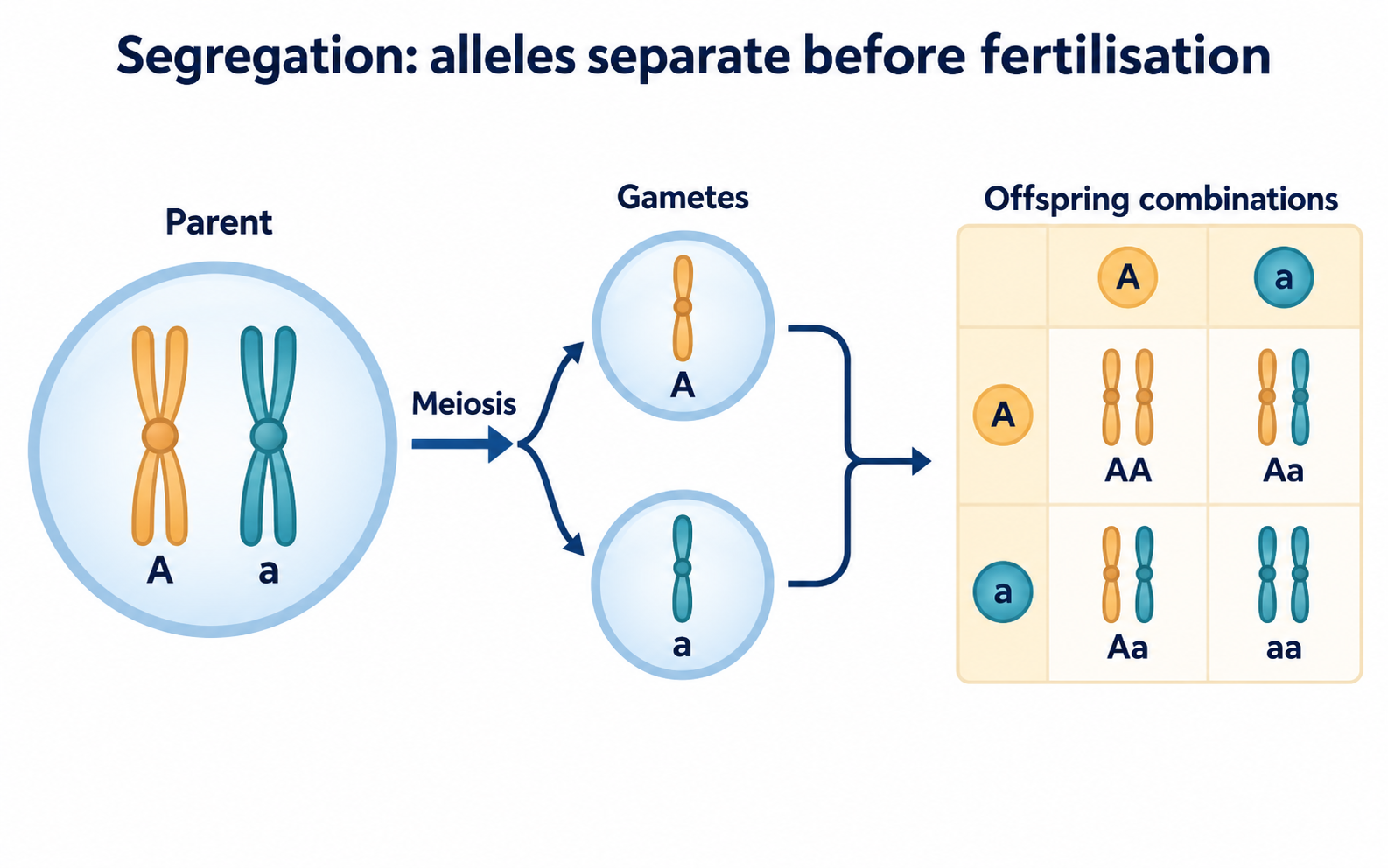
The gamete-first method
A cross becomes a small probability exercise when each line follows from the previous one.
- Write the parental genotype before naming a trait.
- List one allele per gamete.
- Combine gametes in a square and count the requested output only.
- State whether the question asks for genotype, phenotype, carrier status, or probability.
Ratios are outputs, not starting facts
A 3:1 phenotype ratio is useful only after the parent genotypes and dominance condition have been stated. Starting with the ratio makes it easy to carry it into incomplete dominance, codominance, or a different parental cross where it does not belong.
The steadier habit is to write gametes first. The rest of the cross then has a visible reason instead of relying on a remembered pattern.
One cross, four different things a question may ask
For Aa x Aa under complete dominance, do not stop after one familiar ratio. Identify the requested output first.
| Requested output | Result from Aa x Aa | How it is obtained | Common error |
|---|---|---|---|
| Possible gametes | A and a from each parent | Segregation of paired alleles | Putting Aa itself into a gamete |
| Genotype ratio | 1 AA : 2 Aa : 1 aa | Four combinations in the square | Writing the phenotype ratio |
| Phenotype ratio | 3 dominant : 1 recessive | Complete dominance only | Using it for every inheritance pattern |
| Probability of aa | 1 in 4 | One aa outcome among four equal combinations | Calling every recessive-phenotype individual a carrier |
Use the Punnett square as a probability map, not a memory card
For Aa x Aa, each parent can produce A and a gametes. Combining the two gamete sets gives AA, Aa, Aa, and aa as the four equally likely genotype combinations in the usual simple model. This yields a 1:2:1 genotype ratio and, under complete dominance, a 3:1 phenotype ratio.
The ratios are consequences of the gamete combinations. If a question changes the parental genotypes or the dominance relationship, the familiar 3:1 pattern may no longer apply. Rebuild the gametes instead of forcing a remembered ratio onto a different cross.
A two-minute cross check before choosing an answer
Write three lines: parent genotypes, possible gametes, and offspring combinations. Only after those lines are complete should you count genotypes or phenotypes. For a dihybrid context, keep the two gene pairs visibly separate until you have listed the allowed gametes.
A useful final check is to ask whether the question wants a genotype, a phenotype, a carrier status, or a probability. Those four requests can produce different correct answers from the same cross, and confusing the requested output is more common than a drawing error.
Common confusions to check
- A dominant allele is not automatically more common, stronger, or healthier.
- A gamete from Aa carries A or a, not both alleles together.
- A 3:1 phenotype ratio requires the stated complete-dominance and parental-cross conditions.
Editorial note and disclaimer
Written by: DongFeng. Published by: MedQGo. Last updated: September 20, 2026.
Disclaimer: This guide is a revision aid for NEET-UG aspirants and does not constitute medical advice. For clinical or health-related queries, consult a qualified medical professional.
References
Related revision guides
How to use this guide
Read the relevant NCERT chapter first. Then redraw the relationships or process described here from memory, compare your version with the textbook, and correct only the gaps. This is an independent revision aid, not official NCERT, NTA, or NEET material.