Read a pedigree as evidence across generations
A pedigree is a compact record of how a stated trait appears in a family. Begin with the key, then read generation by generation: a horizontal line joins partners, a vertical line leads to their offspring, and the symbols indicate the sex convention used in the diagram. A shaded symbol shows an individual described as having the trait; it does not, by itself, reveal the genotype.
The useful task is not to name a pattern from one symbol. Look for repeated clues: whether unaffected parents have an affected child, whether the trait appears in successive generations, whether males and females occur in comparable ways, and whether a father-to-son route is present. Each clue narrows possibilities; a conclusion should fit the whole family, not one striking branch.
Start with parent-offspring combinations that rule patterns out
For a simple autosomal dominant model, an affected person usually has an affected parent. If two unaffected parents are shown with an affected child, that observation does not fit the usual fully penetrant dominant model, but it can fit a recessive model when both parents carry the allele. Treat this as a model check, not as a statement about every real family.
For a simple autosomal recessive model, the phenotype can appear among siblings while both parents are unaffected carriers. The trait may therefore seem to skip generations. An affected person has two recessive alleles in the basic model, while an unaffected carrier has one dominant and one recessive allele. Keep phenotype and carrier status separate: a pedigree may establish the former before it can establish the latter for every person.
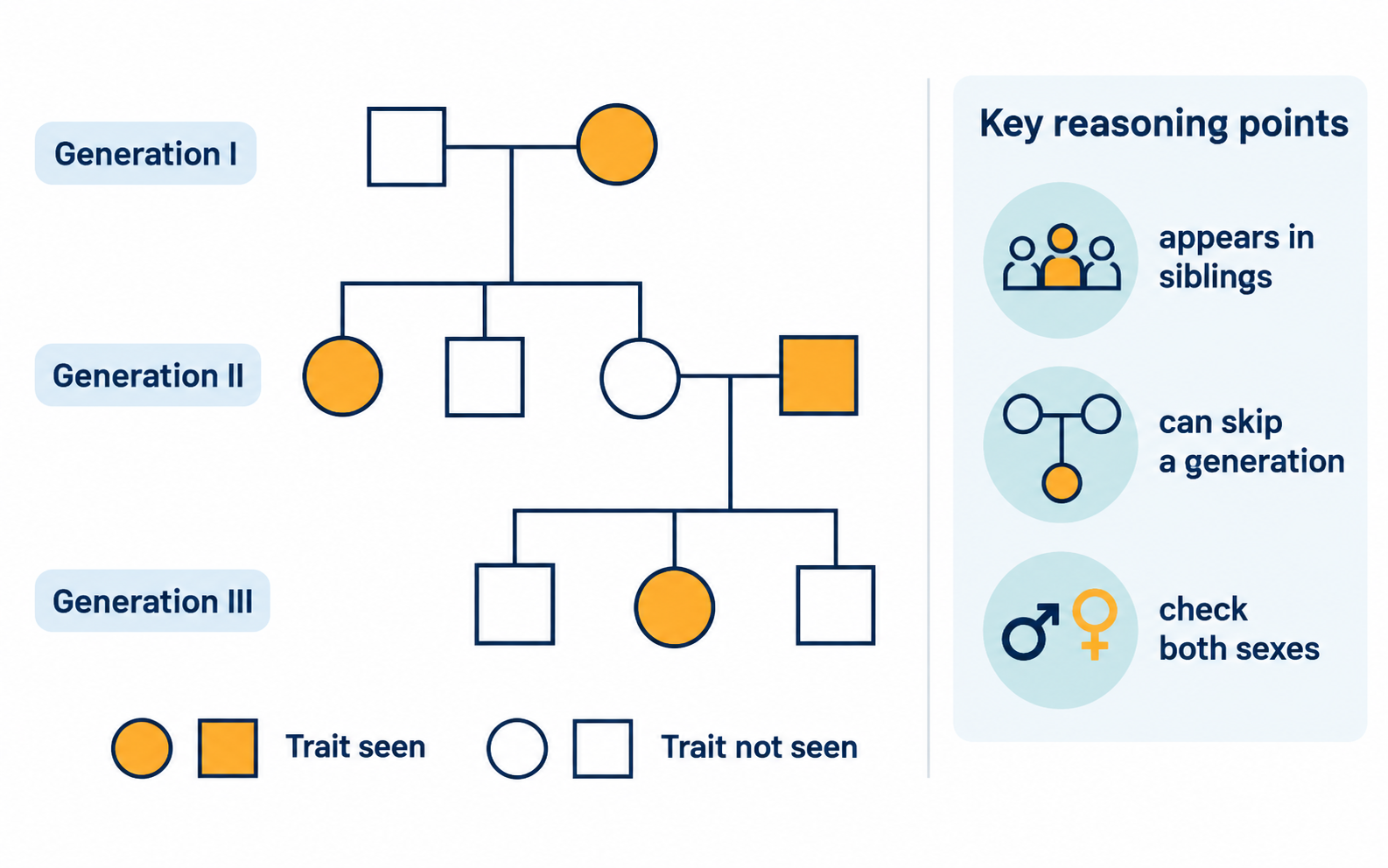
The observation-first method
Treat each branch as evidence. Write the observable fact first, then test whether a simple inheritance model can account for it.
- A shaded symbol reports the stated trait, not a complete genotype.
- Unaffected parents with an affected child can fit a simple recessive model when both parents carry the allele.
- A father cannot pass an X-linked allele directly to a son because he passes a Y chromosome to sons.
- A family diagram can suggest a model, but it is not a personal clinical prediction tool.
A pedigree is a hypothesis test, not a symbol-matching game
A family diagram can look decisive before it has been read carefully. The steadier approach is to write down an observation, ask which simple models conflict with it, and only then attach letters for possible genotypes.
That order matters because the same shaded symbol can occur in more than one inheritance model. A conclusion becomes stronger when it accounts for partners, siblings and generations together rather than relying on one person in the diagram.
Pedigree clues: what each observation can and cannot tell you
Use a family observation to test a model. A single clue is rarely the whole answer, so read the next row before deciding.
| Pedigree observation | Model it can support | Reasoning move | Do not conclude |
|---|---|---|---|
| Unaffected parents with an affected child | Simple autosomal recessive model | Both parents can be unaffected carriers | That every unaffected relative is definitely a carrier |
| Trait in successive generations | Simple dominant model can fit | An affected person may have an affected parent | That it proves dominance without checking all branches |
| No direct father-to-son route | An X-linked model remains possible | Fathers pass Y, not X, to sons | That absence alone proves X linkage |
| Affected people of more than one sex | Autosomal model remains possible | Autosomal genes are not tied to sex chromosomes | That sex counts alone identify the pattern |
Sex-linked clues need a direction check
Autosomal traits are not tied to the sex chromosomes, so the basic model allows the trait in people of either sex with similar probability. X-linked patterns need a different question: which parent can pass an X chromosome to which child? A father passes his X chromosome to daughters and his Y chromosome to sons, so an X-linked trait does not travel directly from father to son.
For an X-linked recessive pattern, a male with the allele on his single X chromosome expresses the stated trait in the simple model. A female generally needs the relevant recessive allele on both X chromosomes to express it. Do not use a count of males alone as proof. Use the inheritance route, then see whether the observed pattern agrees with it.
A pedigree-reading routine that shows your reasoning
Cover any label that names the pattern. On paper, mark every affected person first. Next write one observation under the diagram: for example, 'unaffected parents have an affected child' or 'there is no father-to-son transmission'. Then cross out the models that contradict the observation before assigning possible genotypes.
For a two-minute recall check, draw a small three-generation family with two unaffected parents and one affected child. State one inheritance model that can explain it and one simple dominant model it does not support. Then draw an X-linked route from a father to a daughter and from a father to a son; the route itself should make the chromosome rule visible.
- Read the legend before using the symbols.
- Use more than one clue before naming a model.
- Write possible genotypes only after the phenotype pattern has been checked.
- Keep classroom inheritance models separate from clinical prediction for a real family.
Common confusions to check
- A shaded pedigree symbol indicates the stated trait; it does not automatically reveal the genotype.
- One branch of a pedigree is not enough to establish an inheritance model when the rest of the family disagrees.
- A father passes an X chromosome to daughters and a Y chromosome to sons, so direct father-to-son transmission is not an X-linked route.
Editorial note and disclaimer
Written by: DongFeng. Published by: MedQGo. Last updated: September 20, 2026.
Disclaimer: This guide is a revision aid for NEET-UG aspirants and does not constitute medical advice. For clinical or health-related queries, consult a qualified medical professional.
References
Related revision guides
How to use this guide
Read the relevant NCERT chapter first. Then redraw the relationships or process described here from memory, compare your version with the textbook, and correct only the gaps. This is an independent revision aid, not official NCERT, NTA, or NEET material.