Find the parent that makes two chromosome classes
Memorising that males are XY works for one model, but fails as soon as a bird or an XO insect enters the comparison. A more reliable starting point is to list the sex-chromosome contribution of each parent's gametes. The parent producing two different classes is heterogametic; the parent producing one class is homogametic.
These words refer to sex-chromosome classes, not to all genetic variation in gametes. Eggs carrying X chromosomes can still differ at many other loci. Likewise, heterogametic does not mean heterozygous at every gene. Keep the scope of the description narrow before drawing the possible fertilisation outcomes.
XY and ZW reverse which parent supplies the alternative
In the usual human XX/XY chromosome model, eggs contribute an X chromosome, while sperm contribute either X or Y. Combining the contributions gives XX or XY. The sperm-producing parent is heterogametic in this model because there are two sex-chromosome classes of sperm.
In the usual bird ZZ/ZW model, the male is ZZ and produces Z-bearing sperm; the female is ZW and produces Z-bearing or W-bearing eggs. Fertilisation produces ZZ or ZW. Here the egg-producing parent is heterogametic. The illustration places these models side by side so that the changing source of the alternatives is easy to check.
Do not obtain the bird model simply by relabelling X as Z and Y as W while leaving the parental roles unchanged. The key difference is which parent has unlike sex chromosomes. The symbols identify a model; the gamete list explains its inheritance.
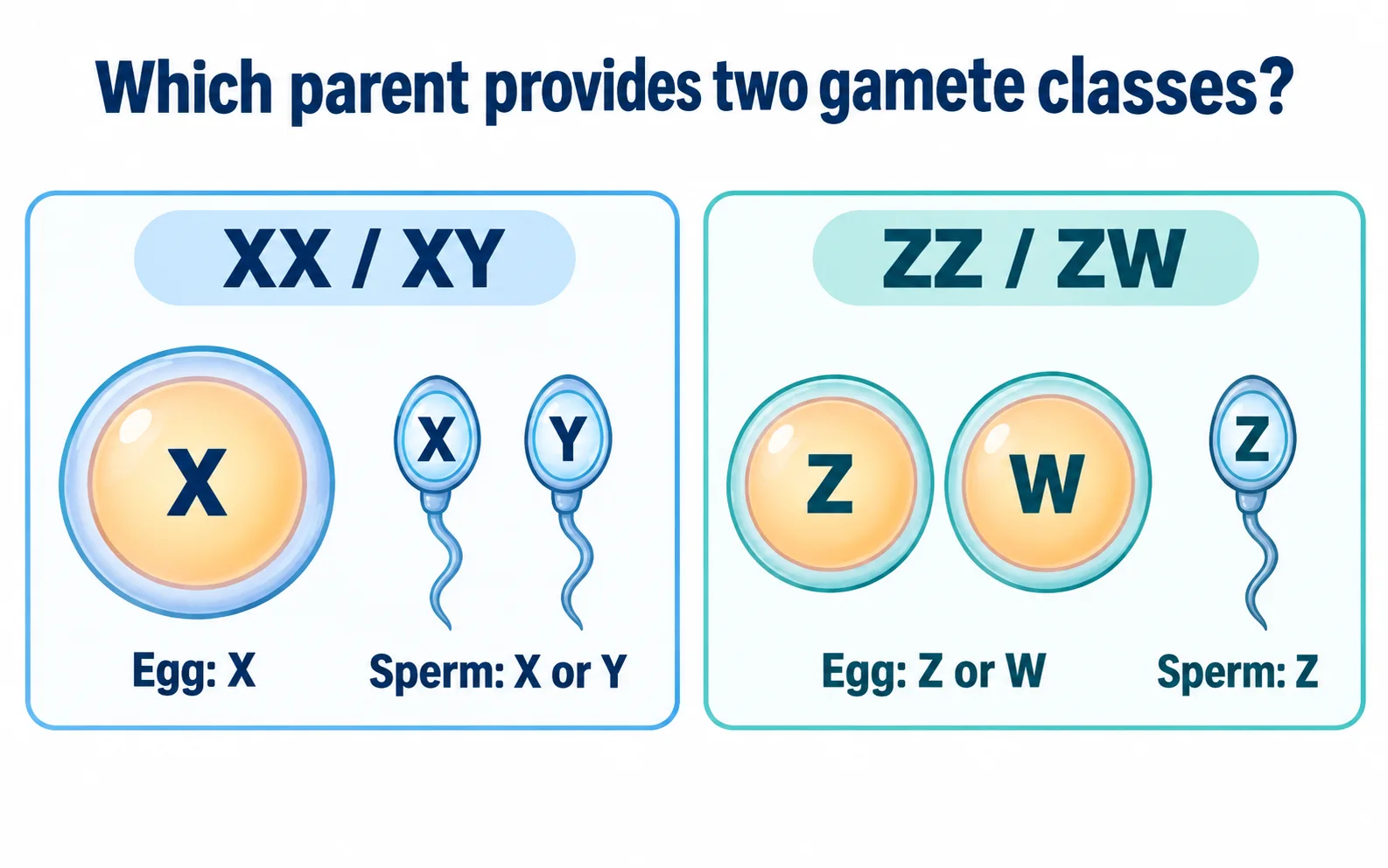
Heterogamety is a contribution rule
When the symbols change from XY to ZW, return to the two gamete lists. The comparison concerns which parent contributes the alternative sex chromosome. It says nothing about one parent's importance, responsibility or ability to choose the outcome.
Identify the system through the gamete contribution
These are the conventional NCERT models. Sex-chromosome symbols do not describe the entire chromosome complement.
| System and example | Egg contribution | Sperm contribution | Decisive distinction |
|---|---|---|---|
| XX/XY, usual human model | X | X or Y | Male heterogamety |
| XX/XO, certain insects | X | X or no sex chromosome | O denotes absence, not a chromosome |
| ZZ/ZW, birds | Z or W | Z | Female heterogamety |
| Haplodiploidy, honeybee model | One set: 16 chromosomes | One set when fertilisation occurs | Fertilised: diploid female; unfertilised: haploid male |
The O in XO is a missing chromosome, not a new one
In the XX/XO system described for certain insects, females are XX and males have one X without a second sex chromosome. O, sometimes written 0, denotes that absence. A male can produce a gamete carrying X or a gamete without a sex chromosome; eggs carry X. The resulting combinations are XX and XO.
A gamete without X is not an empty gamete. It still contains its autosomal contribution. To make the arithmetic concrete, imagine a species with ten autosomes and XX in a female somatic cell, and ten autosomes plus X in a male. Eggs contain five autosomes plus X. The two sperm classes contain five autosomes plus X, or five autosomes without X.
Fertilisation then restores ten autosomes in either case, with either XX or one X. The invented counts demonstrate why the two sexes can differ by one chromosome without one sex lacking an entire genome set. They are an accounting exercise, not chromosome numbers assigned to a named insect.
A one-to-one expectation does not schedule individual offspring
If the two relevant gamete classes contribute equally and have equal chances of successful fertilisation and survival in the simple model, each chromosome outcome has probability one half. This is a probabilistic expectation across many outcomes, not an instruction that consecutive offspring must alternate.
For an invented sequence of three independent fertilisations under those assumptions, the probability of the same specified outcome on all three is (1/2) x (1/2) x (1/2) = 1/8. Seeing two identical outcomes beforehand does not make the opposite outcome certain next time. The third probability remains one half within this model.
Actual population ratios can be influenced by biological and sampling factors beyond this classroom calculation. The model describes chromosome transmission; it does not give anyone control over a child's sex or justify blame directed at either parent. It is also not a complete account of human sex development or its variations.
Honeybees require a ploidy question instead
The NCERT honeybee example introduces haplodiploidy. Fertilised eggs develop into diploid females, whereas unfertilised eggs develop into haploid males. The immediate distinction is the number of chromosome sets and whether fertilisation occurred, rather than a switch between X-bearing and Y-bearing gametes.
In the standard honeybee example, females have 32 chromosomes and males 16. A female egg contributes 16; addition of a sperm contribution restores 32. An unfertilised egg retains a single set and can develop as a male. Do not interpret that male's sixteen chromosomes as half of each chromosome: each is a chromosome, and together they form one set.
This model also exposes a shortcut that fails: 'every multicellular animal is diploid throughout its adult body'. Haploid males are a counterexample. However, it does not follow that all insects use haplodiploidy; the XO model above already provides a different system. Always attach the mechanism to the organism or group specified.
Queens and workers are both female and diploid. Their caste difference is not explained by calling one fertilised and the other unfertilised. This guide stops at the chromosome-set comparison; it does not replace the separate developmental explanation of caste.
Sex determination and sex-linked inheritance ask different questions
A sex-determination model describes how a chromosome or ploidy outcome relates to sex in the stated organism. Sex-linked inheritance tracks an allele carried on a sex chromosome. Establishing an XX/XY system does not tell you whether a particular trait is dominant, recessive or even sex-linked.
For instance, following a father's X to a daughter in the ordinary XX/XY model is a transmission statement. Deciding whether an allele on that X produces a phenotype needs further information about the allele and the other relevant copy. A diagram of chromosome contributions is not, by itself, a pedigree diagnosis.
Keep a two-line annotation beside a problem: first write the organism's sex-chromosome system; then, only if required, place the trait allele on the stated chromosome. Doing these in the opposite order invites the assumption that every trait more common in one sex must be X-linked. Sex-biased expression alone does not establish gene location.
Identify an unfamiliar system from its gametes
Try an original symbolic exercise. Parent P produces only M-bearing gametes. Parent Q produces M-bearing and N-bearing gametes. Without assigning male or female yet, identify the heterogametic parent and write the possible combinations. Q is heterogametic; the combinations are MM and MN. Only a statement about the organism can tell you which corresponds to which sex.
Now substitute Z for M and W for N and apply the bird model. Q is the female. Finally return to XX/XO and explain why O cannot be handled as a physical chromosome labelled N. This sequence checks whether you can use the rule after the familiar symbols are removed.
NCERT anchor: Principles of Inheritance and Variation, Sex Determination and Sex Determination in Humans. Use the direct chapter reference below, then compare chromosome transmission with the linked pedigree guide. The examples here are educational models, not personal reproductive advice.
Common confusions to check
- O in XO is an absence, not a separate chromosome.
- Birds have female heterogamety in the ZZ/ZW model.
- Honeybee workers and queens are both diploid females.
Editorial note and disclaimer
Written by: DongFeng. Published by: MedQGo. Last updated: September 28, 2026.
Disclaimer: This guide is a revision aid for NEET-UG aspirants and does not constitute medical advice. For clinical or health-related queries, consult a qualified medical professional.
References
Related revision guides
How to use this guide
Read the relevant NCERT chapter first. Then redraw the relationships or process described here from memory, compare your version with the textbook, and correct only the gaps. This is an independent revision aid, not official NCERT, NTA, or NEET material.