The heterozygote is the comparison that matters
Two parents have different versions of a gene. Knowing that their offspring receives one version from each parent tells you its genotype, but not yet its appearance. You still need a rule linking that genotype to the feature being observed. Complete dominance, incomplete dominance and codominance describe different relationships at this second step.
The useful comparison is between the heterozygote and both homozygotes. Does the heterozygote resemble one homozygote for the stated trait, show an intermediate phenotype, or express both distinguishable allele-associated features? Those observations separate the three models. They do not change the requirement to identify the parental genotypes and their gametes before calculating a cross.
Pink flowers do not contain a newly blended allele
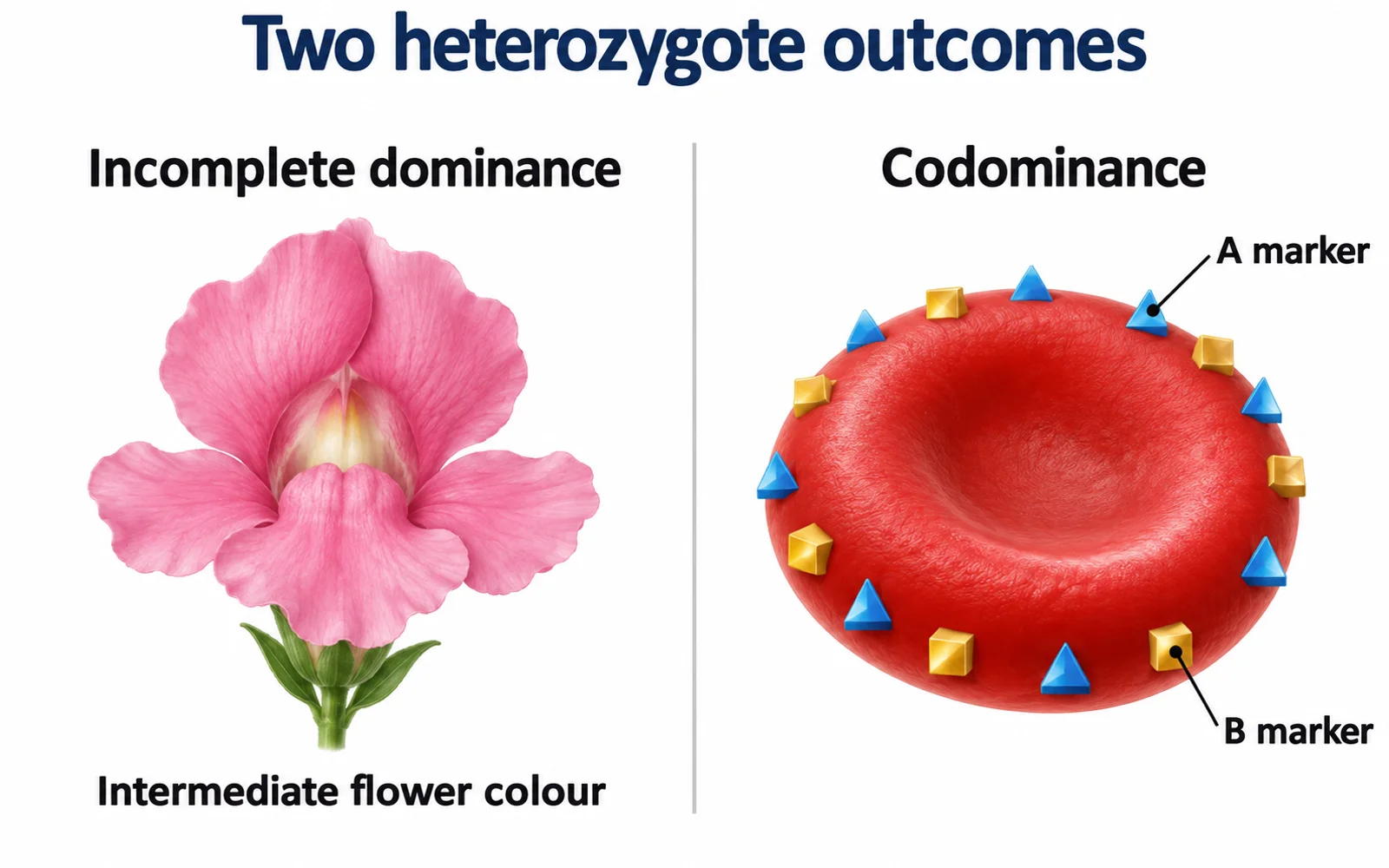
NCERT's inheritance chapter uses snapdragon flower colour to illustrate incomplete dominance: the heterozygote has pink flowers between the red and white homozygous phenotypes. For the reasoning here, call the two alleles C-R and C-W. These are text labels for the red-associated and white-associated alleles, not an assertion that one is completely dominant.
A C-R/C-W plant is pink in this model, but its gametes carry C-R or C-W. They do not carry a third 'pink allele' manufactured by mixing the two. An intermediate phenotype is therefore compatible with particulate inheritance: the alleles retain their identities and segregate. In the figure, the uniformly pink flower represents the phenotype; it is not a picture of the contents of a gamete.
Avoid turning the example into a rule about every red and white flower. The genotype-to-colour relationship is specified for this teaching model. Other pigments, species and genetic backgrounds may behave differently. A colour description alone cannot establish an inheritance mechanism without a suitable comparison.
Do not mistake a picture for the definition
Pink is useful evidence only because the two homozygous flower colours are specified for comparison. Two symbols on the cell mean distinguishable antigen types, not that half a cell belongs to one parent. Codominance need not look like coloured patches, and it does not promise equal quantities of two products. State what is observed before naming the relationship.
Read the phenotype rule, not just the ratio
These comparisons assume a stated single-locus teaching model. The observation used to classify the heterozygote is decisive.
| Relationship | Heterozygote observation | How genotype classes are grouped | What it does not mean |
|---|---|---|---|
| Complete dominance | Matches one homozygote for the named trait | Heterozygote and that homozygote share a phenotype class | The recessive allele disappears |
| Incomplete dominance | Intermediate between the two homozygotes | Heterozygote is a separate phenotype class | Alleles fuse into a third allele |
| Codominance | Both distinguishable allele-associated features are expressed | Heterozygote is distinguishable from either homozygote | A compulsory 50:50 spatial split or equal product quantities |
| Multiple allelism | Not a heterozygote-expression rule | Describes allele diversity at a locus in the population | A diploid individual carries every population allele |
Change the cross and the familiar ratio changes
Consider an independently framed nursery exercise: a pink C-R/C-W plant is crossed with a white C-W/C-W plant. Assume equal segregation, random fertilisation and equal survival. The pink parent supplies C-R or C-W gametes, each with probability one half. The white parent supplies only C-W. Offspring are therefore C-R/C-W or C-W/C-W in equal expected proportions.
The predicted phenotype ratio is one pink to one white, with no red class. In a hypothetical group of 80 offspring, the expected counts are 40 pink and 40 white. These are expectations, not a requirement that every observed group divide exactly in half. Red would require C-R from both parents, which the white parent cannot supply in the stated model.
Now change only the second parent to another pink heterozygote. The possible combinations are C-R/C-R, C-R/C-W, C-W/C-R and C-W/C-W. The middle two are the same heterozygous genotype, giving a 1:2:1 genotype ratio and, here, red:pink:white in the same ratio. The wrong shortcut is to use 1:2:1 for every incomplete-dominance cross without checking the parents.
A different wrong shortcut is 3:1 for the two-pink cross. That groups the heterozygote with one homozygote as though their phenotypes were indistinguishable. They are distinguishable in the stipulated flower-colour model. The segregation calculation was not the problem; the error arose while converting genotypes into phenotype classes.
AB means two antigen types, not an intermediate blood group
In the standard ABO inheritance model, I-A and I-B are codominant with one another. An I-A/I-B individual has both A and B antigen types on red blood cells. This is not a halfway antigen formed by averaging A and B. The right side of the illustration uses two marker shapes to represent their simultaneous presence; the shapes are not actual carbohydrate structures.
The usual third allele is i. I-A/i gives group A, I-B/i gives group B, and i/i gives group O in this simplified model. Thus the same allele system contains more than one relationship: I-A and I-B are codominant to each other, while each is dominant to i for the usual ABO phenotype. Naming an allele without its comparison partner is not enough to specify a dominance relationship.
This is an inheritance explanation, not a transfusion guide or a method for assessing parentage. It deliberately leaves out rare variants, other blood-group systems and clinical interpretation. Those require information that a basic classroom cross does not provide.
An AB-by-O cross exposes the gamete-level mistake
Take a hypothetical I-A/I-B by i/i cross. The AB parent can supply I-A or I-B; the O parent supplies i. The two expected offspring genotypes are I-A/i and I-B/i, giving equal probabilities of the A and B phenotypes in this model. There is no I-A/I-B combination because the O parent supplies neither of those alleles.
Why is the answer 'half AB, half O' tempting? It treats parental phenotypes as intact packages passed through gametes. A gamete carries one allele at this locus, not the parent's two-allele blood-group label. Write the single-allele contributions and that proposed answer has no route through the cross.
For a second check, cross two AB genotypes in the same idealised model. I-A/I-A, I-A/I-B and I-B/I-B have expected frequencies one quarter, one half and one quarter. Their phenotypes are A, AB and B. The numerical pattern matches the two-pink flower cross, but the heterozygote observation differs: simultaneous antigen expression in one example, intermediate flower colour in the other. A 1:2:1 ratio alone cannot distinguish incomplete dominance from codominance.
Three alleles in a population do not mean three in one person
Multiple allelism describes more than two allele forms at a locus in a population. In the ordinary diploid model, one individual still has two copies of that autosomal locus and therefore at most two of those allele forms. ABO can illustrate multiple allelism and codominance at the same time because the terms answer different questions.
Multiple allelism asks how many alternative forms exist in the population. Codominance asks how a particular heterozygous combination is expressed. Neither term means that several separate genes must contribute to the trait; that is the different idea of polygenic inheritance. Keep locus count, population allele variety and heterozygote expression on separate lines in your notes.
Build the phenotype key after the genotype list
For a final recall task, draw two columns headed 'gamete combinations' and 'phenotype rule'. Fill the first with the pink-by-white example, then use the rule to label the results. Repeat with AB-by-O. Your checks are pink:white = 1:1 and A:B = 1:1 under the assumptions already stated, with no red and no AB offspring respectively.
Finish with one explanatory sentence: segregation tells you which allele combinations can form, while the dominance relationship tells you how to classify their phenotypes. Then explain why both a pink-flower heterozygote and an AB individual retain two distinct alleles. That distinction is more useful than remembering an isolated ratio without its cross.
Common confusions to check
- Intermediate colour does not create a blended allele.
- A 1:2:1 phenotype ratio alone cannot identify incomplete dominance.
- An AB parent contributes I-A or I-B in a gamete, not an intact AB label.
- Multiple allelism and polygenic inheritance count different things.
Editorial note and disclaimer
Written by: DongFeng. Published by: MedQGo. Last updated: October 4, 2026.
Disclaimer: This guide is a revision aid for NEET-UG aspirants and does not constitute medical advice. For clinical or health-related queries, consult a qualified medical professional.
References
Related revision guides
How to use this guide
Read the relevant NCERT chapter first. Then redraw the relationships or process described here from memory, compare your version with the textbook, and correct only the gaps. This is an independent revision aid, not official NCERT, NTA, or NEET material.