Gene expression connects genotype with cell function
A genotype refers to genetic information, while phenotype refers to observable characteristics influenced by genes and environment. Gene expression is the process by which information in DNA is used to produce a functional product, often a protein. It is therefore a bridge between a DNA sequence and the behaviour or structure of a cell.
Not every gene is active in every cell at the same time. Cells with the same DNA can differ because they use different sets of genes. Keep this idea separate from mutation: regulation changes when or where existing information is used, whereas a mutation is a change in genetic material.
What a mutation changes
A mutation is a heritable alteration in genetic material. It can involve a change in the nucleotide sequence of a gene or a larger change involving chromosome structure or chromosome number. The effect depends on where the change occurs and how it affects a gene product or chromosome behaviour; a mutation is not automatically harmful, beneficial or visible.
When revising mutation types, separate the level at which the change occurs. Gene-level changes affect a DNA sequence within a gene. Chromosomal changes concern larger segments or number. Mixing these levels is a common source of confusion because both can influence inherited traits.
- Substitution changes one base pair for another.
- Insertion or deletion can alter the reading frame when the number of added or removed bases is not a multiple of three.
- A mutation may change a protein sequence, have little apparent effect, or affect regulation depending on context.
- Mutagens are factors that can increase the chance of mutation; they are not the same as a mutation itself.
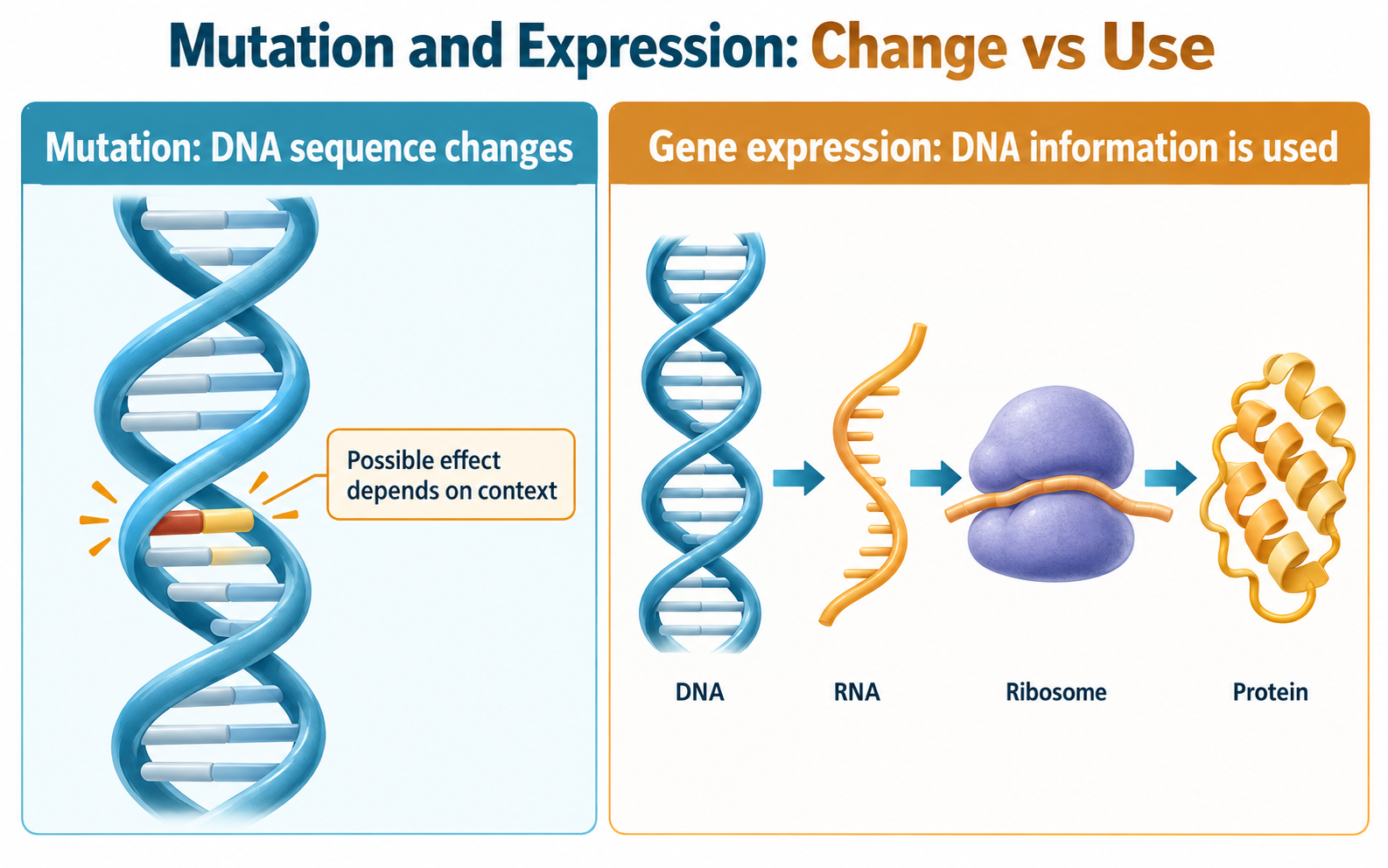
Separate a change in information from a change in use
The shortest reliable distinction is this: mutation changes genetic information or its arrangement; gene regulation changes when, where, or how much information is used.
- A substitution changes one base-pair position and may or may not change the resulting amino-acid sequence.
- An insertion or deletion can alter downstream codon grouping when it changes the reading frame.
- Gene expression follows the route from DNA information to RNA and, for protein-coding genes, to a polypeptide product.
- A visible trait depends on context; a DNA change is not automatically a disease statement.
Mutation is not a synonym for disease
A mutation can be harmful, neutral, or occasionally useful. The exam may quietly test this by offering a dramatic option that says every mutation causes disease.
The safer habit is to ask what level changed: a base, a reading frame, a chromosome segment, or chromosome number. The effect depends on that level and context.
Mutation versus regulation
The cleanest split: mutation changes information; regulation changes how information is used.
| Idea | What changes | Possible result | Exam trap |
|---|---|---|---|
| Mutation | DNA sequence or chromosome structure/number | Protein, regulation, or no visible effect | Assumed always harmful |
| Gene expression | Use of DNA information | RNA or functional product | Confused with mutation |
| Substitution | One base pair | May or may not alter amino acid | Treated as frameshift every time |
| Insertion/deletion | Added or removed bases | Can shift reading frame | Ignored after the first codon |
From DNA change to protein consequence
To reason through a gene mutation, follow a sequence: DNA information is transcribed into RNA, RNA codons are read during translation, and the resulting amino-acid sequence contributes to protein structure and function. A change in DNA does not guarantee a dramatic phenotype, because the genetic code has redundancy and because the position of the change matters.
A frameshift is especially important as a concept because inserting or deleting bases can change how later codons are grouped. By contrast, a substitution changes one position without necessarily shifting the downstream grouping. Draw the codons in groups of three to make this distinction visible.
Regulation is not an on-off slogan
Gene regulation means that a cell can control the timing, location or amount of gene expression. For revision, do not treat it as a vague switch. Ask what is being regulated: formation of an RNA transcript, availability of a protein product, or a response to a cellular signal. The exact mechanisms can be detailed, but the core principle is selective use of genetic information.
This principle helps explain cell differentiation. A nerve cell and a muscle cell can contain the same genome but perform different functions because their patterns of gene expression differ. The distinction is about expression pattern, not about one cell type having an entirely different set of chromosomes.
A 20-minute revision routine
Create two columns labelled 'change in DNA' and 'use of DNA'. Put mutation in the first column and regulation in the second. Then write a four-step path from DNA to protein and mark where a substitution, an insertion, and a deletion could affect the result. Keep the examples general rather than trying to memorise a large list of diseases.
Finish by explaining three pairs aloud: mutation versus mutagen, genotype versus phenotype, and gene regulation versus gene mutation. If you can state the difference and one connection for each pair without notes, the chapter is ready for a more detailed NCERT review.
Common confusions to check
- A mutation is not automatically harmful or automatically visible in phenotype.
- An insertion or deletion can alter later codon grouping; a substitution does not necessarily do so.
- Gene regulation is not the same as a change in DNA sequence.
A changed codon need not change the amino acid
Compare two invented RNA codons in the same reading frame: GAA and GAG. Both specify glutamate in the standard genetic code, so this substitution is synonymous at the amino-acid level. If GAA instead becomes UAA in a coding region, the new codon is a stop signal. The number of altered bases is one in each example, but the coding consequences differ.
The claim 'every substitution changes the protein sequence' is therefore false. Equally, a synonymous change should not be declared harmless in every biological context merely because the encoded amino acid is unchanged. The result established by this exercise is narrower: the codon table predicts the same amino acid.
Contrast both substitutions with an insertion of one base within a coding sequence: downstream triplet grouping changes until the frame is restored or translation stops. Connect the Mutation and Genetic Code discussions in NCERT's inheritance chapters; do not infer an organism's phenotype from the codon alone.
Editorial note and disclaimer
Written by: DongFeng. Published by: MedQGo. Last updated: September 30, 2026.
Disclaimer: This guide is a revision aid for NEET-UG aspirants and does not constitute medical advice. For clinical or health-related queries, consult a qualified medical professional.
References
Related revision guides
How to use this guide
Read the relevant NCERT chapter first. Then redraw the relationships or process described here from memory, compare your version with the textbook, and correct only the gaps. This is an independent revision aid, not official NCERT, NTA, or NEET material.