A codon lookup is only as good as the grouping
An RNA sequence can contain familiar triplets and still be translated incorrectly on paper. The trouble often begins before the lookup: the strand is read backwards, the starting position is assumed, or a stop triplet is counted as an amino acid. Establish direction and reading frame before opening a codon table.
Our worked sequence is deliberately short and invented: 5'-AUG GCU UAC GGA UAA-3'. Assume that the first AUG is the initiation codon for this exercise. That condition matters: an isolated AUG appearing somewhere in an RNA molecule is not enough to prove that translation starts there in its biological context.
Follow fifteen bases into four amino-acid residues
Read the supplied mRNA from its 5' end towards its 3' end in the stated frame. AUG specifies methionine, GCU alanine, UAC tyrosine and GGA glycine. UAA is a termination signal in the standard genetic code. The initial translated sequence is therefore Met-Ala-Tyr-Gly: four residues, not five.
The fifteen nucleotides include a three-nucleotide stop codon. Subtract that codon before turning the remaining twelve bases into four residues. A chain of four residues has three peptide bonds. This checks the route from nucleotides to codons to residues to bonds without treating any of those counts as interchangeable.
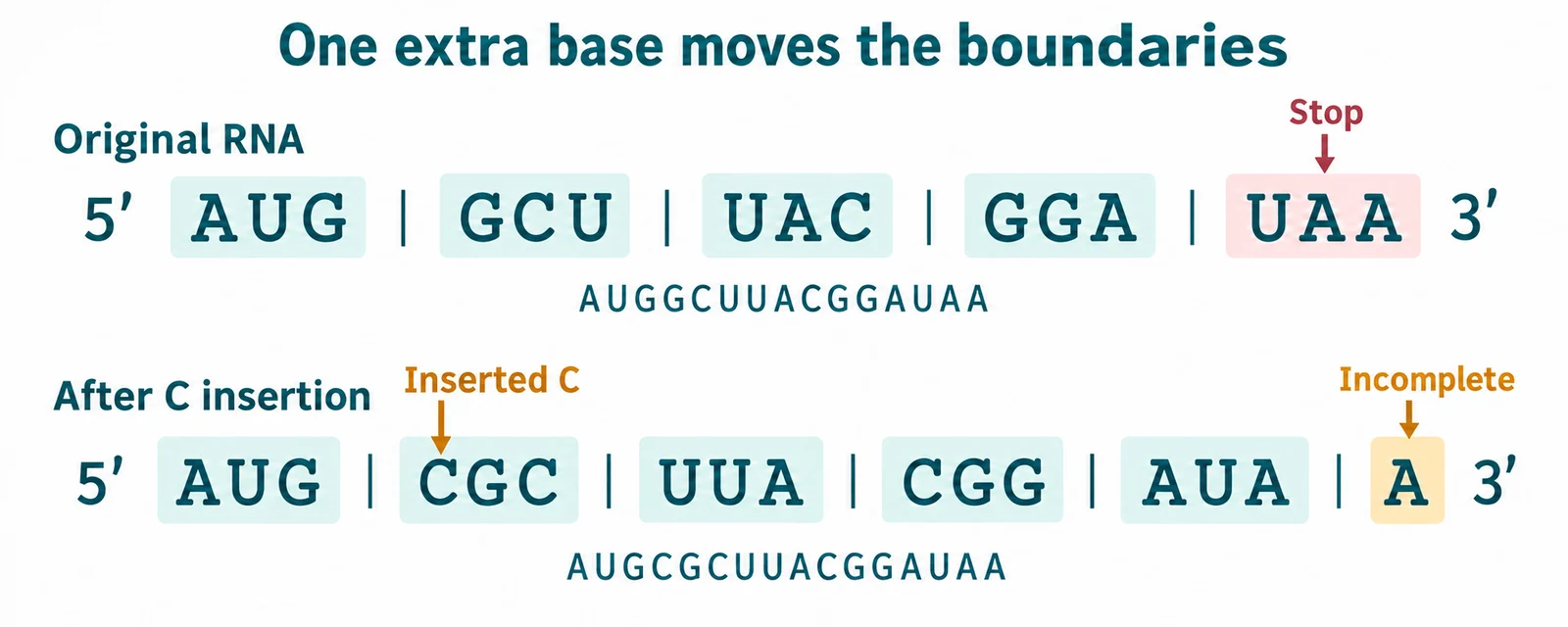
The illustration compares this sequence with a one-base insertion after AUG. Its role is to show the movement of triplet boundaries. The spaces are marks added by the reader; the RNA itself does not contain blank separators. Keep the same initiation point while regrouping the altered sequence.
Keep the undecoded remainder visible
The final single A in our frameshift fragment is not a complete codon. Leave it marked as incomplete instead of borrowing letters or assuming a stop. Showing where the evidence ends is part of a correct decoding answer.
Four descriptions of one alanine-coding position
End labels are essential. The anticodon shown is the strictly complementary pairing example, without extending the exercise into wobble rules.
| Representation | Sequence with direction | Operation before a codon-table lookup |
|---|---|---|
| mRNA codon | 5'-GCU-3' | Read directly: alanine |
| DNA coding triplet | 5'-GCT-3' | Replace T with U |
| DNA template triplet | 3'-CGA-5' | Build complementary RNA 5' to 3' |
| Aligned tRNA anticodon | 3'-CGA-5' (RNA) | Recover its paired mRNA codon; do not read anticodon as codon |
Degeneracy allows different spellings of one amino acid
There are 64 possible triplets made from four RNA bases. In the standard code, 61 specify amino acids and three specify termination. Several amino acids have more than one codon. This is degeneracy: different codons can converge on the same amino acid.
Unambiguous has a different meaning. A particular sense codon specifies one amino acid in the stated code; it is not a free choice among all the amino acids that have multiple codons. GCU and GCC both specify alanine, but GCU does not randomly alternate between alanine and glycine.
Consequently, a protein sequence usually cannot be converted back into one uniquely determined mRNA sequence. The alanine position in our example could have more than one codon. Finding the protein sequence constrains its coding sequence but normally leaves alternatives. The code is nearly universal, with known exceptions; use the standard code unless the exercise supplies a different context.
One inserted base moves the boundaries downstream
Insert a C immediately after AUG in the original sequence. Regrouping from the unchanged start gives 5'-AUG CGC UUA CGG AUA A-3'. The first codon remains AUG, but the following codons are now CGC, UUA, CGG and AUA, followed by one leftover base in this short fragment. The downstream grouping has shifted.
There is no complete in-frame stop codon in the altered fragment shown. You cannot infer the final protein length from it; more downstream sequence would be needed. In particular, the old UAA cannot still be counted as a stop simply because those letters existed consecutively before the insertion. Termination requires a stop codon in the frame being read.
Now make a different change: insert the three bases CCG after AUG. The sequence reads AUG CCG GCU UAC GGA UAA. It adds a proline codon at that boundary while preserving the later triplet grouping. The downstream frame is retained, but the peptide is still changed. 'In frame' does not mean 'no effect on protein function'.
A substitution changes a letter without moving the dividers
Change GCU to GCC in the original sequence. Both specify alanine, so the encoded amino-acid sequence is unchanged in this example. This is a synonymous substitution at that position, not a frameshift: the sequence length and downstream triplet boundaries have not moved.
A different single-base substitution can change an amino acid or introduce a stop. If UAC becomes UAA, translation terminates after Met-Ala in the stated frame. That change reduces the predicted initial product to two residues, although no nucleotide was inserted or deleted.
These examples separate the type of sequence edit from its consequence. An insertion of one base shifts the frame here; a substitution can be synonymous, amino-acid changing or stop creating. Do not classify severity from the number of changed bases alone. Function requires information beyond the short sequence calculations supplied.
Codon, anticodon and DNA triplet need their own directions
A codon table is normally read using mRNA written 5' to 3'. If a DNA coding strand is supplied in that direction, the corresponding RNA sequence matches it with U in place of T. If the template strand is supplied, construct the complementary, antiparallel RNA first. Merely replacing every T with U in a template strand gives the wrong result.
For the RNA codon 5'-GCU-3', a strictly complementary anticodon aligned beneath it is 3'-CGA-5'. Written in the usual 5'-to-3' direction, that same anticodon is 5'-AGC-3'. The two written strings describe the same pairing when their directions are included. Omitting the end labels can make a correct complement appear contradictory.
This is a base-pairing exercise, not a claim that every codon requires a separate tRNA species; wobble pairing adds flexibility. Stop codons are recognised by release factors in standard translation rather than by an amino-acid-carrying stop tRNA. A termination signal therefore contributes neither a fifth residue nor a hypothetical 'stop amino acid'.
Audit a decoding answer in three passes
First check the input: RNA or DNA, coding or template, end labels and the stated start. Second mark triplets from that start and translate only complete in-frame codons up to termination. Third check the output count, distinguishing residues from peptide bonds and noting whether the provided fragment contains a stop.
For recall, take the original fifteen bases and independently perform three edits: GCU to GCC, UAC to UAA, and insertion of C after AUG. Predict respectively unchanged peptide sequence, earlier termination and changed downstream grouping. Explain why the third fragment leaves final length unresolved. That explanation matters more than memorising the three mutation labels.
NCERT anchor: Molecular Basis of Inheritance, Reprint 2026-27, sections 5.6 through 5.7, especially Mutations and Genetic Code and tRNA as the adapter. The linked DNA/RNA overview supplies the transcription context; the protein guide explains the separate question of structure after synthesis.
Common confusions to check
- A synonymous substitution does not shift the frame.
- An in-frame insertion can still change protein function.
- An incomplete final triplet does not establish the final protein length.
Editorial note and disclaimer
Written by: DongFeng. Published by: MedQGo. Last updated: September 28, 2026.
Disclaimer: This guide is a revision aid for NEET-UG aspirants and does not constitute medical advice. For clinical or health-related queries, consult a qualified medical professional.
References
Related revision guides
How to use this guide
Read the relevant NCERT chapter first. Then redraw the relationships or process described here from memory, compare your version with the textbook, and correct only the gaps. This is an independent revision aid, not official NCERT, NTA, or NEET material.