A sequence and a folded protein are different descriptions
A chain can retain the same order of amino acids while losing the shape needed for its usual activity. That observation is the reason protein structure needs more than one level of description. Knowing the ingredients or even their sequence does not, by itself, show how the chain is arranged in space under particular conditions.
Begin with three questions: what connects neighbouring residues, how does one chain fold, and how many chains form the functional assembly? Keeping those questions separate makes bond-counting exercises and descriptions of denaturation much easier to interpret. This guide concerns protein architecture; reaction rates and the steps of translation belong to the linked guides.
Count backbones before naming structural levels
Amino acids have a shared basic framework and a variable side chain. When incorporated into a polypeptide they are called residues. Peptide bonds join successive residues along the backbone, giving the chain an amino-terminal end and a carboxyl-terminal end. Side chains project from that backbone and contribute different chemical properties.
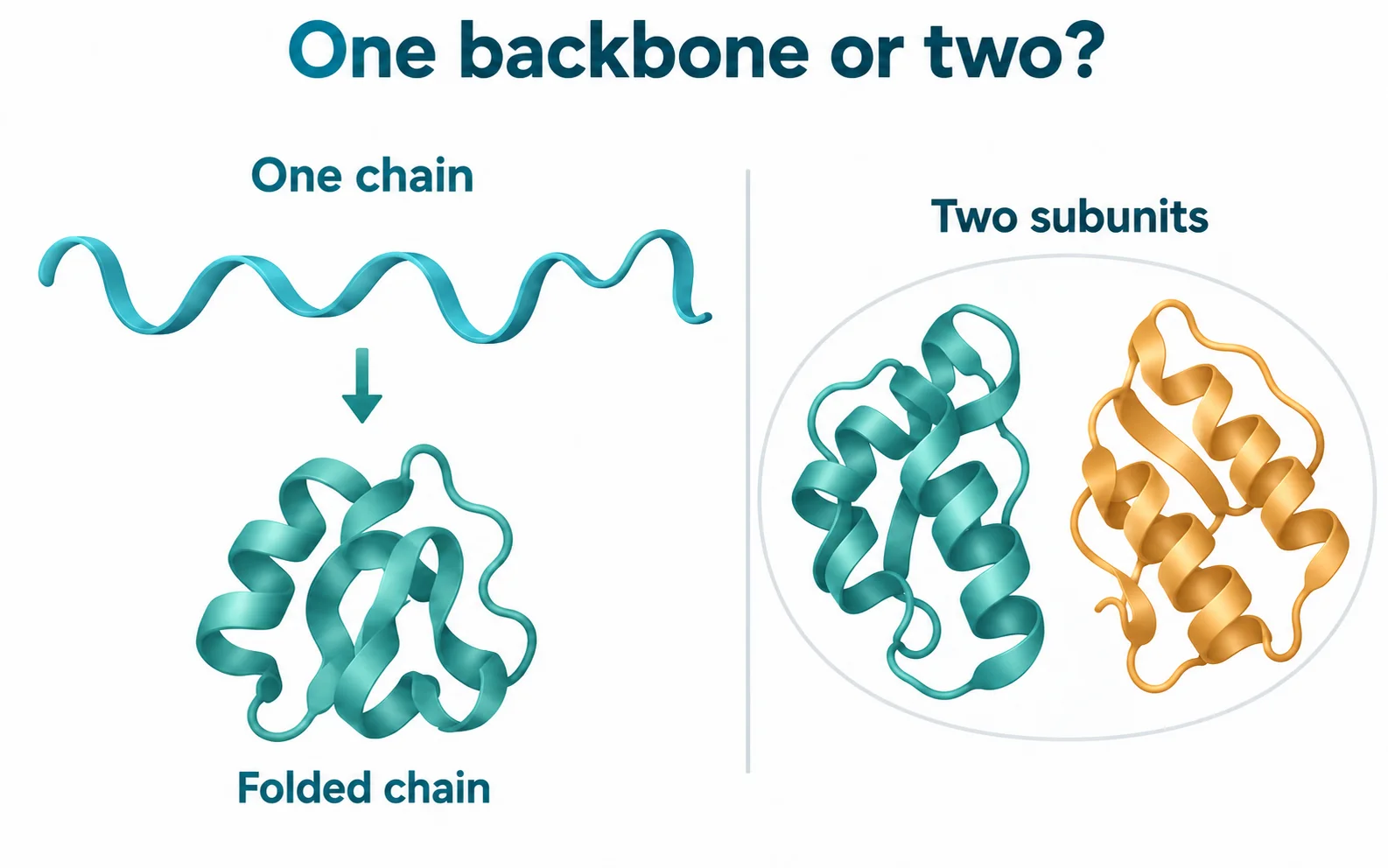
Folding bends a chain into a spatial arrangement; it does not require the backbone to be cut into new chains. In the illustration, one continuous chain remains one chain after folding. Beside it, an assembly contains two separately folded chains. Their association is a different structural fact from the folding within either chain.
Do not use the number of visible loops in a drawing as a subunit count. A single chain can loop many times. To establish multiple polypeptide subunits, you need evidence of distinct chains, not simply several coloured regions or several functions assigned to one molecule.
Keep a separate count for each chain
Before counting peptide bonds in an assembly, mark every independent backbone. Subtract one connection for each ordinary linear chain, not just one for the whole protein complex. Folding and subunit association do not erase the separate chain ends.
Choose the structural claim that the observation supports
The same protein can be described at several levels. Evidence about one level does not automatically determine the others.
| Observed evidence | Level or change described | What else would need checking? |
|---|---|---|
| Residue identities in their order | Primary structure | The spatial arrangement under the stated conditions |
| A local helix or sheet | Secondary structure | How the full chain folds |
| Overall arrangement of one folded chain | Tertiary structure | Whether other polypeptides join the assembly |
| Two separate folded chains associated | Quaternary structure | The sequence and fold of each chain |
| Loss of native fold with intact backbone | Denaturation compatible with retained sequence | Whether structure and activity can recover |
| Peptide bonds cleaved into shorter products | Backbone hydrolysis | Which bonds were cleaved and what products formed |
A short chain makes peptide-bond counting checkable
Take an invented linear chain of eight residues. Join residue 1 to 2, then 2 to 3, continuing until 7 joins 8. There are seven connections, so the backbone contains seven peptide bonds. For an ordinary unbranched, non-cyclic chain with n residues, the count is n - 1.
Now consider an assembly of two separate linear chains, one with eight residues and one with five. Their peptide-bond counts are seven and four, making eleven in total. The incorrect answer twelve treats thirteen residues as if they were a single continuous chain. Association between the chains does not automatically add another peptide bond.
In general, N residues distributed across c separate ordinary linear chains give N - c backbone peptide bonds. This accounting assumes every chain has its own two ends and excludes cyclic peptides and unusual crosslinks. A disulphide linkage, when present, is chemically different and must not be counted as an extra peptide bond.
Check the formula by separating the longer chain at one peptide bond. The residue total stays the same, the number of chains rises by one, and the number of remaining peptide bonds falls by one. The formula predicts exactly that change.
Local patterns do not specify the whole fold
Primary structure records residue order. Secondary structure describes recurring local backbone arrangements, including alpha helices and beta sheets, stabilised by backbone hydrogen bonding. These terms describe different kinds of information about the same chain; secondary structure does not mean a second polypeptide has arrived.
Tertiary structure concerns the overall three-dimensional arrangement of one polypeptide. Interactions involving side chains help organise and stabilise that fold. A protein can contain both helical and sheet regions within a single tertiary structure, so identifying one helix does not classify the whole molecule as only secondary structure.
Use the scale of the observation to choose the term. A list of residue positions supplies sequence information. A local coil supplies information about a local pattern. The relationship between distant portions of a folded chain concerns its overall architecture. None of these observations alone establishes an assembly of multiple chains.
Quaternary structure requires more than one polypeptide
Quaternary structure describes how separate polypeptide subunits associate. Adult haemoglobin is a familiar NCERT example: its assembly contains two alpha and two beta subunits. Four subunits do not mean four different types of chain; here there are two types represented twice each.
A single-chain protein does not need quaternary structure to function. The four structural levels are therefore not four compulsory boxes that every protein must fill. Nor is a small non-protein component automatically a polypeptide subunit. The word subunit must be read in the context of the structure being described.
For a schematic two-chain assembly, first identify the fold within each chain, then the arrangement between chains. The former is tertiary organisation, the latter quaternary organisation. That two-step description prevents the whole assembly from being mistaken for one unusually complicated backbone.
Unfolding is not the same operation as hydrolysis
Denaturation disrupts the organisation responsible for a protein's native properties, often affecting its folding and, where present, subunit association. It need not break the peptide backbone or change residue order. Hydrolysis of peptide bonds instead cleaves the chain. These are distinct processes even though either can destroy the original activity.
Suppose a hypothetical sample loses activity after heating, but analysis still finds the same full-length chain. That observation is compatible with altered folding. It does not support the claim that heating necessarily released free amino acids. To establish backbone cleavage, evidence of shorter chains or corresponding products would be needed.
Recovery after returning to suitable conditions is possible for some proteins but cannot be assumed. Aggregation or other changes can prevent recovery. Equally, a loss of activity by itself does not prove denaturation: an inhibitor or missing required component could also reduce activity. The structural evidence must match the structural claim.
Test three statements against the chain model
First, 'equal amino-acid composition means equal primary structure'. This is false because order matters: a chain with residues A-B-C and one with A-C-B have the same inventory but different sequences. The letters here are placeholders, not a claim about a particular natural protein.
Second, 'a protein with two helical regions has two subunits'. This is unsupported because both regions may be part of one continuous chain. Third, 'loss of shape proves all peptide bonds were hydrolysed'. This confuses spatial organisation with backbone connectivity. In each case, identify exactly which observation is missing before accepting the conclusion.
Finish with a chain-count and evidence sketch
Draw two separate strings containing six and four residues. Mark their peptide connections, fold each without erasing any connection, and bring them together without drawing a new backbone bond. Your total should remain eight peptide bonds. Label residue order, local fold, whole-chain fold and between-chain arrangement beside the appropriate features.
NCERT anchor: Class 11 Biology, Biomolecules, sections 9.4 and 9.7, Reprint 2026-27. OpenStax's protein section provides a complementary explanation of folding and denaturation. The counting examples above are original simplified models; they are not reproduced examination questions or a simulation of cellular protein synthesis.
Common confusions to check
- Two helices do not prove there are two subunits.
- Denaturation need not hydrolyse peptide bonds.
- The same residue inventory can occur in different sequences.
Editorial note and disclaimer
Written by: DongFeng. Published by: MedQGo. Last updated: September 26, 2026.
Disclaimer: This guide is a revision aid for NEET-UG aspirants and does not constitute medical advice. For clinical or health-related queries, consult a qualified medical professional.
References
Related revision guides
How to use this guide
Read the relevant NCERT chapter first. Then redraw the relationships or process described here from memory, compare your version with the textbook, and correct only the gaps. This is an independent revision aid, not official NCERT, NTA, or NEET material.