Biomolecules are easier when you sort by building block
The Biomolecules chapter can feel like a crowded catalogue: amino acids, sugars, bases, lipids, proteins, polysaccharides, nucleic acids and enzymes all appear close together. The safer revision route is to ask one question first: is the molecule a small building block, a large biological polymer, or a membrane-associated lipid?
NCERT separates an acid-soluble pool of smaller compounds from an acid-insoluble fraction that contains the main biological macromolecular material. That separation is not merely a laboratory detail. It gives a useful mental map. Amino acids, sugars, fatty acids, glycerol, nucleotides and nitrogen bases are small units or related small molecules. Proteins, polysaccharides and nucleic acids are the main polymeric macromolecules. Lipids need a special note because they are not true polymers in the same way, yet membrane fragments make them appear with the acid-insoluble fraction.
Three polymer routes and one lipid exception
For NEET revision, proteins, polysaccharides and nucleic acids should not be memorised as three names in a row. Each has a different kind of building block and a different biological job. Proteins are heteropolymers of amino acids; their sequence and folding make enzymes, receptors, structural proteins and many other functional molecules possible. Polysaccharides are long chains of sugar units; cellulose, starch and glycogen show that similar glucose-based chemistry can support structure or storage. Nucleic acids are polynucleotides; DNA and RNA carry or use genetic information through ordered nucleotide sequences.
Lipids do not fit that polymer pattern cleanly. Glycerol is a small alcohol that mixes with water; it should not be described as a water-insoluble lipid. Joining glycerol to fatty acids produces molecules with different properties. Triglycerides mainly store energy, while phospholipids have water-interacting heads and hydrophobic tails that allow them to form membrane bilayers. When a cell is disrupted, membrane pieces separate with the acid-insoluble fraction. Lipids in that fraction are therefore not evidence that every substance there is a true polymer.
Keep two separate questions in your notes: what components make this molecule, and how does the assembled molecule behave? The properties of free glycerol do not describe an entire triglyceride or phospholipid.
The lipid exception is worth saying aloud
When students rush this chapter, they often turn every big-looking biological molecule into the same kind of polymer. I prefer to make the exception visible: lipids travel with membrane fragments in the acid-insoluble fraction, but they are not polymers in the same direct way as proteins, polysaccharides and nucleic acids. That one sentence cleans up many otherwise messy options.
Biomolecule classes: classify by unit, polymer status and role
Use the final column as the decision rule. It keeps the lipid exception and nucleic-acid information role visible.
| Class | Building unit or components | Typical NCERT role | Decision check |
|---|---|---|---|
| Protein | Amino acids in a polypeptide chain | Enzymes, structure, receptors, hormones and other cell functions | Ask whether sequence and folding are central |
| Polysaccharide | Sugar units in long chains | Storage or structure, such as starch, glycogen or cellulose | Ask whether a sugar chain is being described |
| Nucleic acid | Nucleotides containing base, sugar and phosphate | Genetic information in DNA or RNA | Ask whether sequence information is the key idea |
| Lipid | Triglycerides contain glycerol and three fatty acids; other lipid structures differ | Triglycerides store energy; phospholipids form membrane bilayers | Free glycerol is water-miscible; do not transfer its properties to the assembled lipid |
Protein structure: sequence first, shape later
Protein questions often become untidy because sequence, folding and subunit assembly are mixed. The primary structure is the amino-acid sequence of one polypeptide chain. Secondary structure describes local folding patterns such as helices and sheets. Tertiary structure is the three-dimensional folding of one chain. Quaternary structure appears when more than one polypeptide subunit works together.
That order matters for enzymes. An enzyme's active site depends on folding, so a change in tertiary structure can affect activity even when the peptide backbone has not been hydrolysed. Heat denaturation is therefore not the same claim as breaking every peptide bond. If a question asks about catalytic activity, ask whether the active site shape remains suitable for substrate binding.
A small check: if a protein has one chain of 90 amino acids, it has 89 peptide bonds in that ordinary linear chain. If a functional protein has two separate chains of 90 amino acids each, count each backbone separately: 89 + 89. Subunit assembly does not create one continuous polypeptide unless a covalent connection is stated.
Carbohydrates and nucleic acids: same idea, different evidence
Polysaccharides and nucleic acids are both polymers, but their building blocks and evidence differ. In a polysaccharide, the unit is a sugar residue. Cellulose is a glucose polymer that supports plant cell walls. Starch stores energy in plant tissues, while glycogen is a storage form in animals. The word carbohydrate does not automatically mean quick energy; the role depends on the arrangement and biological context.
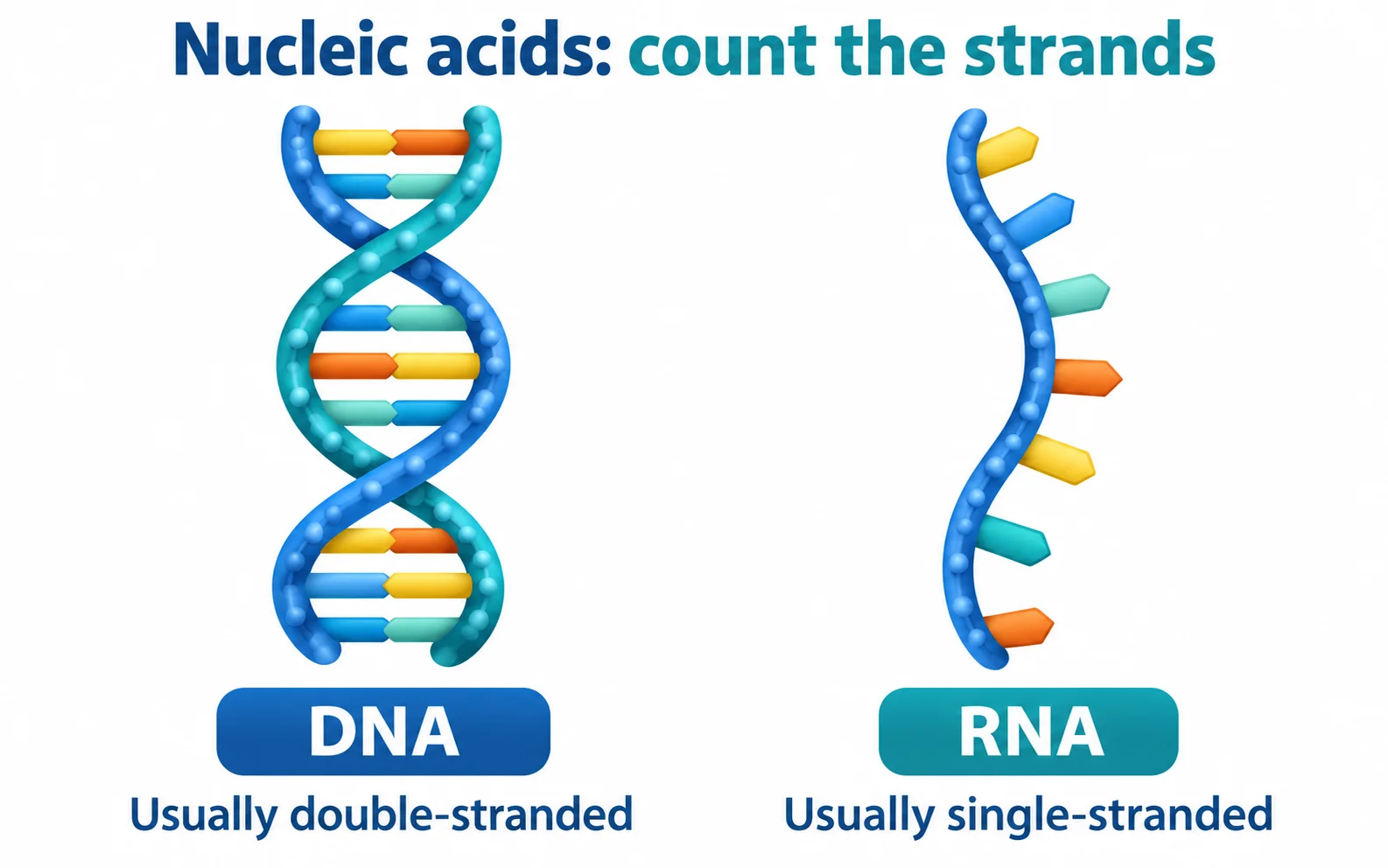
Nucleic acids use nucleotides, each built from a nitrogenous base, sugar and phosphate. Cellular DNA is usually double-stranded, while RNA is usually single-stranded and can fold through pairing within parts of its own strand. The illustration separates these usual forms; a DNA double helix should not stand for both. DNA and RNA also differ in sugar and base composition. A base sequence can store hereditary information, be copied, transcribed or translated depending on the chapter context.
A useful boundary check is this: sugar chains usually answer structure or storage questions; nucleotide chains usually answer information questions. Some molecules have additional roles, but that first distinction stops many option-level mix-ups.
Worked example: classify by unit, polymer and role
Imagine a four-row notebook table with these entries: glucose units in cellulose, amino acids in collagen, nucleotides in DNA and fatty acids with glycerol in a triglyceride. The task is not to recite definitions. The task is to decide the category and the reason.
Cellulose belongs under polysaccharide because sugar units make a long chain and the named role is structural in plant cell walls. Collagen belongs under protein because amino acids form a polypeptide and the named role is structural in animals. DNA belongs under nucleic acid because nucleotides form an information polymer. The triglyceride row should not be forced into the same polymer column: one glycerol is joined to three fatty acids, and the principal role is energy storage. Phospholipids, rather than triglycerides, form the membrane bilayer. Neither is a true polymer in the same sense as proteins, polysaccharides and nucleic acids.
This example is deliberately plain. If you can classify a molecule from its building unit and role, most longer Biomolecules statements become shorter.
Common confusion checks
- Lipids in the macromolecular fraction do not prove lipids are true polymers; membrane association explains the separation.
- A protein's biological activity can depend on folding; denaturation is not automatically peptide-bond hydrolysis.
- Carbohydrate is not a synonym for glucose. Polysaccharides can be structural or storage materials.
- A nucleotide is not the same as a nucleoside. The phosphate group is the extra component in a nucleotide.
- Enzymes lower activation-energy barriers and speed reactions, but they do not change the basic identity of substrate and product categories.
A 12-minute recall routine
Draw four columns from memory: small unit, large molecule, NCERT role and common trap. Fill rows for protein, polysaccharide, nucleic acid and lipid. Then close the notebook and explain aloud why lipid is the odd row.
Finish by writing one sentence for each link: amino acids to proteins, sugars to polysaccharides, nucleotides to nucleic acids, lipids to membranes. If one sentence becomes vague, return to the NCERT subsection rather than adding more examples.
Common confusions to check
- Lipids in the acid-insoluble fraction are not true polymers like proteins.
- Denaturation is not the same as peptide-bond hydrolysis.
- A carbohydrate name does not automatically mean glucose or quick energy.
Editorial note and disclaimer
Written by: DongFeng. Published by: MedQGo. Last updated: September 29, 2026.
Disclaimer: This guide is a revision aid for NEET-UG aspirants and does not constitute medical advice. For clinical or health-related queries, consult a qualified medical professional.
References
Related revision guides
How to use this guide
Read the relevant NCERT chapter first. Then redraw the relationships or process described here from memory, compare your version with the textbook, and correct only the gaps. This is an independent revision aid, not official NCERT, NTA, or NEET material.