A faster reaction is not a different destination
Two reaction mixtures contain the same starting materials. One produces a detectable amount of product within a minute; the other changes too slowly to measure during the lesson. Adding an enzyme can explain that difference without changing which products are chemically possible. Catalysis concerns the route and its activation barrier, not a new supply of energy that makes every reaction favourable.
This guide approaches enzymes through observations: what changes when substrate, temperature or an inhibitor changes? The useful question is not just which enzyme name belongs to which substrate. It is whether the proposed explanation accounts for the rate you observed. Most enzymes are proteins, but catalytic RNA molecules, called ribozymes, prevent us from making that description an absolute definition.
Follow one catalytic cycle before interpreting a graph
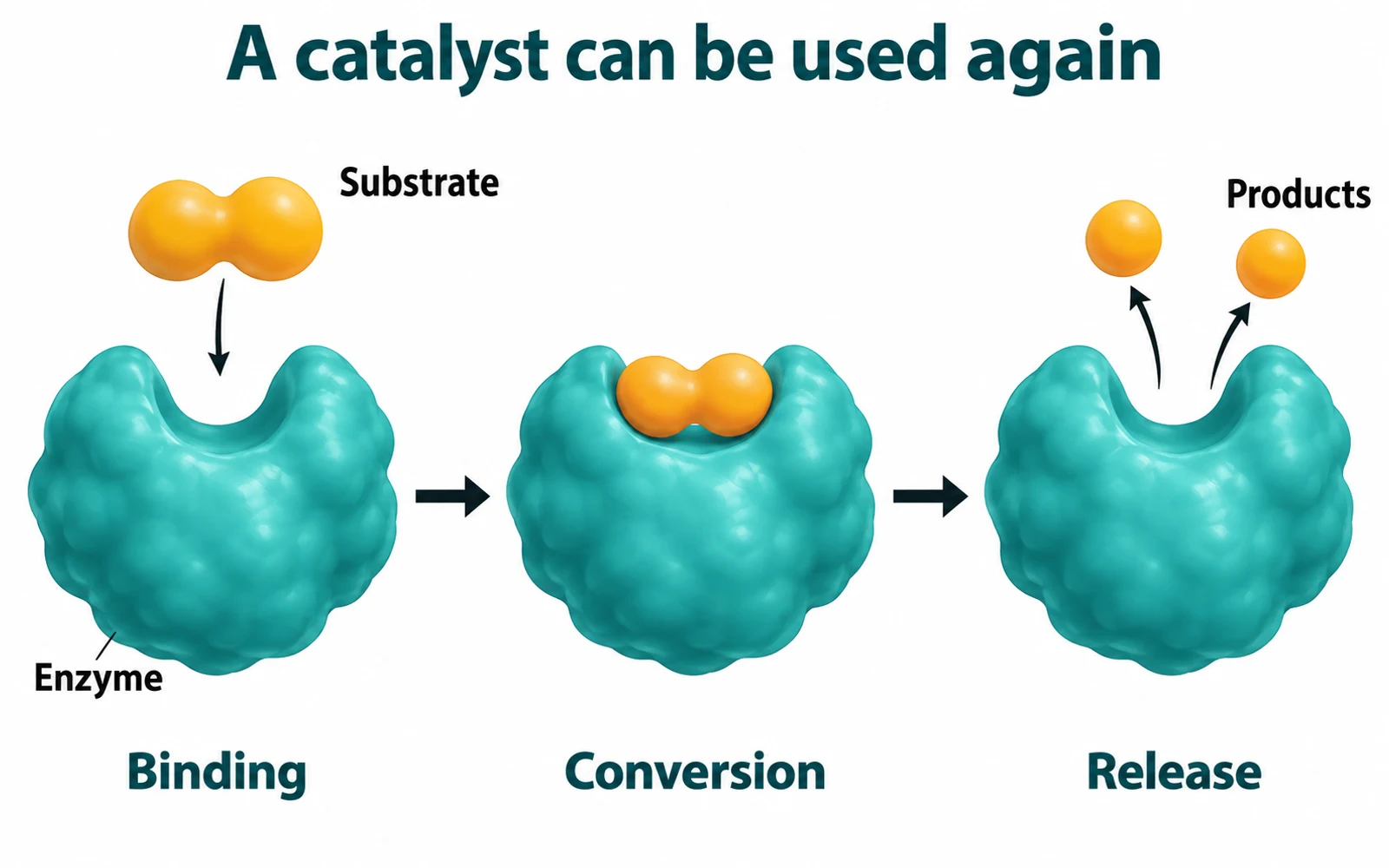
A substrate interacts with an enzyme's active site, a region whose shape and chemical properties support binding and reaction. Binding can involve adjustments in the enzyme rather than a perfectly rigid fit. A temporary enzyme-substrate association is followed by conversion and product release. The enzyme is available for another cycle; it is not consumed as a stoichiometric ingredient of the product.
The illustration uses a splitting reaction to make product release visible. Many enzymes instead join molecules, transfer groups or rearrange bonds. Do not infer that all catalysis cuts one molecule into two. Similarly, an enzyme being reusable does not mean it survives every temperature or pH indefinitely. A damaged enzyme may no longer catalyse effectively even though the reaction itself does not use it up.
Activation energy is the barrier to reaching a reaction's transition state. Enzymes provide a lower-barrier route, so more reactant molecules can undergo reaction per unit time under suitable conditions. They do not change the energy difference between reactants and products or move the equilibrium position. A catalyst can help a system approach equilibrium sooner; it cannot continually force net conversion after equilibrium has been reached.
Amount, rate and capacity are three different claims
A bottle can contain more product because it was left longer. An enzyme can work at a high rate while extra substrate has almost no effect. Separate how much has accumulated, how fast it is forming and what limits further acceleration before explaining any curve.
Which observation distinguishes the explanations?
Use matched conditions before attributing a rate change to one variable.
| Observation | Possible interpretation | Check before concluding |
|---|---|---|
| More substrate, little extra initial rate | Catalytic capacity approaches saturation | Keep enzyme amount constant |
| Activity returns after a cold sample warms | Reversible slowing is plausible | Test both samples at the same temperature |
| Extra substrate reduces an inhibitor's effect | Consistent with simple competition | Do not generalise to every inhibitor |
| Activity returns with a required cofactor | A necessary component was missing | Rule out changes in other conditions |
Calculate a rate before calling an enzyme more active
Here is an invented initial-rate comparison, not laboratory data. Mixture A produces 12 micromoles of product in 30 seconds. Mixture B produces 18 micromoles in 60 seconds. Assume the measured interval is linear, starting product is zero, and the volumes and enzyme amounts are equal. A's rate is 12/30 = 0.4 micromoles per second; B's rate is 18/60 = 0.3 micromoles per second. A is faster even though B's final product amount is larger.
The wrong conclusion, '18 is larger than 12, so B is faster', compares amounts while ignoring time. If enzyme amounts or volumes differed, the comparison would also need appropriate normalisation. Before interpreting a figure, read the axes: product accumulated, product per time and product per enzyme amount are different measurements.
Short initial measurements help reduce complications from substrate depletion and accumulating product. They do not eliminate the need for controls. If temperature and substrate concentration both differ between tubes, a rate difference cannot be assigned to temperature alone. A simple explanation is only persuasive when the experimental comparison isolates its cause.
Why adding substrate eventually gives little extra speed
At a fixed enzyme concentration, supplying more substrate often increases initial reaction rate. At sufficiently high substrate concentrations, the available catalytic capacity becomes limiting: enzymes spend most of their time processing bound substrate. Further substrate addition then produces little increase, giving the familiar approach to a plateau.
Saturation does not mean all substrate has disappeared or the enzyme has stopped working. Product can still be forming rapidly at the plateau. Nor does it mean every enzyme follows an identical curve; the simple rising-to-plateau model is the starting case, not a description of all regulation. Keep substrate concentration on the horizontal axis separate from elapsed time in a single tube.
Adding more active enzyme can raise the attainable rate when other conditions and sufficient substrate are maintained. That is a different intervention from adding more substrate to the same enzyme amount. An experiment that changes both at once cannot show which one removed the limitation.
Temperature and pH act through the catalyst's condition
A moderate temperature increase can accelerate molecular encounters and reaction. Beyond a suitable range, loss of the protein structure required for catalysis can outweigh that gain. The resulting activity curve reflects competing effects, not a rule that hotter always means faster. Different enzymes operate in different environments, so there is no single optimum temperature for every enzyme.
Low activity in the cold is not automatically denaturation. Activity may recover on warming if structure remains functional. After severe heat exposure, recovery is not assured. To distinguish these situations, measure activity after returning samples to the same test conditions rather than comparing them only while they are at different temperatures.
pH affects the ionisation of groups involved in binding and catalysis and can also affect protein structure. An optimum belongs to an enzyme under specified conditions. Memorising one numerical pH for all digestive enzymes would erase the very environmental differences that the examples are meant to teach.
An inhibitor and a missing helper are different explanations
In the simple competitive model, inhibitor and substrate compete for access to the enzyme's active site. Increasing substrate concentration can reduce the inhibitor's effect on observed rate. This does not imply that more substrate reverses every kind of inhibition, or that an inhibitor must permanently destroy the enzyme. The location and reversibility of the interaction matter.
Some enzymes require a non-protein component for activity. Cofactor is the broad category; metal ions and organic helpers are important examples. A coenzyme is organic, while a prosthetic group is tightly associated with its enzyme. These terms describe composition or association, not extra products that the enzyme manufactures during every turnover.
If activity returns after a required cofactor is restored, that supports a missing-component explanation. It does not establish competitive inhibition. Treat these as alternative hypotheses to test, not interchangeable vocabulary for any reduction in rate.
Check the reaction, not the name ending
Enzyme names often end in -ase, but a suffix is not a mechanism. NCERT's introductory classification distinguishes reaction types such as oxidation-reduction, transfer, hydrolysis, non-hydrolytic bond removal, rearrangement and joining. Use those actions to interpret an unfamiliar example rather than inventing a substrate from its name. This guide follows that textbook grouping without claiming it is the complete modern classification system.
For a final retrieval check, explain three observations without looking back: an enzyme raises initial rate without changing equilibrium; a substrate-rate curve plateaus while product continues forming; a cold-treated sample regains activity after warming. The explanations are respectively a lower activation barrier, limited catalytic capacity and potentially reversible temperature slowing. None requires the enzyme to become part of the final product.
NCERT anchor: Biomolecules, sections 9.8.2-9.8.6 in the 2025-26 reprint, connects catalytic rate, action, conditions and cofactors. Use the molecular-tools note next to see how particular enzymes serve a laboratory task; that article is an application, not a replacement for these rate distinctions.
Common confusions to check
- A larger final product amount is not necessarily a faster rate.
- Substrate saturation does not mean catalysis has stopped.
- More substrate cannot reverse every type of inhibition.
Editorial note and disclaimer
Written by: DongFeng. Published by: MedQGo. Last updated: September 23, 2026.
Disclaimer: This guide is a revision aid for NEET-UG aspirants and does not constitute medical advice. For clinical or health-related queries, consult a qualified medical professional.
References
Related revision guides
How to use this guide
Read the relevant NCERT chapter first. Then redraw the relationships or process described here from memory, compare your version with the textbook, and correct only the gaps. This is an independent revision aid, not official NCERT, NTA, or NEET material.