Where this supplementary guide fits
Digestion and Absorption appeared as a separate chapter in older Class 11 NCERT editions. It is not a separate chapter in the 2026-27 contents. Use this guide as background human physiology alongside the current textbook and examination syllabus, rather than as a claim that every detail is currently examinable.
Use one food route before learning enzymes
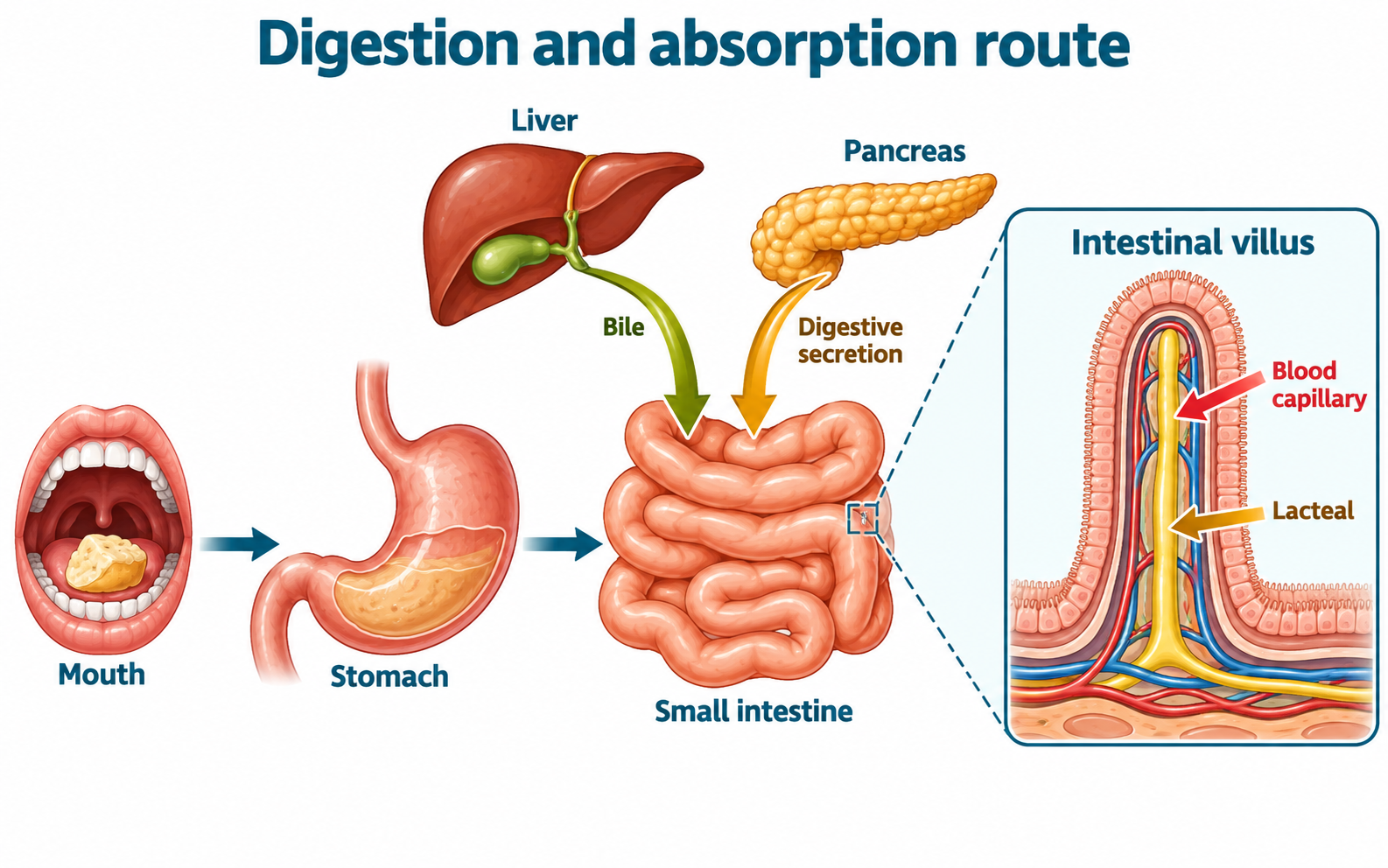
The alimentary canal is easiest to revise as a route: mouth, pharynx, oesophagus, stomach, small intestine, large intestine, rectum and anus. Accessory glands add secretions, but food does not pass through the liver or pancreas. That distinction removes a common diagram error.
Mechanical handling and chemical digestion work together. Chewing increases surface area, muscular movements mix and move food, and enzymes help convert large food molecules into forms that can be absorbed. Digestion and absorption are not interchangeable words.
Emulsification changes droplets; hydrolysis changes molecules
Imagine dividing one large fat droplet into many smaller droplets while keeping the total amount of fat the same. More surface becomes accessible to lipase, but the triglyceride molecules have not yet been chemically cleaved. Bile salts help make that surface available.
Lipase then catalyses hydrolysis of chemical bonds. Naming the physical change and the chemical change separately explains how bile assists an enzyme without being an enzyme itself.
Digestion and absorption: keep the action separate
A nutrient can be chemically digested without yet being absorbed. This table keeps the route and outcome visible.
| Material or stage | Main action | Result | Common mix-up |
|---|---|---|---|
| Carbohydrate | Enzymatic digestion | Simple sugars | Named as amino acids |
| Protein | Enzymatic digestion | Amino acids | Said to enter a lacteal as the main route |
| Fat and bile | Emulsification then enzyme action | Absorbable lipid products | Bile called an enzyme |
| Small intestine | Absorption across villi | Nutrients enter blood or lacteal routes | Confused with the stomach |
Match each nutrient to an absorbable outcome
Carbohydrate digestion produces simple sugars, proteins are broken into amino acids, and fats are handled as fatty acids and glycerol-related products before uptake. The names matter because an option may give a correct enzyme but pair it with the wrong substrate or product.
Bile is a classic check. It helps emulsify fats, increasing the surface available for enzyme action, but it is not itself a digestive enzyme. A statement can be partly correct about fat digestion and still fail at that distinction.
The small intestine is built for absorption
Most absorption occurs in the small intestine. Its length, folds, villi and microscopic surface features increase contact area, while blood vessels and lacteals support transport away from the intestinal lining. Structure and function should be learnt together here.
Glucose and amino acids enter intestinal blood capillaries and reach the liver through the hepatic portal circulation. Many products of long-chain fat digestion first enter absorptive cells, are reassembled into triglycerides and packaged into chylomicrons. These particles enter lacteals and travel in lymph before reaching the blood. Short-chain fatty acids can enter portal blood more directly, so 'all fats go into lymph' is too broad.
Follow starch and protein through a changing chemical environment
Starch breakdown begins with salivary amylase. As the swallowed material becomes acidified in the stomach, this enzyme loses activity; carbohydrate digestion is then continued by pancreatic amylase in the small intestine and enzymes at the intestinal surface. An enzyme's presence in a swallowed mouthful does not mean it remains active throughout the route.
Protein takes a different sequence. Gastric acid helps denature proteins and supports conversion of pepsinogen to pepsin, which cuts proteins into smaller peptides. Pancreatic proteases and intestinal peptidases continue the breakdown. This is why 'protein becomes amino acids in the stomach' skips the later stages needed to complete the explanation.
Three short reasoning checks
If a food sample has been broken into small molecules but those molecules remain in the intestinal lumen, has absorption occurred? No: chemical breakdown and crossing the intestinal lining are separate events. If villus surface area falls, which step is directly impaired? Uptake capacity falls even if digestive enzymes are still present.
Why do glucose and a chylomicron have different early transport routes? Glucose can enter villus blood capillaries, whereas the assembled lipid particle enters a lacteal. Name the transported form before choosing the vessel; the word nutrient alone is not specific enough.
A 15-minute recall routine
Draw the food route as a single line and add liver and pancreas as side branches only. Under the small intestine, write three pairs: carbohydrate to simple sugars, protein to amino acids, and lipids to absorbable products. Then mark blood capillary and lacteal as separate exit routes.
Finish with three corrections: bile is not an enzyme, the liver is an accessory organ rather than a food passage, and absorption is not the same event as digestion.
Common confusions to check
- Digestion breaks complex food into absorbable units; absorption moves those units across the intestinal lining.
- Bile aids fat emulsification but is not itself a digestive enzyme.
- Most absorption occurs in the small intestine, not the stomach or large intestine.
Editorial note and disclaimer
Written by: DongFeng. Published by: MedQGo. Last updated: September 20, 2026.
Disclaimer: This guide is a revision aid for NEET-UG aspirants and does not constitute medical advice. For clinical or health-related queries, consult a qualified medical professional.
References
Related revision guides
How to use this guide
Use the linked physiology references to check this supplementary topic. Draw the food route and explain where digestion ends and uptake begins; check the current examination syllabus before allocating revision time. This is an independent revision aid, not official NCERT, NTA, or NEET material.