Start with the two loops of double circulation
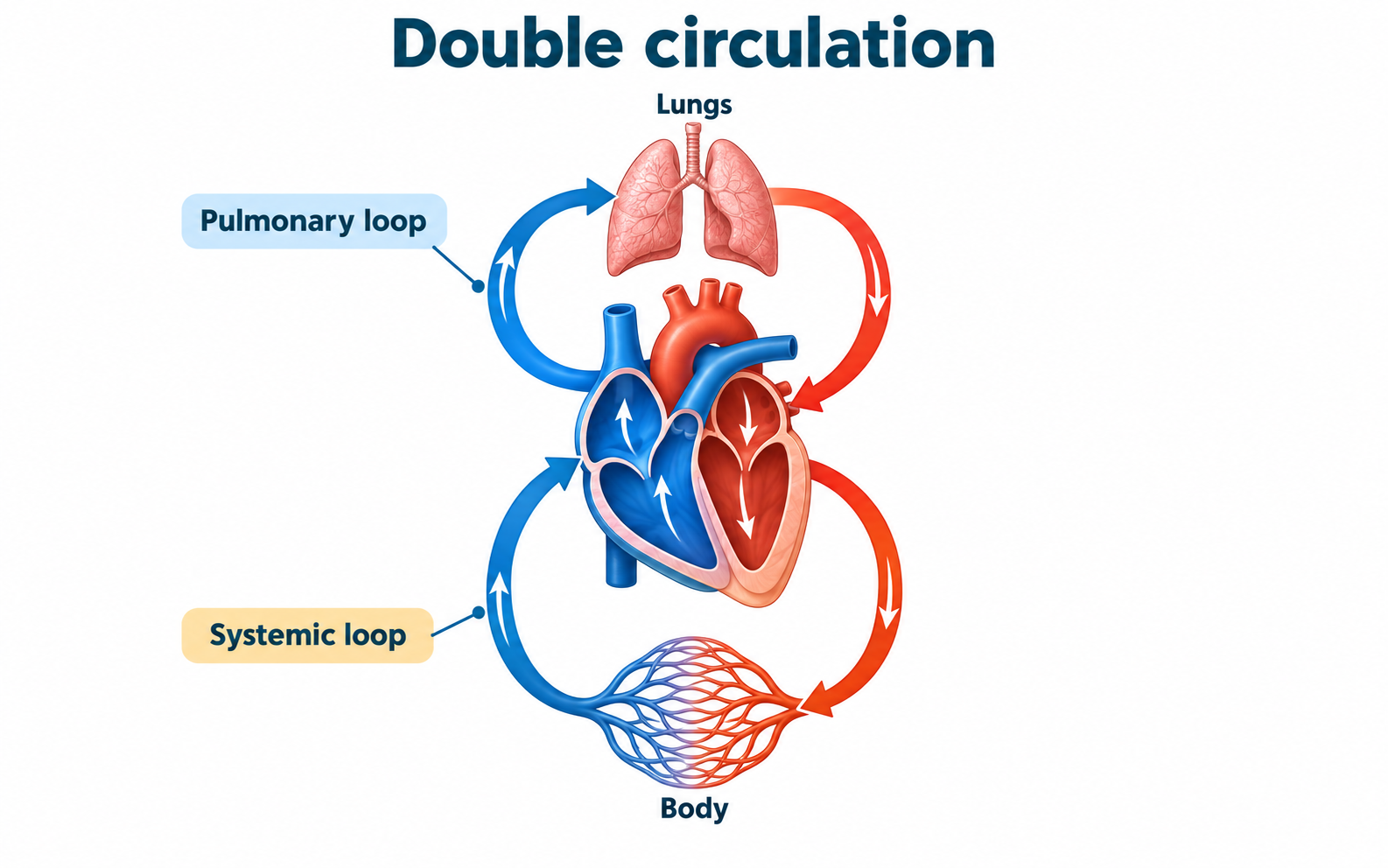
Human double circulation is best recalled as two connected loops. In pulmonary circulation, blood travels from the right side of the heart to the lungs and returns to the left side. In systemic circulation, blood leaves the left side for body tissues and returns to the right side.
An artery carries blood away from the heart, while a vein carries blood toward it. Oxygen content is often associated with the vessels but does not define them; pulmonary vessels are the useful exception that tests the rule.
Blood has a fluid part and formed elements
Plasma is the fluid component that carries dissolved substances. Red blood cells are closely linked with oxygen transport through haemoglobin, white blood cells participate in defence, and platelets support clotting. Learn the function beside the component rather than treating every cell in blood as a transport cell.
Clotting is a protective sequence. At NEET level, platelets and clotting factors participate in forming a clot that helps limit blood loss after vessel damage.
Name the direction before the colour
The shortcut 'artery means oxygenated' fails as soon as pulmonary circulation appears. An artery takes blood away from the heart; a vein returns it.
Once the direction is secure, oxygenation becomes a second fact to add, not the definition that can mislead the whole route.
Circulation: follow the direction, then the oxygen state
Vessel names are defined by their direction relative to the heart. Add oxygen content only after that first check.
| Part | Direction or role | High-yield fact | Common mix-up |
|---|---|---|---|
| Artery | Away from the heart | Pulmonary artery carries deoxygenated blood | Defined as always oxygenated |
| Vein | Toward the heart | Pulmonary veins carry oxygenated blood | Defined as always deoxygenated |
| Right ventricle | To pulmonary artery and lungs | Begins the pulmonary outflow | Paired with the aorta |
| Left ventricle | To aorta and body | Begins systemic outflow | Confused with right-side circulation |
Follow blood through the chambers and valves
A chamber route is more reliable than a labelled heart picture: venae cavae -> right atrium -> right ventricle -> pulmonary artery -> lungs -> pulmonary veins -> left atrium -> left ventricle -> aorta -> body tissues. Valves support one-way flow by preventing backward movement when pressure changes.
Do not confuse the chamber with the vessel that follows it. The right ventricle sends blood toward the lungs, while the left ventricle supplies systemic circulation. That division follows the two-loop map.
Capillaries connect transport with exchange
Arteries branch into smaller vessels and capillary networks, where exchange with tissues can occur across thin walls. Veins collect blood for the return journey. This connects large-scale circulation with the local exchange of gases, nutrients and wastes described in neighbouring chapters.
For blood groups, retain that red-cell surface antigens and plasma antibodies must be considered together in transfusion compatibility. Do not reduce the topic to a single letter without checking the antigen-antibody relationship in the question.
A 15-minute recall routine
Draw two loops around a four-chamber heart, using words rather than colour alone: pulmonary to lungs and systemic to body. On a second line, list plasma, red blood cell, white blood cell and platelet with one function each. Then redraw the chamber route from memory.
Explain why a pulmonary artery can carry deoxygenated blood without ceasing to be an artery. If the answer is direction away from the heart, the definition is secure.
Common confusions to check
- Arteries carry blood away from the heart and veins carry it toward the heart; oxygen content is not the defining rule.
- Pulmonary circulation is heart to lungs to heart, while systemic circulation is heart to body to heart.
- Platelets support clotting; they are not a type of white blood cell.
Follow a red cell through two circuits
Start an imagined red cell in a vein returning from a leg. Trace it through the vena cava, right atrium, tricuspid valve, right ventricle and pulmonary artery to lung capillaries. After gas exchange, continue through a pulmonary vein, left atrium, mitral valve, left ventricle and aorta towards a systemic capillary bed. Passing through the heart twice completes the pulmonary and systemic circuits together.
Now test the claim 'every artery carries oxygenated blood'. The pulmonary artery in that route carries relatively deoxygenated blood, yet it remains an artery because flow is away from the heart. Pulmonary veins return relatively oxygenated blood. Vessel names describe direction, not oxygen content. Valves support one-way flow; they do not add oxygen.
For a separate pump check, an invented heart rate of 72 beats per minute and stroke volume of 65 mL per beat give 4,680 mL per minute, or 4.68 L per minute, for one ventricle. Do not double this merely because the heart has two ventricles: the circuits operate in series. Connect both checks to the Cardiac Output and Double Circulation discussions in NCERT's Body Fluids and Circulation chapter.
Editorial note and disclaimer
Written by: DongFeng. Published by: MedQGo. Last updated: September 30, 2026.
Disclaimer: This guide is a revision aid for NEET-UG aspirants and does not constitute medical advice. For clinical or health-related queries, consult a qualified medical professional.
References
Related revision guides
How to use this guide
Read the relevant NCERT chapter first. Then redraw the relationships or process described here from memory, compare your version with the textbook, and correct only the gaps. This is an independent revision aid, not official NCERT, NTA, or NEET material.