Human respiration: the high-yield sequence
For NEET revision, treat respiration as one connected sequence: ventilation moves air, diffusion exchanges gases, blood transports them, and tissues use oxygen for cellular respiration. A question may test one step, but the options often borrow terms from another step.
Keep the direction of movement clear. During normal inspiration, thoracic volume increases and intrapulmonary pressure falls slightly below atmospheric pressure, allowing air to enter. Expiration at rest is mainly passive because elastic recoil reduces thoracic volume.
Gas exchange at the respiratory surface
Alveoli provide a large, moist and thin exchange surface. Oxygen diffuses from alveolar air into pulmonary capillary blood because its partial pressure is higher in the alveoli. Carbon dioxide moves in the opposite direction because its partial pressure is higher in deoxygenated blood reaching the lungs.
Do not replace partial-pressure gradients with a vague idea that gases simply move toward the heart. Diffusion occurs across the respiratory membrane, while circulation carries the exchanged gases away from or toward that membrane.
- Ventilation: movement of air into and out of lungs.
- External respiration: exchange between alveoli and pulmonary blood.
- Transport: movement of gases in blood.
- Internal respiration: exchange between systemic blood and tissues.
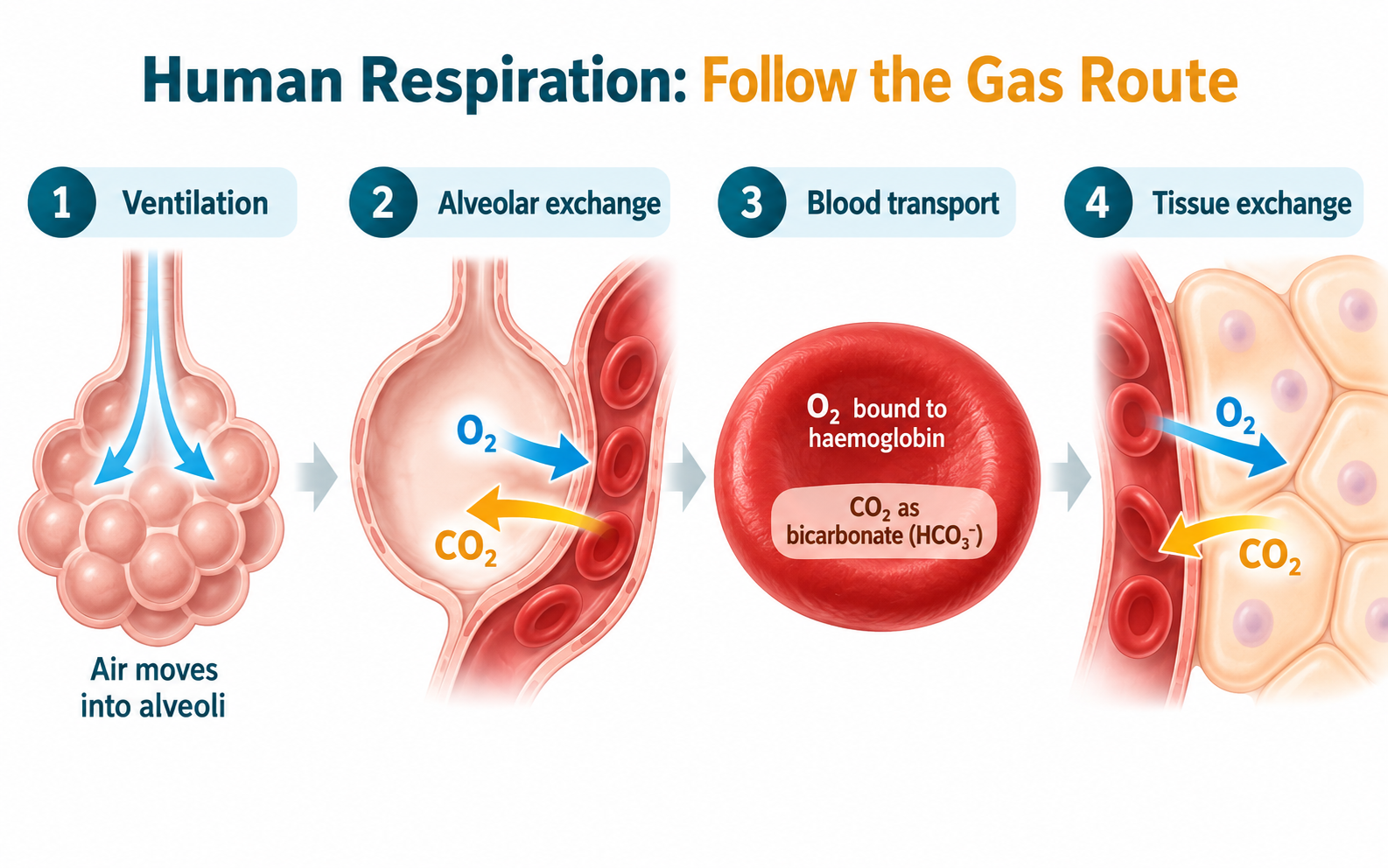
Gas movement: trace the route before naming a molecule
Respiration becomes much clearer when each event is placed on the same route instead of treated as a loose fact.
- Ventilation moves air between the atmosphere and alveoli; it is not itself diffusion across a membrane.
- At the alveoli, oxygen moves into pulmonary blood while carbon dioxide moves into alveolar air along their partial-pressure gradients.
- In systemic tissues, the direction reverses: oxygen leaves blood for tissues and carbon dioxide enters blood from tissues.
- For transport, attach oxygen mainly to haemoglobin and carbon dioxide mainly to bicarbonate before adding smaller transport fractions.
Air movement is not the same as gas exchange
A neat way to catch respiration errors is to ask: are we moving air, moving gases across a membrane, or moving gases in blood? Those are three different jobs.
The option may use a beautiful word like haemoglobin or bicarbonate. That does not make it right if the question was only about inspiration and pressure change.
Respiration stages that should not be mixed
A respiration option may be true but still belong to the wrong stage. That is the trap.
| Stage | What happens | Direction clue | Common mix-up |
|---|---|---|---|
| Ventilation | Air moves in and out | Atmosphere to alveoli and back | Called gas exchange |
| External respiration | Gas exchange at alveoli | Oxygen into blood, CO2 out | Mixed with tissue exchange |
| Transport | Blood carries gases | Haemoglobin and bicarbonate matter | Confused with diffusion itself |
| Internal respiration | Exchange at tissues | Oxygen leaves blood | Mixed with cellular respiration wording |
Oxygen and carbon dioxide transport
Most oxygen is transported bound reversibly to haemoglobin in red blood cells; only a small fraction is dissolved in plasma. The oxygen-haemoglobin dissociation curve is therefore a useful way to think about loading in the lungs and unloading in actively respiring tissues.
Carbon dioxide is carried in more than one form. The largest share is transported as bicarbonate, with smaller fractions dissolved in plasma or associated with haemoglobin and plasma proteins. In close options, identify whether the question asks for the major form, not merely a possible form.
Regulation and common NEET traps
- Do not confuse respiratory rhythm generation with gas exchange at alveoli.
- At rest, inspiration requires muscle activity; quiet expiration is primarily elastic recoil.
- Oxygen is mostly haemoglobin-bound, whereas carbon dioxide is mostly transported as bicarbonate.
- Partial pressure, not total atmospheric pressure alone, explains diffusion direction.
- Separate ventilation problems from transport problems: both can reduce oxygen delivery, but they are not the same mechanism.
A 15-minute revision method
First draw four boxes labelled ventilation, alveolar exchange, blood transport and tissue exchange. Add one direction arrow for oxygen and one for carbon dioxide in each box. Then make a two-column list: oxygen transport versus carbon dioxide transport. Finally, solve a short set and rewrite every wrong answer as a one-line correction tied to one of the four boxes.
This approach builds retrieval rather than recognition. It also makes it easier to reject distractors that use a correct fact in the wrong stage of the respiratory process.
Common confusions to check
- Ventilation moves air; gas exchange moves gases across a respiratory membrane.
- At rest, inspiration requires muscle activity while quiet expiration is largely elastic recoil.
- Oxygen is mainly haemoglobin-bound, whereas carbon dioxide is mainly transported as bicarbonate.
Equal minute ventilation can hide different useful airflow
Compare two invented breathing patterns with an assumed anatomical dead-space volume of 150 mL per breath. Pattern A moves 500 mL twelve times per minute; pattern B moves 250 mL twenty-four times per minute. Both have minute ventilation of 6,000 mL. Under this simplified model, fresh air reaching the gas-exchange region is (tidal volume - dead space) x breathing frequency: A gives 4,200 mL per minute, while B gives 2,400 mL per minute.
The difference comes from filling conducting passages more frequently with the same total inspired volume. Saying 'twice as many breaths means twice the gas exchange' ignores volume per breath and dead space. This is a calculation model, not advice about how someone should breathe.
NCERT's Breathing and Exchange of Gases chapter distinguishes the conducting part from the respiratory part and defines tidal volume and respiratory rate. Return to those definitions before comparing airflow with diffusion: air reaching alveoli and oxygen crossing the respiratory membrane are related but separate events.
Editorial note and disclaimer
Written by: DongFeng. Published by: MedQGo. Last updated: September 30, 2026.
Disclaimer: This guide is a revision aid for NEET-UG aspirants and does not constitute medical advice. For clinical or health-related queries, consult a qualified medical professional.
References
Related revision guides
How to use this guide
Read the relevant NCERT chapter first. Then redraw the relationships or process described here from memory, compare your version with the textbook, and correct only the gaps. This is an independent revision aid, not official NCERT, NTA, or NEET material.