Plant respiration is cellular energy release
Plants exchange gases through surfaces such as stomata, lenticels and roots, but they do not use specialised respiratory organs in the way mammals use lungs. Respiration is a cellular process that releases usable energy from organic substrates, and it occurs in living plant cells in both light and dark conditions.
Keep it separate from photosynthesis. Photosynthesis stores light-derived energy in organic molecules; respiration releases energy from those molecules through enzyme-controlled pathways. The processes are connected in a plant, but neither is simply the reverse label of the other.
Glycolysis is the shared starting route
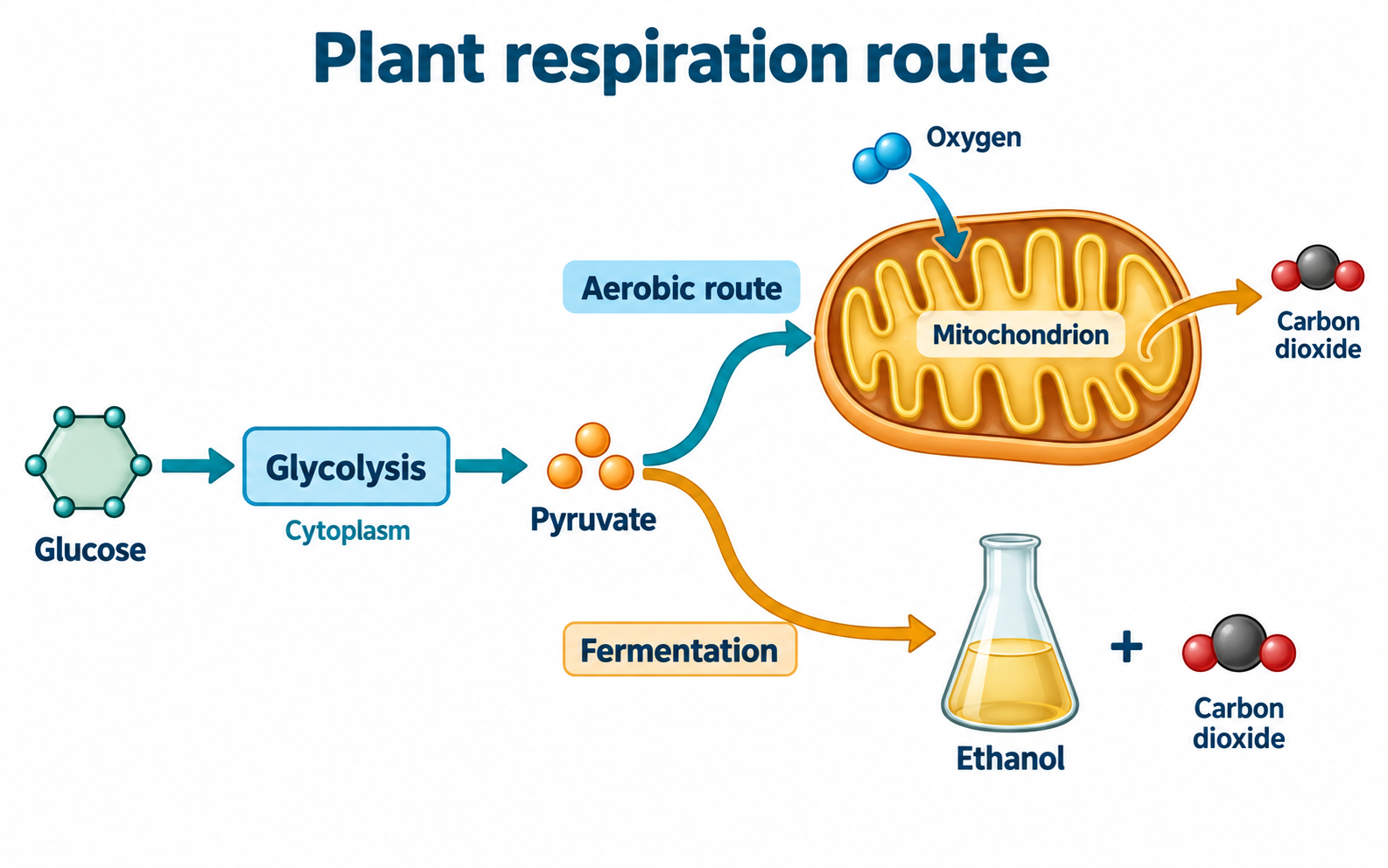
Glycolysis occurs in the cytoplasm and converts glucose to pyruvate. It is the common starting stage before pyruvate follows an aerobic route when oxygen is available or an anaerobic route under limited oxygen conditions.
Write glucose -> glycolysis -> pyruvate first, then branch the diagram. This prevents the error of placing the whole pathway inside mitochondria or treating fermentation as a step after complete aerobic oxidation.
Do not let a green leaf hide respiration
A leaf in daylight can photosynthesise and respire at the same time. One process stores energy in organic molecules; the other releases usable energy from them.
When an option says respiration happens only in darkness, return to the word cellular. Living cells need energy in light as well as dark.
Respiration route: locate the stage before naming it
The most reliable distinction is glucose to pyruvate first, followed by a branch that depends on oxygen availability.
| Stage | Location | Main outcome | Common mix-up |
|---|---|---|---|
| Glycolysis | Cytoplasm | Glucose to pyruvate | Placed entirely in mitochondria |
| Aerobic route | Mitochondria after glycolysis | More complete oxidation and greater energy capture | Treated as fermentation |
| Alcoholic fermentation | Cytoplasm | Ethanol and carbon dioxide from pyruvate | Called complete oxidation |
| Respiratory quotient | Gas-exchange measurement | CO2 released divided by O2 consumed | Used as the pathway itself |
Aerobic and anaerobic routes answer different conditions
With adequate oxygen, pyruvate enters mitochondria for later stages of aerobic respiration. Oxygen acts as the terminal electron acceptor in electron transport, and the route extracts more energy from glucose than fermentation does.
Under anaerobic conditions, pyruvate can be converted through fermentation. In plant tissues and yeast, alcoholic fermentation produces ethanol and carbon dioxide. The useful comparison is incomplete breakdown with much less energy capture, not a memorised ATP total detached from the pathway.
Respiratory quotient is a ratio with a context
The respiratory quotient compares carbon dioxide released with oxygen consumed. Carbohydrate respiration commonly gives an RQ close to one, whereas fats tend to give a value below one because they require relatively more oxygen.
An RQ is an observation about gas exchange, not a substitute for the pathway. Glycolysis, later aerobic stages and electron transport explain how a substrate is being processed.
A 15-minute recall routine
Make a three-part pathway: glucose in the cytoplasm, pyruvate as the branch point, and an aerobic or fermentation destination. Add the location and whether oxygen is required beside every arrow.
Explain why a green leaf can photosynthesise in light and still respire. If the explanation contains both energy storage and energy release, the distinction is secure.
Common confusions to check
- Glycolysis occurs in the cytoplasm, while later aerobic stages are associated with mitochondria.
- Fermentation is not the same as complete aerobic oxidation of glucose.
- Respiration continues in plant cells in light and dark; it is not the reverse name for photosynthesis.
Calculate RQ without reversing the gas ratio
An invented dark-chamber record for respiring seeds shows 14 mL of carbon dioxide released and 20 mL of oxygen consumed during the same interval, measured at the same temperature and pressure. RQ is carbon dioxide released divided by oxygen consumed: 14 / 20 = 0.70. Writing 20 / 14 reverses the definition. Comparable gas volumes can be used because they represent the same relative amounts of gas under these conditions.
A value below one is consistent with a substrate such as fat requiring proportionally more oxygen than carbohydrate. It does not identify a particular fatty acid or prove that only one substrate was used. For complete glucose oxidation, the balanced reaction consumes six oxygen molecules and releases six carbon dioxide molecules, giving RQ = 1. During alcoholic fermentation, oxygen uptake is zero, so the same division has no finite value; do not report RQ = 0.
Check the Respiratory Quotient section of NCERT's Respiration in Plants chapter, linked below. Then explain why a photosynthesising leaf is a poor substitute for this dark-chamber example: the measured gas exchange can combine photosynthesis with respiration.
Editorial note and disclaimer
Written by: DongFeng. Published by: MedQGo. Last updated: September 30, 2026.
Disclaimer: This guide is a revision aid for NEET-UG aspirants and does not constitute medical advice. For clinical or health-related queries, consult a qualified medical professional.
References
Related revision guides
How to use this guide
Read the relevant NCERT chapter first. Then redraw the relationships or process described here from memory, compare your version with the textbook, and correct only the gaps. This is an independent revision aid, not official NCERT, NTA, or NEET material.