Photosynthesis begins with a chloroplast map
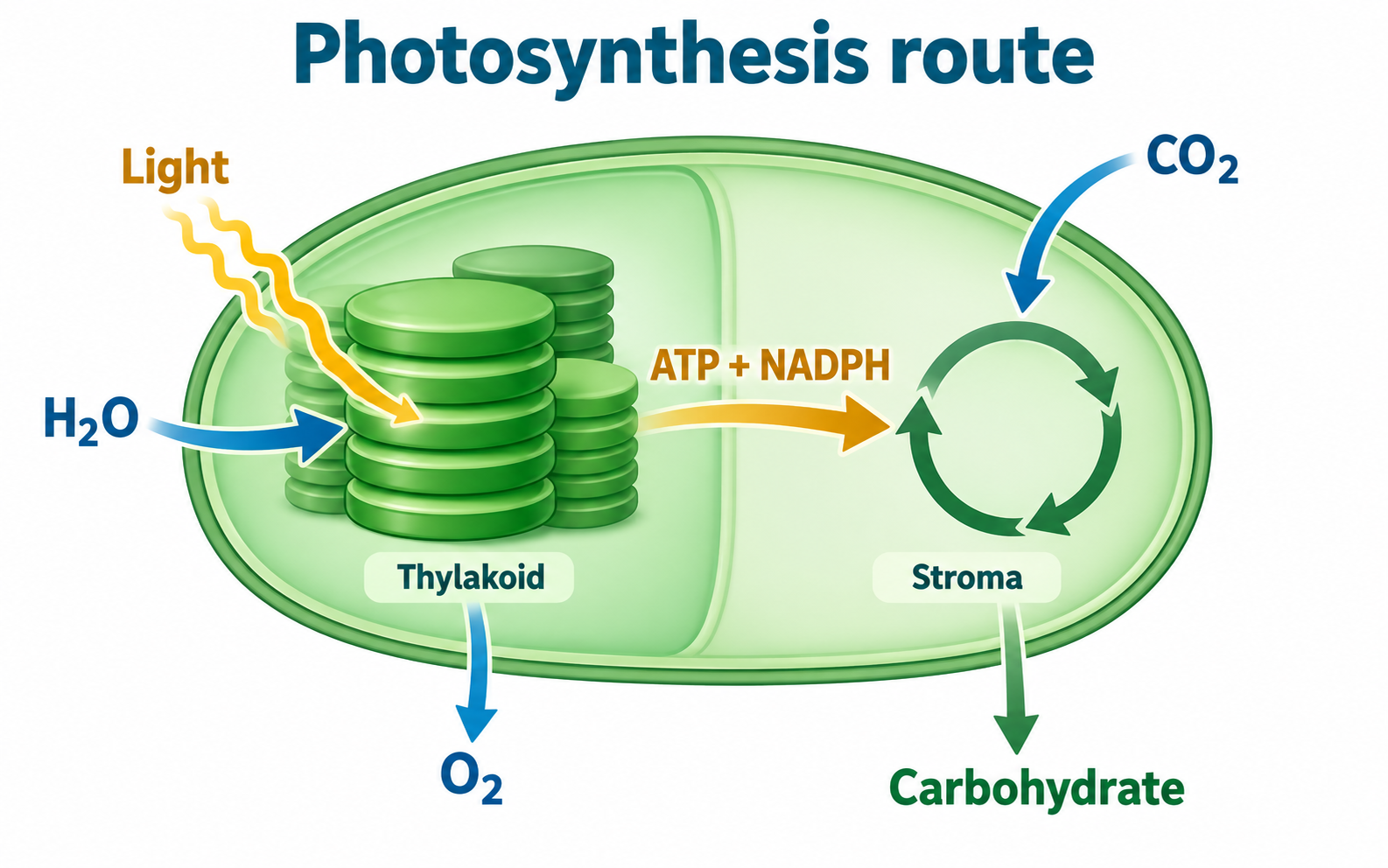
Start by locating the two linked parts of the process. Light-dependent reactions are associated with thylakoid membranes, where pigments capture light energy and water is split. The Calvin cycle takes place in the stroma and uses carbon dioxide together with ATP and NADPH from the light reactions to build carbohydrate.
This map explains why oxygen is linked with water splitting, why ATP and NADPH are intermediates rather than food, and why carbon dioxide fixation belongs in a different chloroplast space.
- Thylakoid membrane: photosystems, electron transfer, ATP and NADPH formation.
- Stroma: carbon dioxide fixation and carbohydrate-forming reactions.
- Water supplies electrons in the light-dependent reactions; oxygen is released.
- Carbon dioxide supplies carbon during the Calvin cycle.
Photosystems: keep the numbering and sequence apart
In non-cyclic electron flow, photosystem II acts before photosystem I. The numbers reflect their order of discovery, not the order in which they act. Electrons lost by photosystem II are replaced through photolysis of water, while electrons reaching photosystem I can contribute to NADPH formation.
Cyclic photophosphorylation should be kept separate: it involves photosystem I and produces ATP without the same NADPH formation or oxygen release associated with non-cyclic flow. Draw two short arrow paths rather than learning the difference as a paragraph.
The PSII-before-PSI trap
The numbering is the trap. Photosystem II acts first in non-cyclic flow even though II looks as though it should come after I. Write the route once and the question loses its shortcut.
A second check is to ask where oxygen comes from. In this chapter it is linked with water splitting, not with carbon dioxide entering the leaf.
Photosynthesis: location and output check
Use the compartment first. It is the quickest way to reject a true fact placed in the wrong part of the chloroplast.
| Process | Main location | What it provides | Common mix-up |
|---|---|---|---|
| Light reactions | Thylakoid membranes | ATP, NADPH and released oxygen | Placed in the stroma |
| Calvin cycle | Stroma | Carbon fixation and carbohydrate formation | Called a darkness-only process |
| C3 pathway | Mesophyll cells | Initial carbon fixation and Calvin cycle | Confused with the C4 location split |
| C4 pathway | Mesophyll then bundle-sheath cells | Initial four-carbon fixation then Calvin cycle | Said to remove all photorespiration |
C3, C4 and photorespiration: read the locations
In C4 plants, carbon dioxide is first fixed in mesophyll cells into a four-carbon compound and then delivered to bundle-sheath cells, where the Calvin cycle proceeds. This spatial separation helps reduce photorespiration under suitable conditions.
The central comparison is enough for a first revision: initial fixation in mesophyll, then carbon dioxide concentration around the Calvin cycle in bundle-sheath cells. Avoid turning it into a claim that C4 plants never photorespire.
Factors affect a rate, not a single switch
Light, carbon dioxide concentration, temperature and water availability influence the rate of photosynthesis. A limiting factor is the factor closest to restricting the rate under the stated conditions; changing another factor may not increase the rate once a different condition becomes limiting.
Severe water shortage can lead to stomatal closure and reduced carbon dioxide entry. That is more accurate than saying water simply acts as an on-off switch for a leaf.
A 15-minute recall routine
Draw a chloroplast with thylakoid and stroma. Put water and light on one side, carbon dioxide on the other, and place ATP plus NADPH between the two compartments. Then add a small C3-versus-C4 location sketch without looking at notes.
Finish with three corrections aloud: PSII can act before PSI; the Calvin cycle is not a darkness-only process; and released oxygen is linked with water splitting.
Common confusions to check
- PSII is named before PSI in the non-cyclic pathway even though its number is higher.
- The Calvin cycle does not require darkness; it uses ATP and NADPH made by light reactions.
- C4 plants initially fix carbon dioxide in mesophyll cells before the Calvin cycle operates in bundle-sheath cells.
Count carbon atoms before counting glucose
In the Calvin-cycle model, three carbon dioxide molecules enter three turns of carboxylation. Six molecules of three-carbon 3-PGA are formed and then reduced using ATP and NADPH. Of the six resulting triose-phosphate equivalents, five are used to regenerate three five-carbon RuBP molecules; one is the net three-carbon output. The net account uses nine ATP and six NADPH per three carbon dioxide molecules.
The tempting answer 'three carbon dioxide molecules produce one glucose' loses half the carbon atoms. A six-carbon sugar equivalent requires six carbon dioxide molecules and two net three-carbon equivalents; the corresponding cycle account is eighteen ATP and twelve NADPH. Glucose is not the immediate product of a single carboxylation reaction.
Check the Calvin Cycle section of NCERT's Photosynthesis in Higher Plants. On paper, keep regeneration separate from net output. Carbon returned to RuBP remains inside the cycle and cannot simultaneously be counted as exported sugar.
Editorial note and disclaimer
Written by: DongFeng. Published by: MedQGo. Last updated: September 30, 2026.
Disclaimer: This guide is a revision aid for NEET-UG aspirants and does not constitute medical advice. For clinical or health-related queries, consult a qualified medical professional.
References
Related revision guides
How to use this guide
Read the relevant NCERT chapter first. Then redraw the relationships or process described here from memory, compare your version with the textbook, and correct only the gaps. This is an independent revision aid, not official NCERT, NTA, or NEET material.