An ecosystem has two linked accounting systems
A useful way to enter this chapter is to keep two questions on the page at once. Where does energy enter, and where do chemical nutrients go? Energy reaches most ecosystems as sunlight, is captured by producers, passes through feeding relationships and is eventually lost as heat. Elements such as carbon, nitrogen and minerals can return to the environment and be used again.
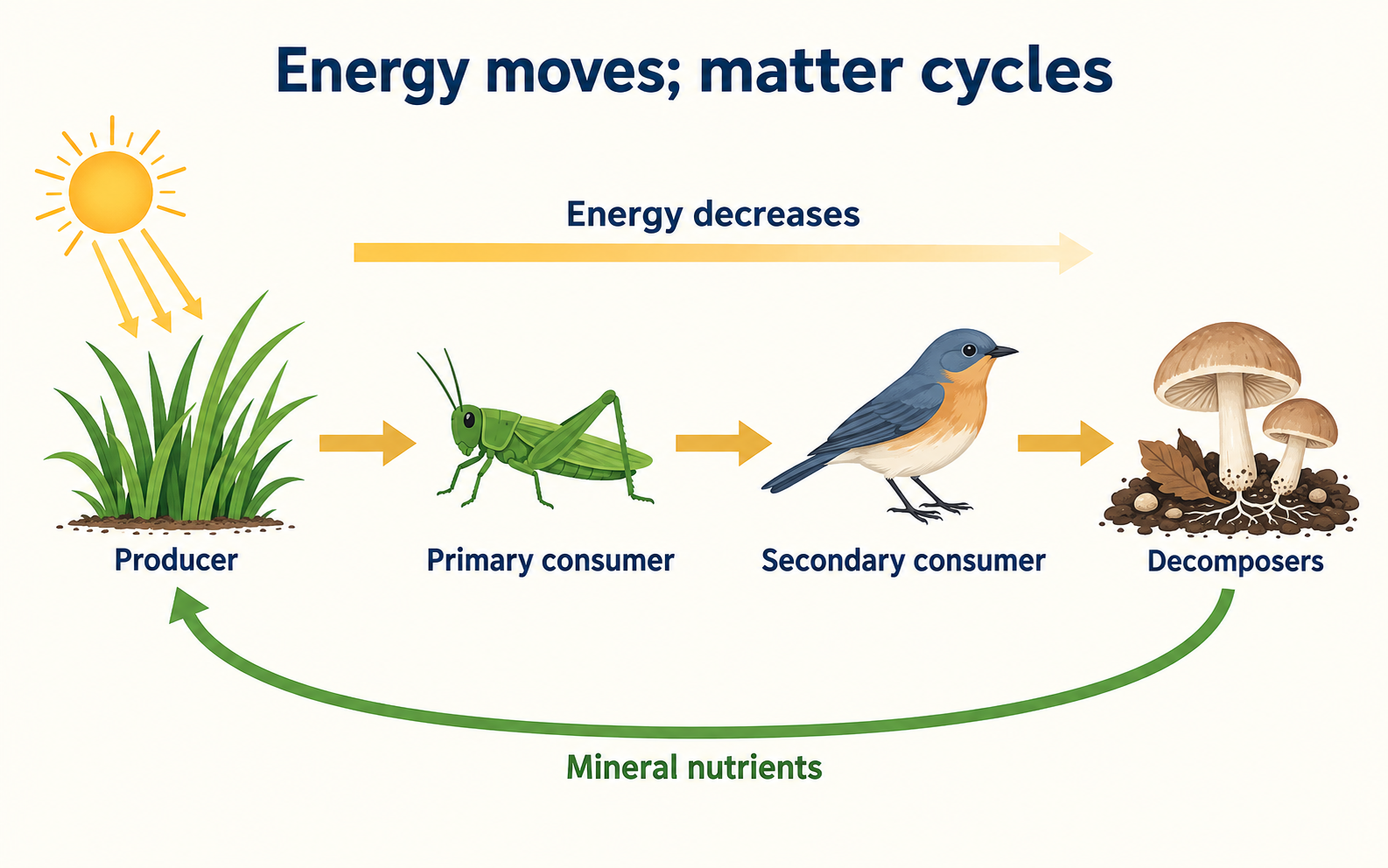
This is why a curved arrow from decomposers to plants must be labelled as nutrients, not energy. Decomposition can make inorganic nutrients available in soil or water; it cannot send the heat released by respiration back into a leaf. One pathway is a flow, the other is a cycle.
Start at producers: production is a rate, not a pile of biomass
Producers convert a fraction of incoming light energy into chemical energy through photosynthesis. Gross primary productivity, or GPP, is the total rate at which a producer community fixes organic material. Producers also respire, so not all of that captured material remains available to the next trophic level.
Net primary productivity is the remainder after producer respiration: NPP = GPP - R. It is the part that can support herbivores, decomposers and later trophic levels. The word productivity matters here: it describes a rate over area and time, whereas standing biomass is the amount of living material present at one moment.
- GPP: total organic material fixed by producers per unit area per unit time.
- R: energy used by producers for their own respiration.
- NPP: organic material left after producer respiration and available to heterotrophs.
The unit-and-arrow check
Before choosing a pyramid or following an arrow, name what is being measured and whether time is part of its unit.
- GPP is the total rate of producer fixation; NPP is what remains after producer respiration.
- Biomass is an amount at a particular time, while productivity includes area and time.
- A food web joins many feeding routes; a food chain is one route within that web.
- Decomposers return inorganic nutrients to the environmental pool, but energy leaves the system as heat rather than cycling back.
What the simplified drawing leaves out
Decomposers receive dead material and wastes from producers and consumers at every trophic level. The bird-to-decomposer arrow in this drawing represents just one possible input; decomposers are not a single final trophic level above all predators.
To extend the drawing, add arrows from grass and herbivores into the detritus pool. A fallen leaf can enter that pool without first being eaten. The grazing and detritus pathways are therefore connected routes, not a compulsory sequence through every box.
Ecological pyramids: choose the quantity before judging the shape
A pyramid's name tells you what is measured. That is the first fact needed to reason about its form.
| Pyramid | What it represents | Can it be inverted? | Decisive check |
|---|---|---|---|
| Number | Number of individuals at trophic levels | It can vary with the organisms involved | Count organisms, not their mass or energy |
| Biomass | Standing living material at a stated time | Yes, including some aquatic systems | A snapshot of phytoplankton can be small despite rapid turnover |
| Energy | Rate of usable energy transfer through trophic levels | No | Energy is lost at every transfer, so the next level receives less |
| Productivity | Organic material formed per unit area per unit time | Not a standing crop | Look for a time unit before calling it biomass |
A food chain is one route through a web, not the whole ecosystem
A grazing food chain begins with living producers and moves to herbivores and their consumers. A detritus food chain begins with dead organic material and involves decomposers and detritus-feeding organisms. These routes overlap in real communities, so a food web is usually the better picture of how many species are connected.
Trophic level means feeding position, not a permanent label attached to a species. An organism feeding in different chains can occupy different trophic positions. In a NEET question, identify what the organism is eating in the stated relationship before assigning its level.
Why an energy pyramid cannot turn upside down
At each trophic transfer, much of the energy in food is used in life processes and dissipated as heat. The NCERT ten-percent law is a useful approximate revision rule: only a small fraction, often expressed as about ten percent, becomes available to the next level. It is not a fixed universal conversion for every ecosystem.
An energy pyramid therefore narrows from producers upward and is always upright. It represents the energy flow or productivity at successive trophic levels, so an upper level cannot receive more usable energy than the level below it supplied. The reason is the one-way loss at every transfer, not the relative body size of organisms.
Work a productivity budget before applying ten percent
For an invented annual budget, suppose producers fix 20,000 kJ per square metre and use 12,000 kJ per square metre in respiration. NPP is 8,000 kJ per square metre per year. All three values must cover the same area and interval. Subtracting a monthly respiration figure from annual GPP would not give a meaningful NPP.
If a simplified exercise assumes ten-percent transfer from this producer NPP, primary-consumer production would be 800 kJ per square metre per year and secondary-consumer production 80. The assumption is part of the exercise, not a measured efficiency. Applying ten percent directly to GPP would skip the stated producer respiration loss.
The remainder is not all immediately released as heat at a single transfer. Some material is uneaten or egested and can enter the detritus pathway; respiratory activity dissipates energy as heat. Distinguishing these destinations helps connect the budget to an actual food web.
Read the pyramid name before deciding its shape
Pyramids of number and biomass answer different questions from a pyramid of energy. A terrestrial biomass pyramid is commonly upright because producer standing biomass is large. In an aquatic ecosystem, a biomass pyramid may be inverted at a particular time because phytoplankton have a small standing crop but can reproduce and turn over quickly enough to support a larger consumer biomass.
Do not use an inverted biomass example to argue that energy moves upward. The examples differ because biomass is a snapshot, while an energy pyramid tracks a rate of transfer. Name the measured quantity first; only then judge the shape.
Decomposers close nutrient loops without reversing energy flow
Dead organic material enters the detritus pathway. Decomposers and detritus-feeding organisms break it down, and mineralisation returns inorganic nutrients to the environmental pool. Producers can then take up those nutrients again. This link makes decomposers central to ecosystem functioning rather than an optional final box in a food chain.
For a fast recall sketch, draw sunlight above a producer, then three arrows to a primary consumer, a secondary consumer and decomposers. Add a separate curved arrow labelled mineral nutrients from decomposers toward the producer. Finally write GPP - R = NPP beside the producer. If every arrow has a named meaning, the common confusions are much harder to make.
Common confusions to check
- Energy flows one way and needs continuing input; nutrients can return to producers through environmental cycles.
- An energy pyramid is always upright, while biomass can be inverted in an aquatic ecosystem.
- Standing biomass describes an amount at a time; productivity includes an area-and-time rate.
Editorial note and disclaimer
Written by: DongFeng. Published by: MedQGo. Last updated: September 20, 2026.
Disclaimer: This guide is a revision aid for NEET-UG aspirants and does not constitute medical advice. For clinical or health-related queries, consult a qualified medical professional.
References
Related revision guides
How to use this guide
Read the relevant NCERT chapter first. Then redraw the relationships or process described here from memory, compare your version with the textbook, and correct only the gaps. This is an independent revision aid, not official NCERT, NTA, or NEET material.