What would a seed collection fail to protect?
Imagine a woodland is cleared after seeds from its trees have been placed in storage. Some plant material survives, but the woodland has not been conserved as a functioning community. Pollination, nesting sites, decomposer activity and the conditions that let seedlings establish do not fit inside a seed jar. This difference between preserving selected material and maintaining a living system is the starting point for biodiversity conservation.
There are three questions to keep apart: what variation is present, what is removing it, and what a proposed protection measure actually preserves. A reserve can address habitat loss without eliminating every threat. A seed bank can provide a valuable safeguard without replacing the reserve. The task is to match the response to the biological problem, not to choose one universally superior method.
In situ and ex situ describe where protection happens
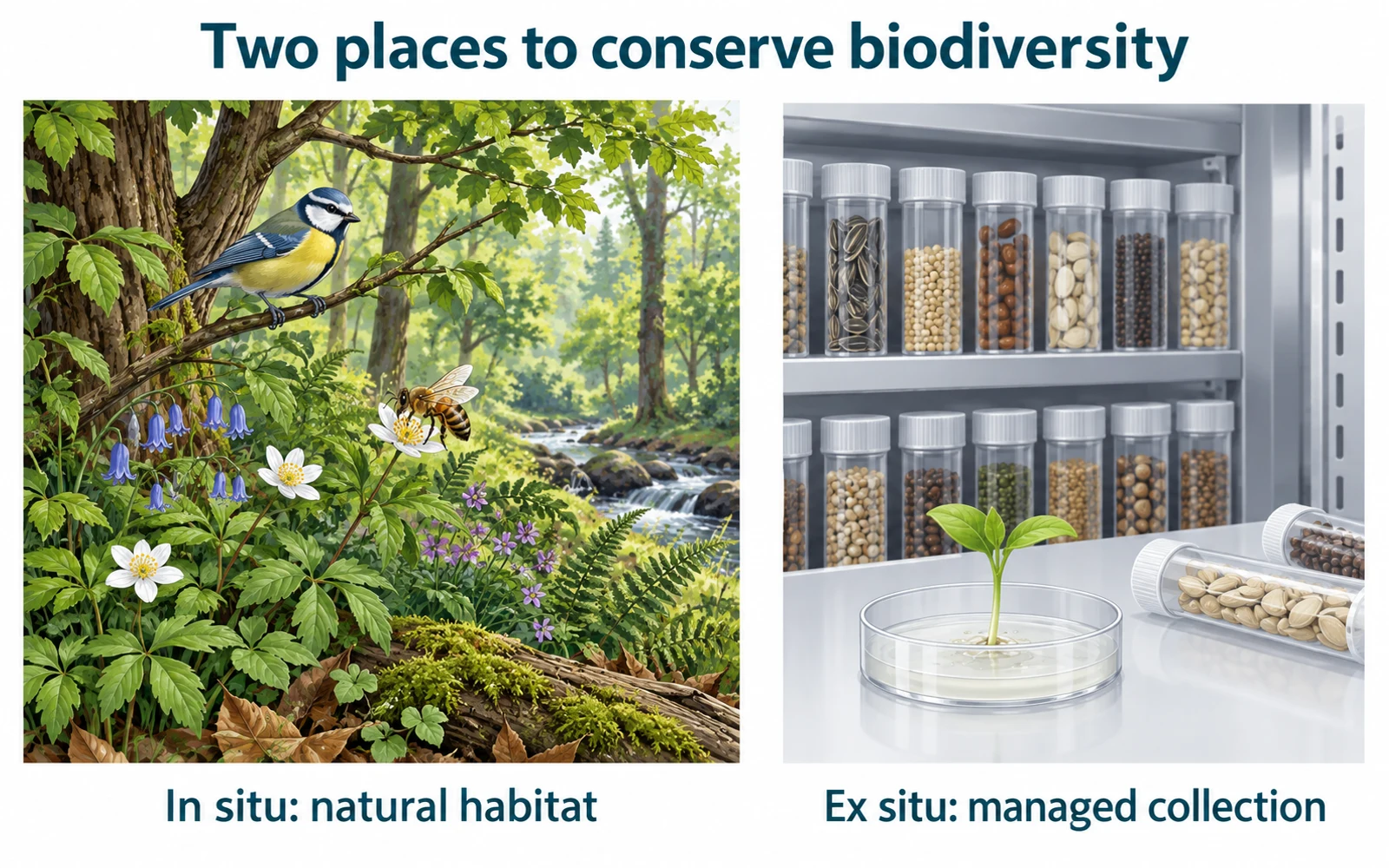
In situ conservation protects organisms within their natural habitats. National parks, wildlife sanctuaries and biosphere reserves are familiar syllabus examples, although they have different management arrangements. Protecting the habitat can retain interactions among species as well as populations exposed to their local environment. The important word is habitat, not simply outdoors.
Ex situ conservation maintains organisms or biological material outside their natural habitats. Botanical gardens, managed breeding collections and seed banks illustrate different forms. A botanical garden is outdoors but remains ex situ for plants maintained outside their natural setting. Seed storage is useful only when the material remains viable; not every species tolerates the same storage method.
The two approaches can support each other. An outside collection may safeguard material during a crisis, while habitat protection addresses conditions required for survival in the wild. Keeping a species alive in a managed collection does not, by itself, establish a self-sustaining wild population. That distinction matters when evaluating what the word 'saved' is claiming.
A surviving specimen is not the same as a recovered population
The phrase 'the species has been protected' needs a follow-up: what is now possible that was not possible before? Stored material, reproduction in a managed collection and successful reproduction in a natural habitat are different outcomes. Each can matter, but one does not automatically demonstrate the next.
When comparing conservation measures, state both the gain and the remaining problem. This makes an answer more precise than calling in situ good and ex situ bad, or assuming a collection removes the need to protect habitat.
What each conservation action retains, and what it leaves unresolved
Evaluate the biological coverage of an action instead of assuming its label proves success.
| Proposed action | Biological coverage | Unresolved risk |
|---|---|---|
| Protect an intact natural habitat | Populations and many interactions in their existing setting | Extraction, invasion or other pressures may still require management |
| Keep viable seed collections outside the habitat | Selected plant genetic material | Pollination, food webs and habitat conditions are not stored with the seeds |
| Maintain a managed breeding population | Living individuals and opportunities for reproduction | Wild survival and successful re-establishment are not demonstrated |
| Retain several varieties of one crop | Within-species variation represented by those varieties | This does not establish high species richness or ecosystem diversity |
Count species, but do not lose sight of genes and ecosystems
Genetic diversity concerns differences within a species. Species diversity concerns the variety of species in a community or region. Ecological diversity concerns the variety of ecosystems. These are different levels of description, not three alternative labels for the same count. A collection of many varieties of one crop is evidence of within-species variation, not automatically evidence of many species.
Consider an original bookkeeping example: a garden holds eight varieties of one species, then adds one plant belonging to a second species. The species count rises from one to two. It is not now nine species. Equally, replacing all eight original varieties with one clone could remove substantial within-species variation while leaving the original species present. A species list alone would miss that loss.
Species richness specifically counts species. It does not tell you the abundance of each, the genetic differences within them, or all their ecological roles. Before comparing two places, check whether the observation describes a count, a population size, or a different level of biodiversity. Two sites with the same richness need not be equivalent communities.
Read the species-area equation as a proportional change
The species-area relationship connects sampled area A with species richness S through S = C A^Z. C and Z belong to the fitted relationship; they are not universal constants for every place and scale. Taking logarithms gives log S = log C + Z log A, so Z is the slope when both axes are logarithmic. The intercept on that plot is log C, not the species count itself.
For a made-up comparison, suppose A increases by a factor of 16 and the fitted exponent is Z = 0.25, with C unchanged. Divide the two equations: S2/S1 = (A2/A1)^Z = 16^0.25 = 2. The model predicts twice as many species, not sixteen times as many. If the starting model value was 40 species, the second value would be 80. The exponent here is chosen for arithmetic practice, not presented as a typical measured value.
Why is 'sixteen times as many' a tempting wrong answer? It silently replaces the exponent with 1. Check the exponent before calculating. A larger positive Z produces a stronger richness response to the same proportional increase in area. Do not turn this fitted sampling relationship into a precise prediction that clearing a particular fraction of one forest must immediately extinguish a particular number of species.
Latitude is a pattern, not an explanation on its own
Many groups show greater species richness in tropical than in temperate or polar regions. Latitude records the pattern; it does not name a single mechanism that guarantees it. Longer evolutionary histories without repeated major glaciation, environmental stability and energy availability are explanations discussed in the syllabus. They can contribute together and should not be reduced to 'warm means diverse'.
A useful correction is to separate a geographical trend from an absolute rule. The trend does not prove that every tropical patch contains more species than every temperate patch. Comparisons must consider the organism group, sampling area and local conditions. Likewise, an old inventory figure should be read with its stated source date rather than relabelled as a current global census.
Diagnose the loss before naming the conservation response
Habitat destruction removes suitable living space. Fragmentation breaks a larger habitat into separated pieces; a landscape can still look partly green while movement and population connections are disrupted. Over-exploitation instead describes removal faster than a population can replace itself. A protected boundary cannot solve that problem if damaging extraction continues within it.
Alien species are introduced outside their native range; some become invasive and harm native populations. 'Alien' and 'invasive' therefore should not be treated as identical claims. Co-extinction focuses on dependency: loss of one species can threaten another that requires it. An obligately dependent partner has fewer alternatives than a generalist with several usable resources or partners.
In an invented conservation note, a flowering plant is present in a reserve but produces no new seeds after its only effective pollinator disappears locally. The plant count alone initially hides the reproductive problem. A seed collection safeguards some material, but recovery of reproduction requires examining the missing interaction. This illustrates vulnerability through dependency; it is not a report about a real reserve or proof that the plant is already globally extinct.
Endemism, hotspots and the reasons for protection
An endemic species has a restricted natural geographical distribution. Endangered describes extinction risk. A species can be both, but neither term is a definition of the other. A biodiversity hotspot combines exceptional endemism with substantial habitat loss; it is not merely a place with a large total number of organisms. These distinctions explain why conservation priorities cannot be built from abundance alone.
Reasons to conserve biodiversity extend beyond useful products. Direct resources, ecological services and ethical responsibility answer different questions. Pollination is a process that supports reproduction; a harvested product is a direct benefit; the argument that other species have value independent of human profit is ethical. Protecting only species with a known immediate commercial use would miss the other two arguments.
Greater biodiversity can support ecological functioning and stability, but avoid making it a guarantee that no disturbance can cause damage. A conservation explanation is stronger when it names the process being protected and acknowledges what the evidence does not establish.
Finish with a three-sentence conservation decision
Choose the imagined woodland from the opening and write three sentences without looking back. First name one level of biodiversity at risk. Next identify the mechanism of loss. Finally name a protection measure and one thing that measure cannot achieve by itself. A checkable answer could link habitat destruction with ecological diversity, propose in situ protection, and recognise that enforcement and functioning interactions still matter.
For the numerical part, explain why a sixteen-fold area change gave only a two-fold richness change in the practice model. If your explanation includes the exponent and the assumption of a shared C, you have reconstructed the calculation rather than memorised its answer.
NCERT reading anchor: Class 12 Biology, Chapter 13, Reprint 2026-27. Use section 13.1.2 for geographical and species-area patterns, 13.1.4 for causes of loss, and 13.2.2 for conservation approaches. Read those sections alongside the linked chapter rather than using this guide as a substitute for the textbook.
Common confusions to check
- A botanical garden is ex situ even though it is outdoors.
- Endemic means geographically restricted, not automatically endangered.
- A species-area sampling model does not predict an exact immediate extinction count after habitat removal.
Editorial note and disclaimer
Written by: DongFeng. Published by: MedQGo. Last updated: September 23, 2026.
Disclaimer: This guide is a revision aid for NEET-UG aspirants and does not constitute medical advice. For clinical or health-related queries, consult a qualified medical professional.
References
Related revision guides
How to use this guide
Read the relevant NCERT chapter first. Then redraw the relationships or process described here from memory, compare your version with the textbook, and correct only the gaps. This is an independent revision aid, not official NCERT, NTA, or NEET material.