Immunity: start with the body's lines of defence
For NEET revision, arrange immunity from broad to specific. Physical barriers such as skin and mucous membranes form the first line. Innate responses act quickly and do not depend on a previous encounter with one particular antigen. Acquired immunity is antigen-specific and develops memory.
This sequence helps with close options. A response can be rapid without being specific, and it can be specific without being the first response to an infection. Identify whether the question is asking about a barrier, an innate cell-based response, or an acquired immune response.
- Innate immunity: present from birth and broadly protective.
- Acquired immunity: antigen-specific and associated with immunological memory.
- Active immunity: the body produces its own immune response after antigen exposure.
- Passive immunity: ready-made antibodies are received from another source.
Antigens, antibodies and lymphocytes
An antigen is a substance that can be recognised by the immune system and can trigger a specific response. Antibodies are proteins produced by plasma cells derived from B lymphocytes. They bind particular antigens; they are not general-purpose chemicals that kill every pathogen in the same way.
T lymphocytes and B lymphocytes have different roles. In simple exam comparisons, B-cell responses are linked with antibody production, while T-cell responses include cell-mediated functions. Avoid choosing an option just because it mentions a lymphocyte: check which mechanism is being tested.
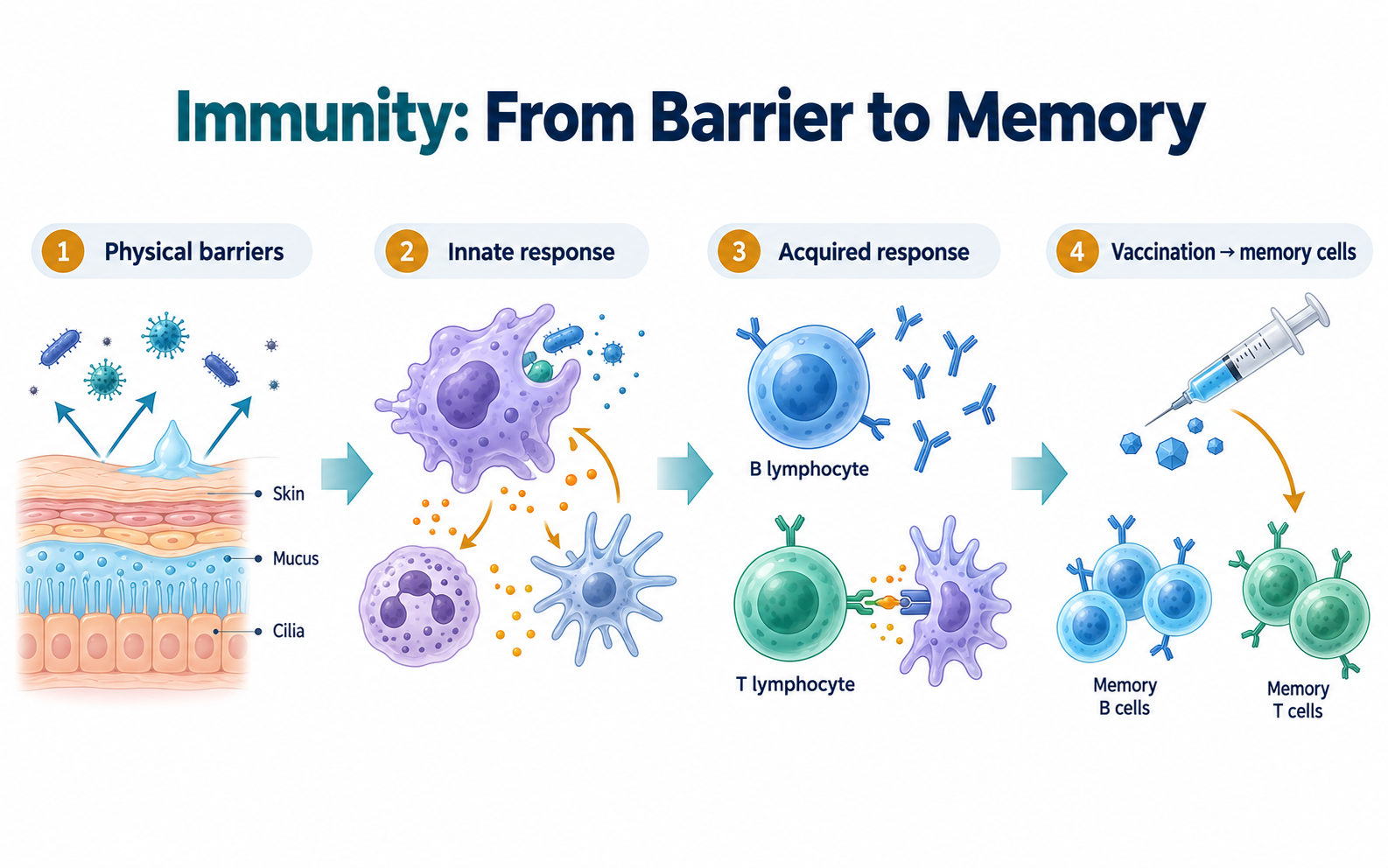
Immunity: identify the kind of protection first
Before matching a cell or molecule to a statement, decide whether the prompt is about a barrier, a rapid broad response, or an antigen-specific response with memory.
- Physical barriers and innate responses are available without a previous encounter with one particular antigen.
- Acquired immunity is antigen-specific and can form immunological memory.
- Vaccination supports active acquired immunity because the body develops its own response after antigenic stimulation.
- Ready-made antibodies give passive immunity: the protection can be immediate, but the receiver does not build the same long-term memory from it.
The mistake hidden in fast responses
Fast does not automatically mean acquired. This is a very common student-style slip: a response acts quickly, so it gets labelled as specific immunity. In reality, innate immunity is fast precisely because it is already broadly available.
When a question mentions memory cells, vaccination, antibodies after exposure, or a second response, then acquired immunity becomes more likely.
Innate, acquired, active and passive immunity in one view
The words sound familiar, which is exactly why they become dangerous in close options.
| Type | Speed | Specificity | Memory |
|---|---|---|---|
| Innate immunity | Fast | Broad, non-specific | No antigen-specific memory |
| Acquired immunity | Slower first response | Antigen-specific | Memory develops |
| Active immunity | Develops after antigen exposure | Specific | Usually long-lasting |
| Passive immunity | Immediate | Depends on received antibodies | No strong long-term memory |
Pathogens and disease transmission
A pathogen is a disease-causing organism or agent. Bacteria, viruses, protozoans, fungi and parasitic worms can all be relevant in the NEET syllabus, but their biology and modes of control differ. Read the organismal clue before matching a disease with its cause or transmission route.
Transmission questions often mix reservoir, vector and route. A vector carries a pathogen between hosts, whereas a reservoir is the organism or environment in which an infectious agent is normally maintained. Contaminated food, water, air, contact and insect vectors are routes or mechanisms, not interchangeable labels.
- Do not classify every microbe as a virus or every infectious disease as vector-borne.
- Separate the causative organism from the symptom, vector and preventive measure.
- A prevention method may reduce transmission without directly treating an established infection.
Vaccination and immune memory
Vaccination presents the immune system with an antigenic stimulus in a controlled way so that memory can develop. On a later exposure to the relevant antigen, the secondary response is typically faster and stronger because memory cells are available.
Vaccines support active acquired immunity. Antiserum containing pre-formed antibodies gives passive immunity and may act immediately, but it does not create the same long-term memory. This active-versus-passive distinction is a dependable way to resolve common NEET distractors.
A 15-minute revision method
Make four columns headed barrier, innate response, acquired response and prevention. Place each NCERT term in one column, then add one example and one common confusion. Finish by explaining active and passive immunity aloud without looking at notes.
When reviewing your recall notes, mark whether the gap came from confusing a cell type, a pathogen, a route of transmission, or a type of immunity. That classification makes the next revision session targeted rather than repetitive.
Common confusions to check
- Fast does not automatically mean antigen-specific; innate immunity is fast and broadly protective.
- A pathogen, disease symptom, vector, reservoir, and transmission route are different categories.
- Passive immunity provides ready-made antibodies but does not create the same lasting memory as active immunity.
Separate an immediate antibody supply from immune memory
Compare two textbook situations: an antigen exposure stimulates the recipient's own immune response, while a transfer of ready-made antibodies supplies antibodies made elsewhere. The first is active immunity; the second is passive immunity. Antibody presence alone cannot tell you which route produced protection.
In a primary active response, activation and expansion of antigen-specific cells take time. A later encounter with the same antigen can produce a faster, stronger secondary response because memory cells were formed. Transferred antibodies can act without that initial production step, but the transfer itself does not generate the recipient's antigen-specific memory cells.
Correct the statement 'anything that supplies antibodies is a vaccine'. Vaccination aims to induce an active response and memory; passive antibody transfer is a different mechanism. Check Active and Passive Immunity and Vaccination and Immunisation in NCERT's Human Health and Disease chapter. This comparison explains categories, not which intervention an individual needs.
Editorial note and disclaimer
Written by: DongFeng. Published by: MedQGo. Last updated: September 30, 2026.
Disclaimer: This guide is a revision aid for NEET-UG aspirants and does not constitute medical advice. For clinical or health-related queries, consult a qualified medical professional.
References
Related revision guides
How to use this guide
Read the relevant NCERT chapter first. Then redraw the relationships or process described here from memory, compare your version with the textbook, and correct only the gaps. This is an independent revision aid, not official NCERT, NTA, or NEET material.