Follow the oxygen through a sewage-treatment plant
A sewage-treatment plant can supply air in one tank and deliberately exclude it in another. That is not a contradiction. The two compartments support different microbial activities and receive different material. Following this change in conditions is a more useful starting point than memorising a long list of helpful microbes without knowing what they do.
Keep three descriptions together: the biological agent, the transformation, and the useful outcome. In an aeration tank, a community uses organic matter under oxygenated conditions. In a sludge digester, an anaerobic community processes settled biomass and produces gases. Elsewhere, microbes change food, supply industrial products or assist plant nutrition. None of these roles means that every microbe is harmless or useful in every setting.
The liquid route and the sludge route separate after settling
Primary treatment is mainly physical separation. Screening and sedimentation remove material from sewage; the liquid leaving primary settling continues to biological treatment. Removing particles does not establish that dissolved biodegradable material or pathogens have disappeared. 'Looks clearer' and 'requires less biological treatment' are not interchangeable observations.
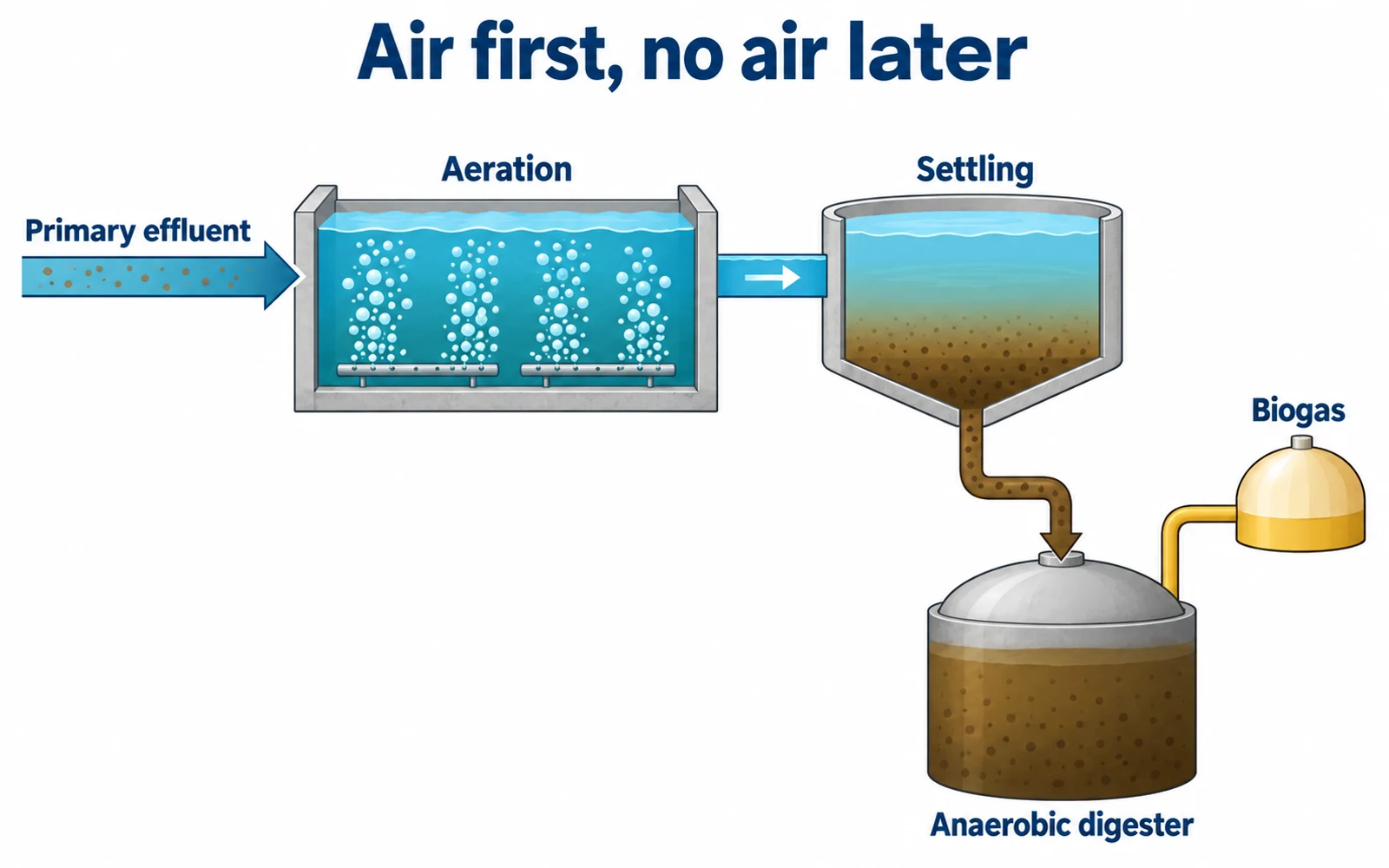
During secondary treatment, aeration supports aerobic microbes that consume much of the organic load. Flocs contain bacteria associated with fungal filaments. After aeration, settling separates these aggregates from the liquid. The sediment is activated sludge. A portion returns to the aeration tank as an inoculum; the remaining sludge can enter anaerobic digestion. The returned material contains a microbial community, not a newly manufactured disinfectant.
Read the illustration as a deliberately simplified split: the downward branch carries sludge, not the entire liquid effluent. The return-sludge loop and later effluent treatment are omitted so that the contrast between aeration and anaerobic digestion stays visible. Real treatment and discharge decisions require more checks than the simplified school-level route supplies.
Do not let the word fermentation decide the oxygen condition
A fermentor describes equipment used to grow a culture; fermentation also has a narrower metabolic meaning. Those uses of the word overlap but are not identical. In revision, take the oxygen condition from the process being described, not merely from the vessel's name.
The same caution applies to 'useful microbe'. Usefulness describes an action in a context. It is not a permanent safety label and does not turn a biological-source fact into a recommendation to consume a culture or use a medicine.
Treatment compartments: name the material before the microbe
The same plant contains physical separation, aerobic consumption and anaerobic processing. They should not share one undifferentiated label.
| Compartment | Material being handled | Condition and operation | Meaning of the output |
|---|---|---|---|
| Primary settling | Incoming sewage with suspended matter | Physical separation | Sludge separates from liquid; biological demand can remain |
| Aeration tank | Primary effluent plus active microbial inoculum | Air supplied; aerobic community consumes organics | Reduced biodegradable load, not certified drinking water |
| Secondary settling | Liquid containing microbial flocs | Aggregates settle | Activated sludge separates; some is returned as inoculum |
| Anaerobic digester | Sludge diverted from the settled fraction | Oxygen excluded; microbial community processes biomass | Gas mixture including methane; not yeast-derived dough gas |
BOD measures demand, not the oxygen already present
Biochemical oxygen demand, or BOD, expresses oxygen used by microorganisms as they break down biodegradable material under specified test conditions. It is an indirect indicator of biodegradable organic load, not a direct count of bacteria and not a reading of dissolved oxygen already in the water. Compare results only when their test conditions are comparable.
Here is an original process check. Comparable samples from before and after a treatment stage have BOD values of 180 and 36 mg/L. The reduction is 144 mg/L, and the percentage reduction is (180 - 36) / 180 x 100 = 80%. This calculation describes the change in measured demand. It does not say that 80% of all pollutants or 80% of pathogens have been removed.
Reject the explanation 'BOD fell because the microbes stopped needing oxygen'. In the treatment model, the microbes have used much of the biodegradable substrate, so the treated sample supports less subsequent oxygen demand. Also reject 'low BOD proves drinking safety'. BOD alone cannot establish the absence of pathogens, toxic chemicals or other hazards. These limits are part of interpreting the result correctly, not extra clinical advice.
Methane belongs to the anaerobic branch, not the bread dough
Anaerobic digestion involves cooperating microorganisms rather than one organism performing every step. Methanogens contribute methane production under oxygen-free conditions; Methanobacterium is a familiar syllabus example. Biogas is a mixture rich in methane, not pure methane and not a generic name for every gas released by a microbe.
NCERT uses older wording such as methanogenic bacteria, while modern classification places methanogens among Archaea. Preserve the chapter's named example, but do not infer that it belongs to the bacterial groups responsible for curd formation. Similarly, the presence of cellulose-rich waste does not mean a methanogen alone carries out the whole breakdown from cellulose to gas.
Yeast fermentation provides a different gas comparison. Carbon dioxide can expand bread dough, whereas methane is the fuel-rich component emphasised in biogas. The bubbles do not identify the process by themselves. Name the organism or community and its conditions before naming the product. This guide explains those biological distinctions, not how to build or operate a gas plant.
Curd, bread and industrial products ask different questions
Lactic acid bacteria help convert milk into curd by producing acid that alters milk proteins. A starter introduces living organisms that multiply under suitable conditions; it is not simply a measured dose of acid. Baker's yeast, Saccharomyces cerevisiae, supports dough fermentation. For bread texture, carbon dioxide is the useful product to identify; for an ethanol-production example, the product being collected is different even when yeast is involved.
An industrial fermentor is a controlled culture vessel, not evidence that its contents must be undergoing oxygen-free fermentation in the strict metabolic sense. Depending on the organism and intended product, oxygen provision can be important. The operational label should not override the biological conditions stated in a question or explanation.
Separate a microbial producer from a harvested molecule. Aspergillus niger is associated with citric acid production, and Acetobacter aceti with acetic acid production. Pectinases used in juice clarification are enzymes: the product's useful activity is not the same thing as adding a live microbial culture to the final drink. Identifying the agent, molecule and use separately prevents three columns of facts from collapsing into one.
The chapter also introduces microbially derived antibiotics and other bioactive products. Their biological sources belong to revision; choosing medicines or giving treatment instructions does not. Do not reason that a useful microbial product makes its producing organism appropriate for direct consumption or self-treatment.
On a root, ask whether the benefit is nutrition or pest control
Biofertilisers assist nutrient availability. Rhizobium in legume root nodules supplies a symbiotic nitrogen-fixation example; Azotobacter provides a free-living example. Mycorrhizal fungi, including the chapter's Glomus example, can improve phosphorus uptake in association with roots. Phosphorus uptake and nitrogen fixation are not two names for the same service.
Biocontrol instead targets a pest or pathogen through biological interactions. Bacillus thuringiensis and selected baculoviruses provide microbial examples. Their effects have target boundaries: 'biological' does not mean that every agent kills all pests or that all possible uses are automatically harmless. A conventional microbial preparation and a plant engineered with a microbial gene are also different applications, even when they draw on the same biological source.
A tempting but wrong explanation says that any beneficial fungus around a root must be a biofertiliser. Consider what benefit is stated. Helping phosphorus acquisition points to a nutritional role; suppressing a plant pathogen points to biocontrol. The chapter discusses Trichoderma in the latter context. The location is not enough to identify the function.
Use a process fault to test your understanding
Imagine an aeration unit loses its air supply while the flow continues. Predicting 'more oxygen automatically dissolves because fewer microbes are working' skips the essential issue: the aerobic treatment community no longer has its intended oxygen supply. Biological removal of organic load can be impaired. The exact outlet BOD cannot be calculated from the fault alone; flow, loading and operating conditions are missing.
Now change only the compartment. Supplying air to a methane-producing anaerobic digester does not improve the same process by the same logic. The community and metabolic conditions differ. These two thought experiments test whether you understand the purpose of each compartment, rather than whether you can reproduce the order of labels in a diagram.
Rebuild the plant, then sort four useful microbial roles
On blank paper, draw an aeration tank and a settling tank connected by a liquid arrow. Add a return arrow for some settled sludge and a separate branch to an anaerobic digester for the remainder. Label the oxygen condition in each biological compartment. Finally, write one sentence explaining why lower BOD does not certify potable water.
Make four small entries headed food transformation, product synthesis, nutrient support and biocontrol. For each, supply one microbial example, its specific action and one nearby wrong interpretation. Check your reconstruction against the source chapter instead of treating the number of remembered names as your only measure of progress.
NCERT reading anchor: Class 12 Biology, Chapter 8, Reprint 2026-27. Section 8.3 explains sewage treatment and activated sludge; 8.4 connects anaerobic activity with biogas; 8.5 and 8.6 separate biocontrol from biofertilisers. Sections 8.1 and 8.2 supply the household and industrial context. The linked supplementary fermentation reading clarifies why acid, ethanol and gas are distinct outcomes.
Common confusions to check
- BOD is oxygen demand under test conditions, not dissolved oxygen already present.
- The carbon dioxide that expands bread dough is not the methane emphasised in biogas.
- Mycorrhizal phosphorus uptake is different from nitrogen fixation or pathogen suppression.
Editorial note and disclaimer
Written by: DongFeng. Published by: MedQGo. Last updated: September 23, 2026.
Disclaimer: This guide is a revision aid for NEET-UG aspirants and does not constitute medical advice. For clinical or health-related queries, consult a qualified medical professional.
References
Related revision guides
How to use this guide
Read the relevant NCERT chapter first. Then redraw the relationships or process described here from memory, compare your version with the textbook, and correct only the gaps. This is an independent revision aid, not official NCERT, NTA, or NEET material.