Classification works as a grid of biological evidence
The five-kingdom system becomes useful when it is treated as a set of decisions rather than five memorised names. Start with cell organisation: is the organism prokaryotic or eukaryotic? Then check whether it is mainly unicellular or multicellular, whether a cell wall is present and what it contains, and how nutrition is obtained. Reproduction and ecological role add supporting evidence.
R. H. Whittaker's system placed Monera, Protista, Fungi, Plantae and Animalia in separate kingdoms using several of these criteria together. No single feature is enough for every boundary. A cell wall occurs in bacteria, fungi and plants, for example, but its composition and the organism's nutrition separate those groups.
- Cell type: prokaryotic or eukaryotic.
- Body organisation: unicellular, colonial or multicellular.
- Nutrition: photosynthetic, absorptive or ingestive heterotrophy.
- Cell covering: absent, variable, or a wall with a characteristic composition.
- Reproduction and ecological role: supporting evidence, not a one-word shortcut.
Monera begins with the absence of a membrane-bound nucleus
Members of Monera are prokaryotic. Their DNA is not enclosed by a nuclear membrane, and membrane-bound organelles are absent. The group includes organisms with wide metabolic diversity: some are photosynthetic or chemosynthetic autotrophs, while many are heterotrophs. A prokaryotic cell should not be called structurally simple in the sense of being biologically inactive; bacteria carry out sophisticated metabolism without eukaryotic compartments.
NCERT separates archaebacteria from eubacteria by features that include their habitats and cell-envelope characteristics. Methanogens, halophiles and thermoacidophiles illustrate archaeal adaptations. Cyanobacteria are photosynthetic eubacteria, not algae with a eukaryotic nucleus. Mycoplasma are notable for lacking a cell wall, which prevents the broad claim that every moneran has one.
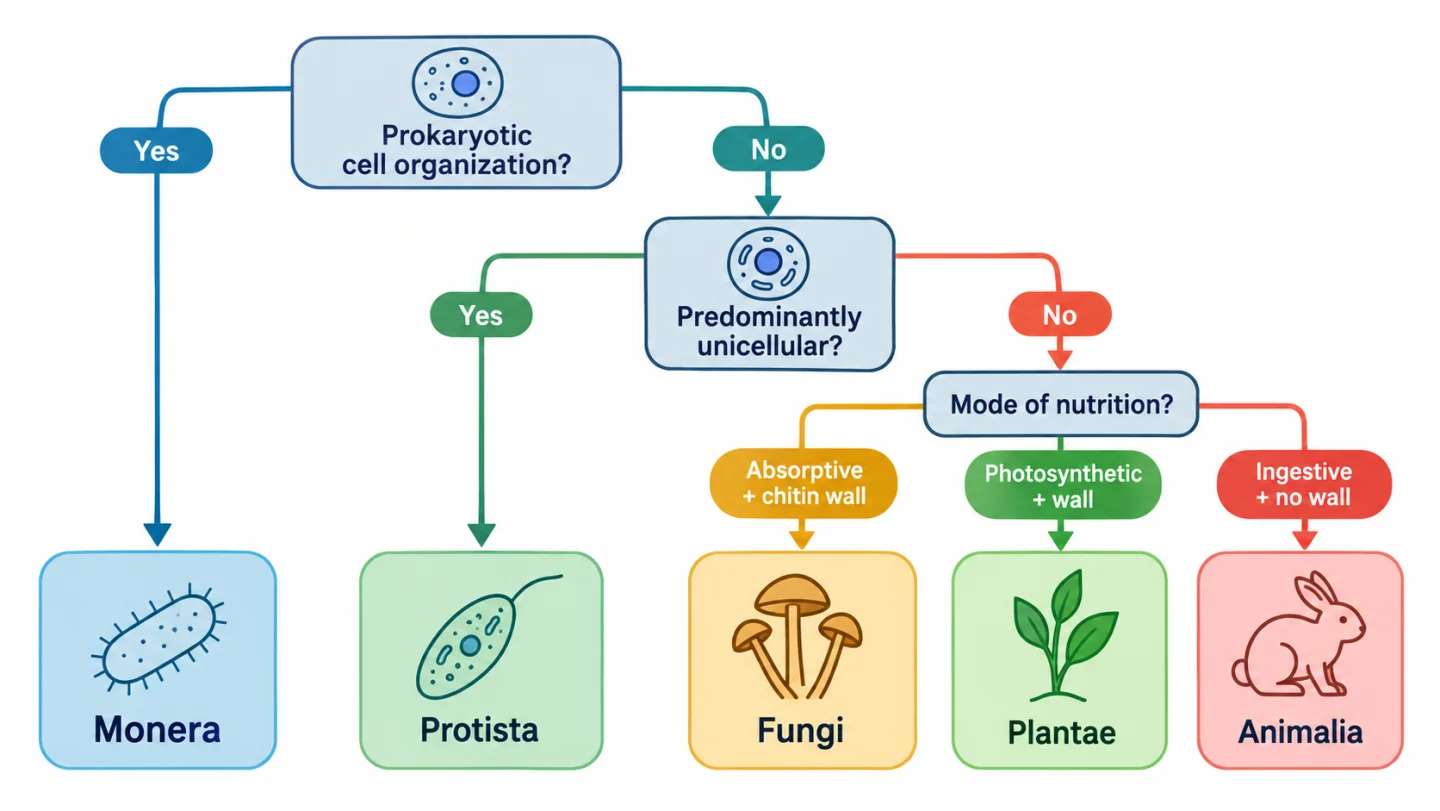
A classification model is not the organism itself
Whittaker's five kingdoms organise a large diversity of life using evidence available at several biological levels. The later three-domain framework uses molecular and cellular evidence to separate Bacteria and Archaea more fundamentally. The two systems answer related questions but should not be pasted together as though 'domain' and 'kingdom' were the same rank.
For this revision guide, use the five-kingdom criteria expected by the NCERT chapter, then recognise where viruses, viroids and symbiotic associations need a boundary note. Precision is stronger than forcing every biological entity into one of five boxes.
Five kingdoms: use the combination, not one familiar feature
Each row gives the broad NCERT pattern. The last column identifies the nearest tempting misclassification.
| Kingdom | Cell and organisation | Wall and nutrition | Decisive check |
|---|---|---|---|
| Monera | Prokaryotic; mostly unicellular | Wall common but absent in Mycoplasma; varied nutrition | No membrane-bound nucleus |
| Protista | Eukaryotic; predominantly unicellular | Covering and nutrition vary | Eukaryotic cell without the multicellular organisation of plants, fungi or animals |
| Fungi | Eukaryotic; usually filamentous, yeast unicellular | Chitinous wall; absorptive heterotrophy | External digestion followed by absorption |
| Plantae | Eukaryotic; multicellular | Cellulose-rich wall; mainly photosynthetic | Multicellular photosynthetic body in this model |
| Animalia | Eukaryotic; multicellular | No cell wall; ingestive heterotrophy | Food is ingested rather than absorbed through a fungal mycelium |
Protista is united by eukaryotic cells, not by one mode of life
Protists are predominantly unicellular eukaryotes. Their nuclei and membrane-bound organelles distinguish them from Monera, but their nutrition, movement and coverings vary greatly. Some are photosynthetic, some ingest food, some absorb dissolved material and some combine nutritional modes. This diversity is why a protist cannot be identified merely as 'an organism that lives in water.'
Within the NCERT framework, chrysophytes include diatoms with silica-rich walls; dinoflagellates commonly have two flagella and cellulose plates; euglenoids have a flexible pellicle rather than a cellulose wall; slime moulds form aggregations under suitable conditions; and protozoan groups are organised by locomotion or lifestyle. The study goal is to attach the diagnostic feature to the named group without making it universal for all protists.
Fungi feed by absorption and build bodies from hyphae
Fungi are eukaryotic heterotrophs that release enzymes into their surroundings and absorb the resulting soluble nutrients. Their walls contain chitin, not cellulose as a defining plant wall component. Most have thread-like hyphae that together form a mycelium, although yeast is unicellular. Saprophytic, parasitic and symbiotic nutrition describe relationships with the food source; they do not turn fungi into different kingdoms.
Fungal grouping in this chapter uses features of the mycelium, spore formation and sexual reproduction. Asexual spores such as conidia or sporangiospores should not be confused with the sexual spores used to distinguish major classes. Lichens and mycorrhizae show associations involving fungi, but the partnership does not erase the identity of the fungal component.
Plantae and Animalia separate two multicellular strategies
In the five-kingdom model, Plantae contains multicellular eukaryotes that are predominantly photosynthetic and possess cell walls, whereas Animalia contains multicellular eukaryotes that lack cell walls and obtain nutrition by ingestion. These are broad kingdom-level patterns. Parasitic plants and unusual animals do not justify replacing the full evidence grid with one feature such as movement or green colour.
Fungi are the important third comparison. Like plants, most fungi have walls and are generally non-motile; like animals, they are heterotrophic. Their absorptive nutrition, chitinous walls and mycelial organisation provide the decisive combination. This is why 'cannot move' is a poor rule for calling an organism a plant.
Viruses, viroids and lichens sit beside the kingdom grid
Viruses are acellular infectious entities with nucleic acid enclosed in a protein coat; they depend on host cells for replication and are not placed as a cellular kingdom in Whittaker's system. A viroid is even simpler in this comparison: it consists of a small infectious RNA molecule without the protein coat of a virus. These distinctions concern biological organisation, not personal diagnosis or treatment.
A lichen is an association between a fungus and a photosynthetic partner, usually an alga or cyanobacterium. It is therefore not a sixth kingdom or a single cell type. Identify the partners and the relationship before deciding where each component belongs in the classification framework.
A two-pass kingdom sorting routine
Draw five columns and fill only four rows from memory: nucleus, organisation, wall or covering, and nutrition. Sort one representative example into each column and write the feature that excludes its nearest alternative. The output should be a reasoned matrix, not a list of kingdom names.
On the second pass, classify cyanobacterium, diatom, yeast, moss and earthworm. Then add virus, viroid and lichen below the grid and explain why each needs a boundary note. If you can state both the placement and the excluding clue, the classification is doing explanatory work.
Common confusions to check
- Cyanobacteria are photosynthetic prokaryotes in Monera, not eukaryotic algae.
- Fungi are absorptive heterotrophs with chitinous walls; lack of movement does not make them plants.
- Viruses and viroids are acellular and are not extra kingdoms in Whittaker's five-kingdom system.
Editorial note and disclaimer
Written by: DongFeng. Published by: MedQGo. Last updated: September 22, 2026.
Disclaimer: This guide is a revision aid for NEET-UG aspirants and does not constitute medical advice. For clinical or health-related queries, consult a qualified medical professional.
References
Related revision guides
How to use this guide
Read the relevant NCERT chapter first. Then redraw the relationships or process described here from memory, compare your version with the textbook, and correct only the gaps. This is an independent revision aid, not official NCERT, NTA, or NEET material.