Start with the cell as an organised system
Cell biology becomes more manageable when structures are grouped by their contribution to one system: a cell has a boundary, stores and uses genetic information, makes molecules, processes and transports materials, releases energy, and removes or recycles selected material. This functional map is more reliable than memorising a disconnected list of organelle names.
Cell theory provides the frame. Cells are the basic structural and functional units of living organisms, and new cells arise from pre-existing cells. Use the theory to distinguish a general principle about life from a description of one specialised organelle.
Prokaryotic and eukaryotic cells: make one clean comparison
A prokaryotic cell does not have a membrane-bound nucleus; its genetic material occupies a nucleoid region. Eukaryotic cells have a membrane-bound nucleus and contain several membrane-bound organelles. This difference is more informative than simply calling one type simple and the other complex.
Both cell types still require a cell boundary, genetic material, cytoplasm and ribosomes. When comparing them, first identify which feature is shared and which feature is a defining difference. A shared feature cannot be used as evidence that a cell is eukaryotic.
- Cell membrane: selectively separates the cell interior from the surroundings.
- Cytoplasm: site of many cellular activities and suspended structures.
- Ribosomes: associated with protein synthesis in both prokaryotic and eukaryotic cells.
- Nucleus: membrane-bound genetic control centre in eukaryotic cells.
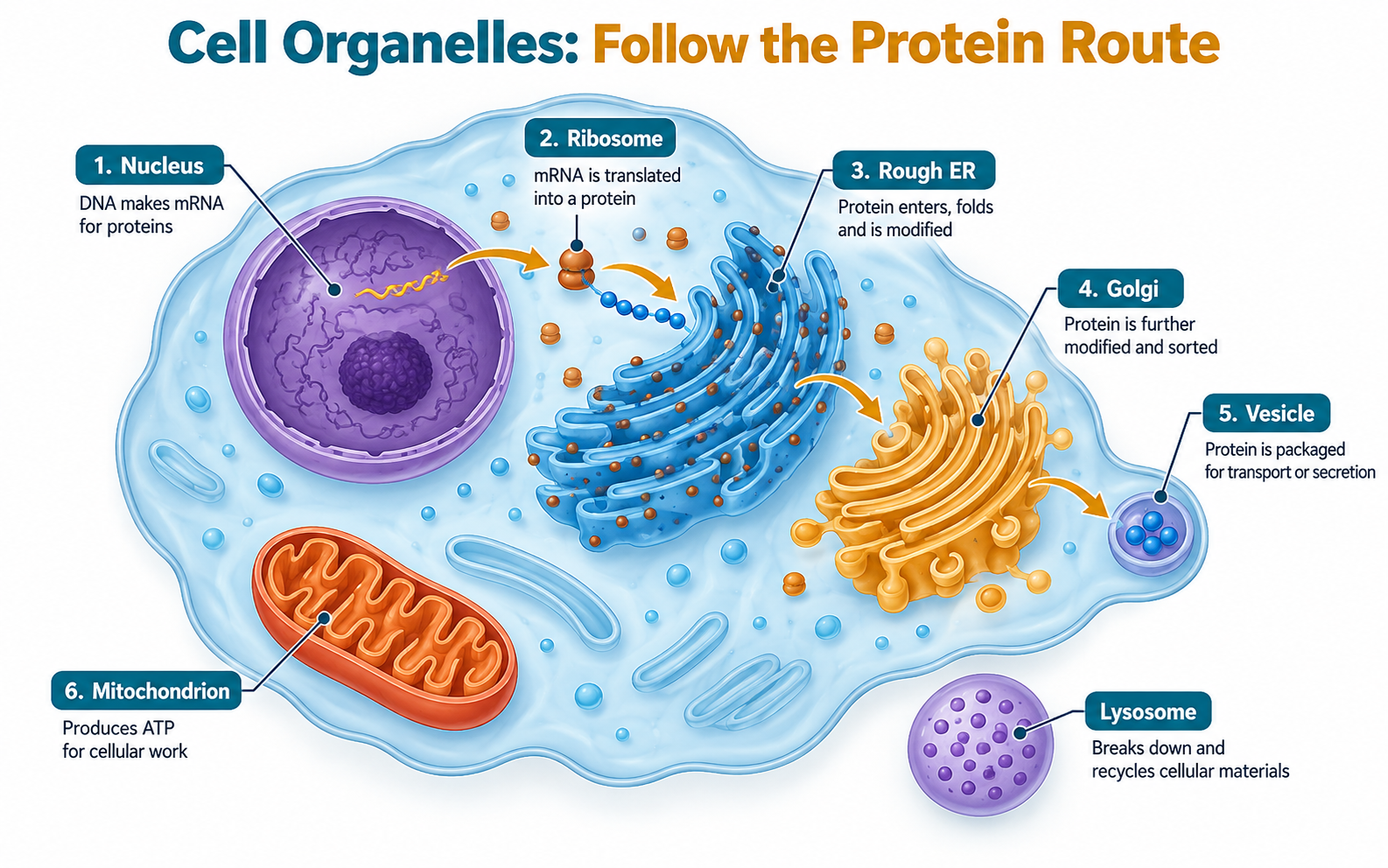
Follow a protein instead of memorising a list
A structure is easier to retain when it is placed in a route. Use a protein-related pathway to separate synthesis, processing, transport, and breakdown functions.
- The nucleus holds genetic information that can be used to make RNA; ribosomes assemble polypeptides.
- Rough endoplasmic reticulum and Golgi apparatus are associated with later handling of many proteins, but they do not replace ribosomes as the synthesis site.
- Mitochondria support aerobic energy release; chloroplasts are associated with photosynthesis in plant cells.
- A lysosome is linked with intracellular digestion, while a vacuole is primarily discussed as a storage compartment in this comparison.
Do not learn organelles as flashcards only
A flashcard that says 'Golgi apparatus: packaging' is useful for ten seconds. A better note asks what happened before packaging and where the product might go after it.
That is why the protein route matters: nucleus gives information, ribosome builds, rough ER and Golgi handle processing and movement. The route is easier to remember than four isolated labels.
Organelle trap table
Do not memorise organelles as a parade of names. Pair each one with the job NEET usually tests.
| Structure | High-yield function | Do not confuse with | Quick check |
|---|---|---|---|
| Ribosome | Protein synthesis | Golgi apparatus | Makes polypeptide, does not package it |
| Mitochondrion | ATP production in aerobic respiration | Chloroplast | Energy release, not photosynthesis |
| Golgi apparatus | Modification and packaging | Ribosome | Handles products after synthesis |
| Lysosome | Intracellular digestion | Vacuole | Breakdown, not general storage |
Follow the protein-processing route
For many cell questions, trace a protein rather than recalling isolated organelles. Genetic information in the nucleus is used to make RNA. Ribosomes assemble polypeptides. Rough endoplasmic reticulum is associated with proteins that enter a processing and transport pathway. The Golgi apparatus modifies, sorts and packages material into vesicles for appropriate destinations.
The important distinction is that ribosomes carry out protein synthesis, while the endoplasmic reticulum and Golgi apparatus support processing, transport and packaging roles. The nucleus directs cellular activities through genetic information, but it is not the site where ribosomes assemble every protein.
Energy, digestion and plant-specific structures
Mitochondria are linked with aerobic respiration and ATP production. Their role should be separated from chloroplasts, which are associated with photosynthesis in plant cells. Both are often discussed as organelles with their own genetic material, but their central energy-related functions are different.
Lysosomes contain digestive enzymes and are associated with intracellular breakdown. Vacuoles can contribute to storage and, in many plant cells, turgor-related functions. The cell wall gives plant cells additional support outside the plasma membrane; it does not replace the selectively permeable cell membrane.
A practical organelle map
Make six headings on one page: boundary, information, protein route, energy, digestion and storage. Place every organelle under one primary heading, then add one secondary connection only where it genuinely helps. For example, mitochondria belong under energy, while the nucleus belongs under information.
Test your map by explaining why a cell membrane and a cell wall are not interchangeable, why a ribosome and a Golgi apparatus are not interchangeable, and why a chloroplast and a mitochondrion are not interchangeable. Those paired explanations expose weak distinctions faster than a long vocabulary list.
Common confusions to check
- Protein synthesis begins at ribosomes; later processing and packaging are different jobs.
- Mitochondria, chloroplasts, and nucleus can all be linked with genetic material in different contexts, so identify the structure being described.
- Do not turn advanced organelle-processing detail into a claimed NCERT fact without checking the source chapter.
Trace a secreted protein without sending it through every organelle
Follow an invented secreted protein with an ER-targeting signal. Its polypeptide is made by a ribosome associated with rough ER and enters the ER during synthesis. It then moves through transport vesicles to the Golgi, is processed and sorted, and reaches the plasma membrane in a secretory vesicle. Fusion releases the cargo outside the cell.
A ribosome joins amino acids; the Golgi does not replace the ribosome as the site of polypeptide synthesis. A lysosome is not a compulsory stop for a protein destined for secretion. The route depends on the cargo's destination, so a cytosolic protein should not automatically be assigned the same ER-to-Golgi journey.
Use NCERT's Cell: The Unit of Life sections on the endomembrane system and ribosomes. Cover the organelle names and reconstruct the route using jobs: synthesis, entry, transport, sorting and release. A mitochondrion can supply energy without being a cargo station in that route.
Editorial note and disclaimer
Written by: DongFeng. Published by: MedQGo. Last updated: September 30, 2026.
Disclaimer: This guide is a revision aid for NEET-UG aspirants and does not constitute medical advice. For clinical or health-related queries, consult a qualified medical professional.
References
Related revision guides
How to use this guide
Read the relevant NCERT chapter first. Then redraw the relationships or process described here from memory, compare your version with the textbook, and correct only the gaps. This is an independent revision aid, not official NCERT, NTA, or NEET material.