Build the chapter around information flow
The most useful starting point is a simple direction map: DNA stores hereditary information, a gene is expressed through an RNA intermediate, and translation uses that RNA information to assemble a protein. This map is not a substitute for the details, but it prevents the common mistake of treating replication, transcription and translation as unrelated lists of terms.
Before revising individual enzymes or molecules, identify the input, output, main location and purpose of each process. Replication makes a new DNA copy before cell division. Transcription produces RNA from a DNA template. Translation reads the information carried by messenger RNA to make a polypeptide. A close comparison is easier when these four anchors are clear.
DNA and RNA: compare structure before function
DNA and RNA are nucleic acids made from nucleotide units. A nucleotide contains a sugar, phosphate group and nitrogenous base. The sugar and base choices help distinguish DNA from RNA: DNA contains deoxyribose and thymine, whereas RNA contains ribose and usually uses uracil in place of thymine.
Structure supports function. DNA is generally treated as the more stable long-term information store, while several RNA molecules take part in using that information. Messenger RNA carries a coded message, transfer RNA brings amino acids during protein assembly, and ribosomal RNA is part of the machinery where polypeptides are made. Avoid reducing all RNA to a single role.
- A gene is a functional segment of DNA associated with a product or regulatory role.
- A chromosome is a larger DNA-protein structure that contains many genes.
- A base pair is a structural relationship in nucleic acid; a codon is an information unit read during translation.
- Complementary pairing explains copying and transcription, but the two processes do not have the same product.
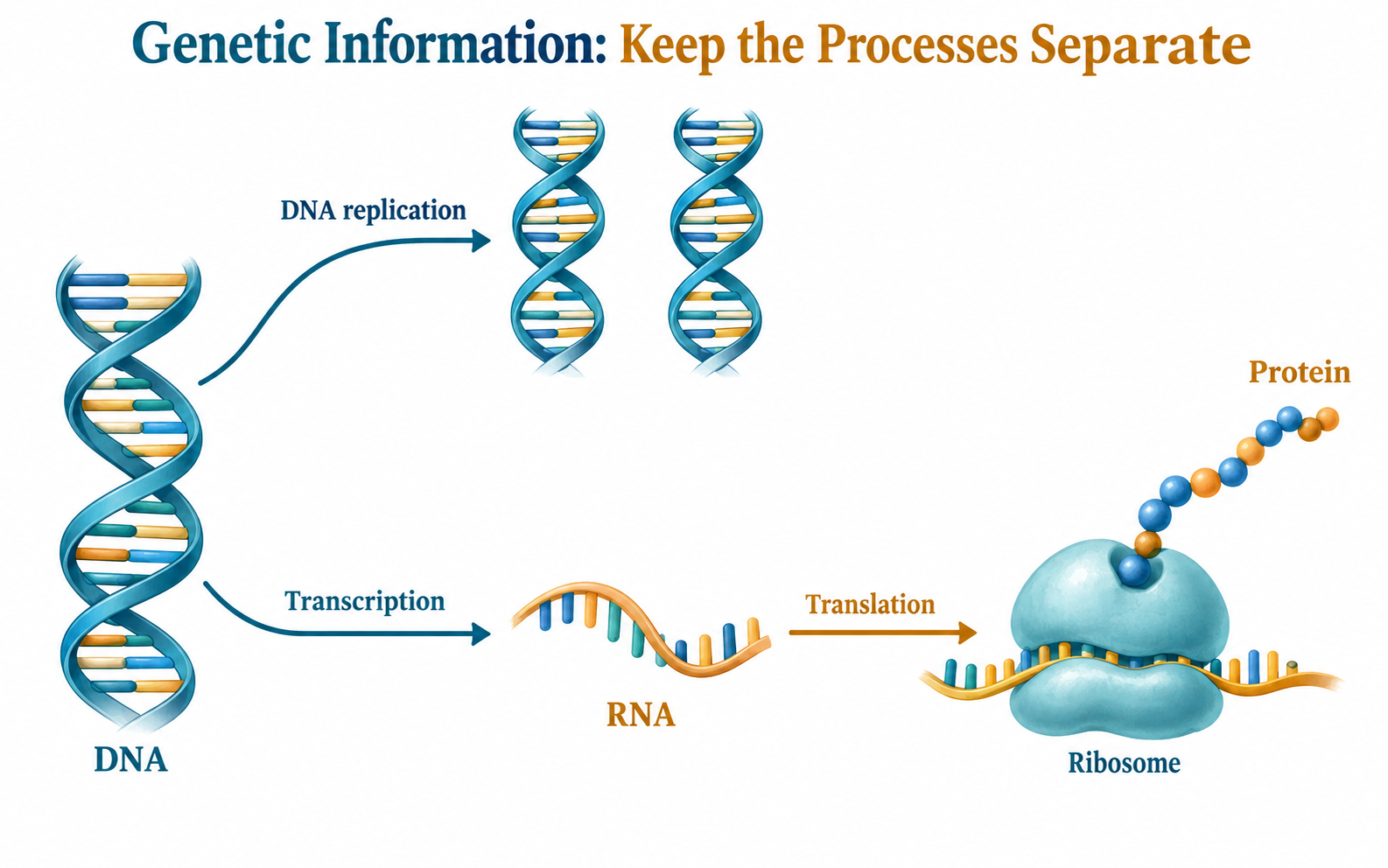
The four-box information check
Write four labels from memory: input, output, location, and purpose. If two processes share a word but differ in one of these boxes, they are not interchangeable.
- Replication uses DNA as a template to make DNA before cell division.
- Transcription uses a DNA template to make RNA; in eukaryotes it is mainly associated with the nucleus.
- Translation reads mRNA information at ribosomes to assemble a polypeptide.
- A codon is read on mRNA, while a tRNA anticodon pairs with it during translation.
The recipe-book shortcut
Think of DNA as a thick recipe book kept in a protected place. Transcription is not cooking the dish; it is copying one recipe onto a working note. Translation is where that working note is read to build the protein.
That small story helps because the exam likes to blur the stages. If the option says protein is made directly from DNA, slow down. Something has been skipped.
- Copying the recipe: transcription.
- Cooking from the copied note: translation.
- Copying the whole book before division: replication.
DNA, RNA, transcription and translation: keep the jobs separate
Most mistakes in this chapter come from choosing a correct word for the wrong job. Use this table before a recall check.
| Term | Main job | Place to watch | Common wrong swap |
|---|---|---|---|
| DNA | Stores genetic information | Nucleus in eukaryotes | Treated as the molecule being translated directly |
| RNA | Carries or helps use genetic information | Nucleus and cytoplasm | Confused with DNA because both are nucleic acids |
| Transcription | Makes RNA from a DNA template | Mostly nucleus in eukaryotes | Mixed with translation |
| Translation | Makes a polypeptide from mRNA information | Ribosomes | Placed in the nucleus without checking the process |
Replication: copying information accurately
During DNA replication, the two existing strands separate and each can guide the formation of a complementary strand. This is why replication is described as semi-conservative: each resulting DNA molecule includes one original strand and one newly made strand. The key idea is template-directed copying, not the creation of a completely unrelated molecule.
Revision questions often become confusing when the direction of copying, the need for a template, and the outcome are mixed together. Keep the outcome fixed in your mind: replication produces DNA from DNA. It is linked with preparation for cell division, whereas transcription is linked with using genetic information for expression.
Transcription and translation: two different stages
Transcription uses one DNA strand as a template to produce an RNA molecule. In eukaryotic cells, it is commonly associated with the nucleus. The RNA sequence is complementary to the template strand, with uracil used in RNA. The result is not a protein and not a second DNA molecule.
Translation occurs at ribosomes. The ribosome reads messenger RNA in codons, and transfer RNA molecules match their anticodons to the codons while carrying the corresponding amino acids. Peptide bonds join amino acids into a polypeptide. The genetic code links a nucleotide triplet in mRNA with an amino acid instruction; it does not mean that a codon itself is an amino acid.
- Replication: DNA template to DNA product.
- Transcription: DNA template to RNA product.
- Translation: mRNA information to polypeptide product.
- Codon: triplet on mRNA. Anticodon: complementary triplet on tRNA.
A 20-minute recall routine
Draw three arrows labelled replication, transcription and translation. Under each arrow, write template, product, location and one essential molecule. Then draw a tRNA beside an mRNA strand and label codon, anticodon and amino acid. Check the drawing against NCERT only after completing it from memory.
For every gap, write a correction as a relationship rather than a lone fact. For example, write 'translation reads mRNA at ribosomes' rather than simply writing 'ribosome'. Relationship-based notes make similar terms easier to separate during a time-limited revision session.
Common confusions to check
- Transcription makes RNA from a DNA template; translation makes a polypeptide from mRNA information.
- A codon is an information unit in mRNA, not an amino acid itself.
- Replication produces DNA from DNA and is not another name for transcription.
Check the template direction before decoding a message
Take this short invented DNA template, written 3-prime to 5-prime: TAC GGA ATT. The complementary RNA written 5-prime to 3-prime is AUG CCU UAA. RNA polymerase reads the template in the opposite direction to the new RNA strand's synthesis. Copying the template letters and merely replacing T with U would give the wrong message.
In this deliberately simplified coding example, AUG specifies the initiating methionine, CCU specifies proline and UAA is a stop signal. The two amino-acid residues form a dipeptide with one peptide bond. A stop codon does not supply a third amino acid. Actual translation initiation also depends on cellular context; an arbitrary AUG in a longer RNA does not by itself establish the reading frame.
Use the Transcription and Genetic Code sections in NCERT's Molecular Basis of Inheritance chapter. First verify strand polarity and complementary bases, then group the RNA into codons. Those are two different checks, and a correct amino-acid table cannot rescue an incorrectly transcribed sequence.
Editorial note and disclaimer
Written by: DongFeng. Published by: MedQGo. Last updated: September 30, 2026.
Disclaimer: This guide is a revision aid for NEET-UG aspirants and does not constitute medical advice. For clinical or health-related queries, consult a qualified medical professional.
References
Related revision guides
How to use this guide
Read the relevant NCERT chapter first. Then redraw the relationships or process described here from memory, compare your version with the textbook, and correct only the gaps. This is an independent revision aid, not official NCERT, NTA, or NEET material.