Inheritance needs DNA to be stored, copied and used
The molecular basis of inheritance is a chapter about information management in cells. DNA must store a sequence, fit into the cell, be copied before division and provide information for RNA and protein production. Treat these as linked jobs rather than one long list of molecules and enzymes.
A nucleotide contains a sugar, phosphate group and nitrogenous base. In DNA, complementary base pairing gives each strand information about the other: adenine pairs with thymine and guanine pairs with cytosine. The sequence carries information; the sugar-phosphate backbone provides the repeating structural framework.
Packaging changes the scale, not the identity of DNA
In eukaryotic cells, long DNA molecules associate with histone proteins to form nucleosomes. Further levels of coiling and organisation allow DNA to fit within the nucleus. Packaging should not be confused with replication: packaging arranges existing DNA, whereas replication makes DNA copies before cell division.
A chromosome is a highly organised DNA-protein structure, while a gene is a DNA segment associated with a functional product or RNA. A chromosome can contain many genes. When an option swaps chromosome and gene, return to scale: one is a large organised carrier, the other is a defined information segment within the DNA.
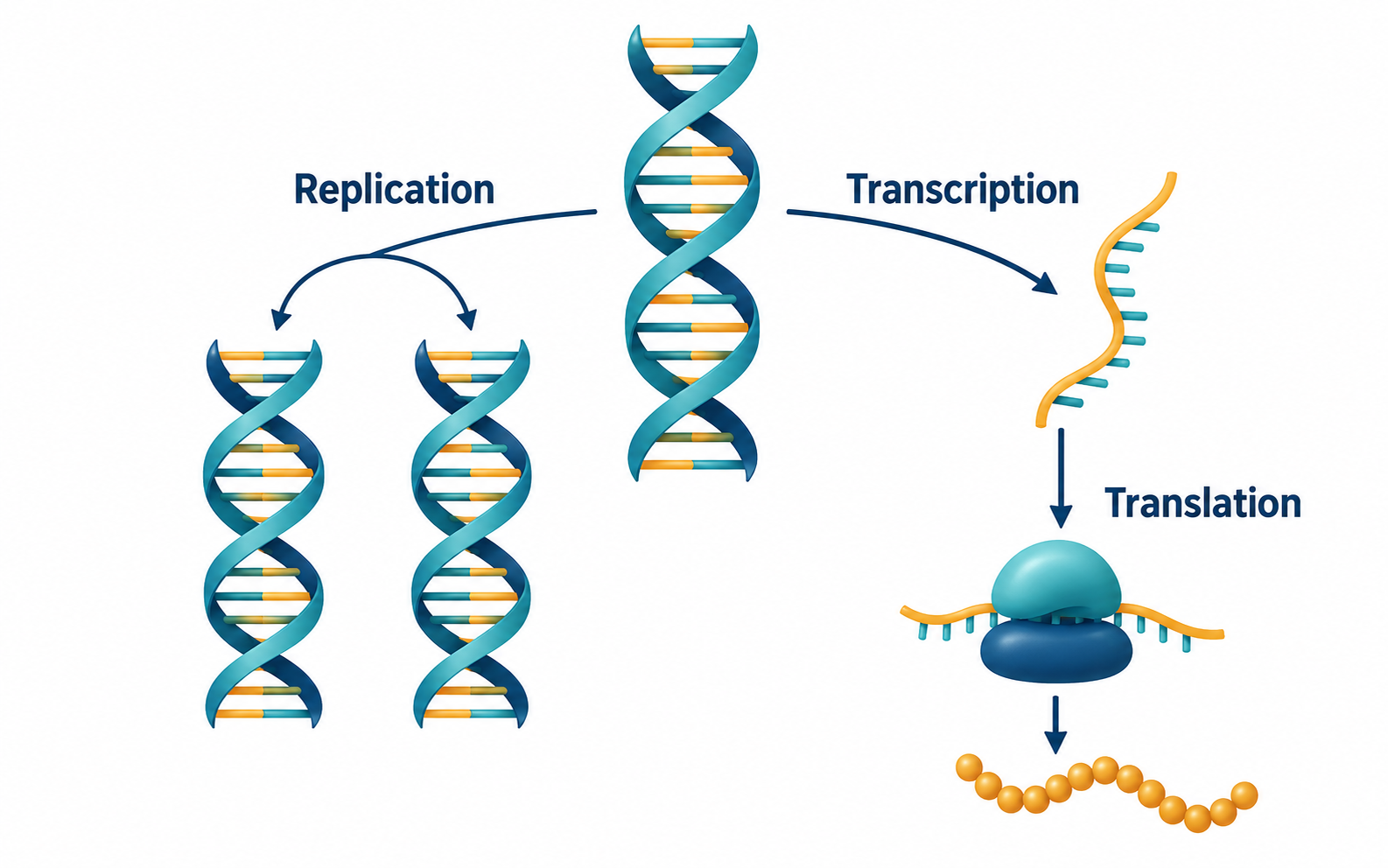
The store-package-copy check
One DNA molecule can be described at several scales. Keep the sequence, its organisation and its duplication as separate questions.
- A DNA nucleotide includes a sugar, phosphate and nitrogenous base; base sequence carries information.
- Histones and nucleosomes describe DNA packaging in eukaryotic cells.
- Semiconservative replication gives each daughter DNA molecule one parental and one newly made strand.
- Leading and lagging synthesis differ because DNA polymerase builds new DNA in one direction along antiparallel templates.
A DNA copy is not just another chromosome label
DNA, gene, chromosome, chromatin and nucleosome belong to the same information system but name different scales or states. The words become manageable when each one answers a different question: what is the molecule, what is the segment, and how is it organised?
Replication adds a second question: how can sequence information be copied accurately? Complementary pairing and the semiconservative model provide the connection, while packaging explains where the long molecule fits.
DNA information: object, action and result
Use the action to distinguish a DNA structure question from a copying or expression question.
| Object or action | What changes | What remains the key idea | Common mix-up |
|---|---|---|---|
| Nucleotide | Bases occur in a sequence on a sugar-phosphate backbone | Base sequence carries information | Calling a base alone a nucleotide |
| Packaging | DNA associates with histones and folds into higher organisation | DNA is organised to fit in the nucleus | Saying new DNA copies are produced |
| Replication | Each template strand guides a complementary new strand | Each product has one parental and one new strand | Calling both product strands newly made |
| Gene expression | DNA information is used through RNA and protein synthesis | Information is read for a product | Treating it as another name for replication |
Semiconservative replication preserves a template relationship
DNA replication uses each parental strand as a template for a new complementary strand. Each resulting double helix therefore contains one old strand and one newly synthesised strand; this is the semiconservative model. The base-pairing rule explains why a template sequence can guide the sequence of a new strand.
DNA polymerase adds nucleotides in a defined direction, and the two template strands are antiparallel. This creates a leading strand that is synthesised continuously and a lagging strand that is assembled in segments. The essential revision distinction is not a long enzyme list: both strands are copied, but their synthesis is organised differently because of strand orientation.
What would distinguish DNA from protein as hereditary material?
A convincing experiment must distinguish competing explanations. Transformation alone showed that a heritable property could pass from one bacterial preparation to another; it did not by itself identify the molecule. In the Avery, MacLeod and McCarty work, removing DNA with DNase prevented transformation, whereas the corresponding protein- and RNA-digesting treatments did not. The comparison makes DNA necessary for that transforming activity.
Hershey and Chase used different radioactive labels for phage DNA and protein. Phosphorus-32 traced DNA, while sulfur-35 traced protein. Following infection, separation of bacterial cells from the external phage coats showed which labelled material entered the cells. The inference comes from the label's location after separation, not simply from detecting radioactivity somewhere in the tube.
Predict the bands before naming semiconservative replication
In the Meselson-Stahl experiment, bacteria first incorporated heavy nitrogen into DNA and were then grown with light nitrogen. After one replication, semiconservative copying predicts double helices with one heavy parental strand and one light new strand: an intermediate-density band. A conservative model would instead predict separate heavy and light DNA populations at that stage.
One intermediate band alone does not distinguish semiconservative copying from every alternative: a dispersive model could also give intermediate material. After the second replication, semiconservative copying predicts both light DNA and hybrid DNA, whereas dispersive copying predicts DNA that remains mixed within its strands. Comparing successive generations is what makes the reasoning stronger.
Use a simple original strand count: label two parental strands H and supply only L for new strands. One round gives two HL molecules. Copy each again and obtain two HL and two LL molecules. There is no HH molecule after the first round, and the parental H strands have not changed into L strands.
Use base composition as a check on the double-stranded model
For a double-stranded DNA sample, A equals T and G equals C. If an original worked example gives 18 percent adenine, thymine is also 18 percent. The remaining 64 percent is divided equally between guanine and cytosine, so each is 32 percent. The total must be 100 percent, not 200 percent; the proportions refer to the whole sample.
Do not impose these equalities on the composition of a single isolated strand. Its complementary partner supplies the balancing bases. Likewise, a complementary strand must be written with the opposite polarity. Writing the correct letters without the 5-prime and 3-prime ends can conceal a direction error. Transcription and translation are developed in the separate DNA-to-protein guide; here the goal is to establish why DNA can store and copy a sequence.
A storage-to-copy recall routine
Draw one central DNA molecule and make three outward arrows: package, replicate and express. Under package, write histones and nucleosome; under replicate, write template plus complementary pairing; under express, write RNA then protein. This map shows where the molecular-basis chapter connects to the separate gene-expression guide without repeating it.
Close the page and answer four checks: What is the difference between a gene and a chromosome? What changes during packaging? What makes replication semiconservative? Why is the lagging strand made in segments? Each answer should name a relationship, not just a term.
Common confusions to check
- A gene is a defined DNA segment; a chromosome is a larger organised DNA-protein structure containing many genes.
- Packaging folds existing DNA; replication makes new complementary DNA strands.
- Each replicated DNA double helix has one parental and one newly synthesised strand, not two entirely new strands.
Editorial note and disclaimer
Written by: DongFeng. Published by: MedQGo. Last updated: September 18, 2026.
Disclaimer: This guide is a revision aid for NEET-UG aspirants and does not constitute medical advice. For clinical or health-related queries, consult a qualified medical professional.
References
Related revision guides
How to use this guide
Read the relevant NCERT chapter first. Then redraw the relationships or process described here from memory, compare your version with the textbook, and correct only the gaps. This is an independent revision aid, not official NCERT, NTA, or NEET material.