Read a flowering plant as a map of organs and landmarks
Plant morphology becomes manageable when every unfamiliar structure is traced back to an organ. Begin with the root system and the shoot system. Roots usually anchor the plant and absorb water and minerals; the shoot bears stems, leaves, flowers and fruits. A modification may look unusual, but its origin still matters more than its appearance.
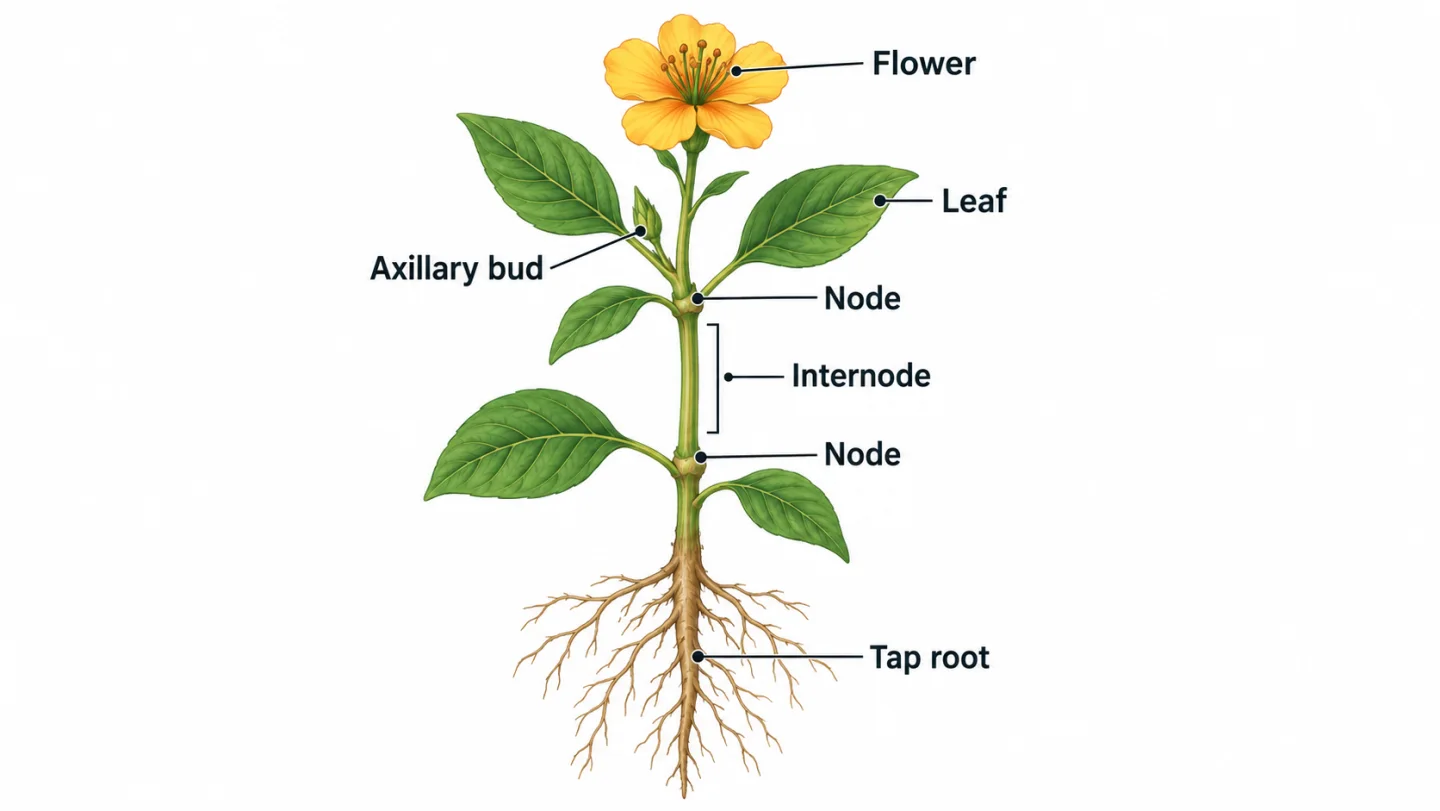
Use positional landmarks before naming a specimen. A stem has nodes, internodes and buds. A leaf normally arises at a node and carries an axillary bud in its axil. A root does not have nodes, internodes or axillary buds. These observations let you distinguish a storage root from an underground stem without relying on colour, shape or the fact that both may grow below ground.
- Root landmark: root cap and root-hair region, without nodes or buds.
- Stem landmark: nodes, internodes, terminal or axillary buds.
- Leaf landmark: leaf base, petiole and lamina, with an axillary bud at the point of attachment.
- Flower landmark: reproductive shoot with floral whorls arranged on a receptacle.
Root systems and modifications: identify origin before function
The primary root develops from the radicle. In a tap-root system it persists as a main axis with lateral branches, a pattern commonly associated with dicotyledonous plants. In a fibrous system, many similarly sized roots arise near the stem base, a common monocot pattern. Adventitious roots arise from plant parts other than the radicle and can serve support, storage or other specialised roles.
Function alone cannot identify the organ. Carrot is a storage tap root, while sweet potato is an adventitious storage root. Prop roots descending from banyan branches and stilt roots arising from lower stem nodes both support the plant, but they differ in origin and arrangement. Pneumatophores grow upward in certain swamp plants and help roots exchange gases in oxygen-poor soil.
When two examples seem similar, write a two-part answer: where the structure originates and what it does. That prevents the broad statement 'all swollen underground organs are roots' from replacing the anatomical evidence.
A plant part keeps its origin when its job changes
Storage, climbing and defence describe functions, not organ identities. A potato and a sweet potato can both store food while one is a stem and the other is a root. The reliable evidence is anatomical position: nodes and buds point to stem identity, while root origin and the absence of those landmarks point elsewhere.
Use this rule cautiously with named examples. Similar-looking structures in different plants may arise from different organs, so the chapter is testing homology and modification rather than a universal visual shortcut.
Modified organs: use visible evidence before naming the function
The same function can be performed by structures of different origin. Diagnose the organ from landmarks, then add the adaptive role.
| Example | Organ identity | Evidence of origin | Main role and trap |
|---|---|---|---|
| Potato tuber | Stem | Eyes are buds associated with nodes | Food storage; not a swollen root |
| Sweet potato | Adventitious root | Develops from a root arising away from the radicle | Food storage; not a stem tuber |
| Ginger rhizome | Stem | Nodes, internodes and scale leaves | Storage and perennation; not a horizontal root |
| Pea tendril | Leaf part | Position and continuity with the compound leaf | Climbing; do not generalise all tendrils as leaves |
| Banyan prop root | Adventitious root | Descends from a branch toward soil | Mechanical support; not a stem branch |
Stem identity survives even when the stem moves underground
A stem connects roots with leaves and bears branches, flowers and fruits. Its repeating units are nodes and internodes, and buds provide decisive evidence of stem identity. Underground stems store food and support perennation or vegetative propagation, but they still retain stem landmarks.
A potato tuber bears eyes, which are buds arranged at nodes; that makes it a modified stem rather than a root. Ginger is a rhizome with nodes, internodes and scale leaves. An onion bulb has a short stem and fleshy scale leaves, so its storage tissue is not described in exactly the same way as a tuber. Above ground, tendrils can support climbing and thorns can protect the plant, but the chapter expects the organ of origin to be checked rather than guessed from function.
- Tuber: swollen underground stem with buds, as in potato.
- Rhizome: horizontal underground stem with nodes and internodes, as in ginger.
- Stem tendril: slender climbing modification arising from a stem or branch position.
- Thorn: hard, pointed stem or axillary-bud modification in the named NCERT examples.
A leaf can be described without memorising a photograph
A typical leaf has a base, petiole and lamina. Venation describes the arrangement of veins and veinlets, while phyllotaxy describes how leaves are arranged on the stem. These are different observation levels: one belongs within a leaf blade and the other compares leaves around a shoot.
In a simple leaf, incisions do not reach the midrib or petiole. In a compound leaf, the lamina is divided into leaflets, but the axillary bud occurs at the base of the whole leaf, not at the base of each leaflet. That bud check separates a leaflet from a small simple leaf on a branch.
Leaf modifications must also be tied to origin. Pea tendrils are leaf modifications, while a tendril in another named plant may be a stem modification. Spines, storage leaves and insect-trapping leaves show that one organ can be reshaped for different functions without losing its developmental identity.
From inflorescence to flower: keep axis growth and whorls separate
An inflorescence is the arrangement of flowers on a floral axis. In a racemose inflorescence, the main axis continues to grow and younger flowers occur toward the apex or centre. In a cymose inflorescence, the main axis ends in a flower, limiting further extension, and the order of flower age is reversed. The decisive clue is what happens to the main axis, not whether the cluster looks dense.
A typical flower is organised into calyx, corolla, androecium and gynoecium. Sepals form the calyx and petals form the corolla. Stamens make up the androecium; each stamen has a filament and anther. The gynoecium consists of one or more carpels, with stigma, style and ovary as key regions. These whorls describe parts of one flower, while an inflorescence describes how multiple flowers are arranged.
Ovary position is read relative to the attachment of the other floral parts. In a hypogynous flower the ovary is superior; in epigynous flowers it is inferior; perigynous construction places other parts around a cup-like thalamus while the ovary remains half inferior or is described according to the NCERT example. Draw the attachment level rather than memorising the prefixes alone.
Fruit and seed terms belong to a developmental sequence
After fertilisation, the ovary generally develops into a fruit and ovules develop into seeds. The fruit wall is the pericarp, derived from the ovary wall. A true fruit develops from the ovary, while an accessory or false fruit includes another floral part such as the thalamus in addition to the ovary-derived tissue.
Seed comparisons should begin with cotyledon number and the distribution of stored food. A dicot embryo commonly has two cotyledons, a plumule and a radicle. A monocot grain has one cotyledon called the scutellum, with protective sheaths associated with the plumule and radicle. Endosperm may persist in some mature seeds and be consumed during development in others, so 'all seeds store food in cotyledons' is too broad.
A specimen-first recall routine
Draw a blank flowering plant and mark only six checkpoints: root origin, stem node, axillary bud, leaf blade, floral axis and ovary. Then place one modification beside the organ it comes from. The output should be a labelled diagnostic map, not a list of examples.
For a second pass, choose potato, sweet potato, pea tendril and ginger. For each, write 'organ evidence -> function'. Finish by sketching one racemose and one cymose axis, adding the oldest and youngest flower positions. If the landmark supports the name, the example is much harder to swap under exam pressure.
Common confusions to check
- An underground storage structure is not automatically a root; nodes and buds identify potato as a stem tuber.
- Phyllotaxy describes leaf arrangement on a stem, while venation describes veins within a leaf blade.
- After fertilisation, ovules develop into seeds and the ovary generally develops into a fruit.
Editorial note and disclaimer
Written by: DongFeng. Published by: MedQGo. Last updated: September 21, 2026.
Disclaimer: This guide is a revision aid for NEET-UG aspirants and does not constitute medical advice. For clinical or health-related queries, consult a qualified medical professional.
References
Related revision guides
How to use this guide
Read the relevant NCERT chapter first. Then redraw the relationships or process described here from memory, compare your version with the textbook, and correct only the gaps. This is an independent revision aid, not official NCERT, NTA, or NEET material.