Begin at the flower, but follow the reproductive cells
A flowering-plant question becomes manageable when the parts of a flower are treated as a route rather than as a labelled diagram. The anther produces pollen grains, the stigma receives compatible pollen, and the ovary contains ovules. Each ovule contains the female gametophyte, the embryo sac.
Keep the two gametophytes distinct. A pollen grain is the male gametophyte and forms a pollen tube after a suitable pollen-pistil interaction. The embryo sac is the female gametophyte within the ovule. Pollen is not the male gamete itself, and an ovule is not the same structure as an ovary.
Pollination starts a route; fertilisation completes it
Pollination is transfer of pollen from anther to stigma. It can occur within the same flower or between flowers, depending on the route. Fertilisation is later: it requires the male gametes delivered through a pollen tube to reach the embryo sac. A pollen grain on a stigma therefore tells you that pollination has occurred, not that a seed has already formed.
After germination on a receptive stigma, the pollen tube grows through the style toward an ovule. It enters the embryo sac and releases two male gametes. In sequence questions, check whether an option has quietly placed the pollen tube after fertilisation or sent pollen directly into the ovary without the stigma-style route.
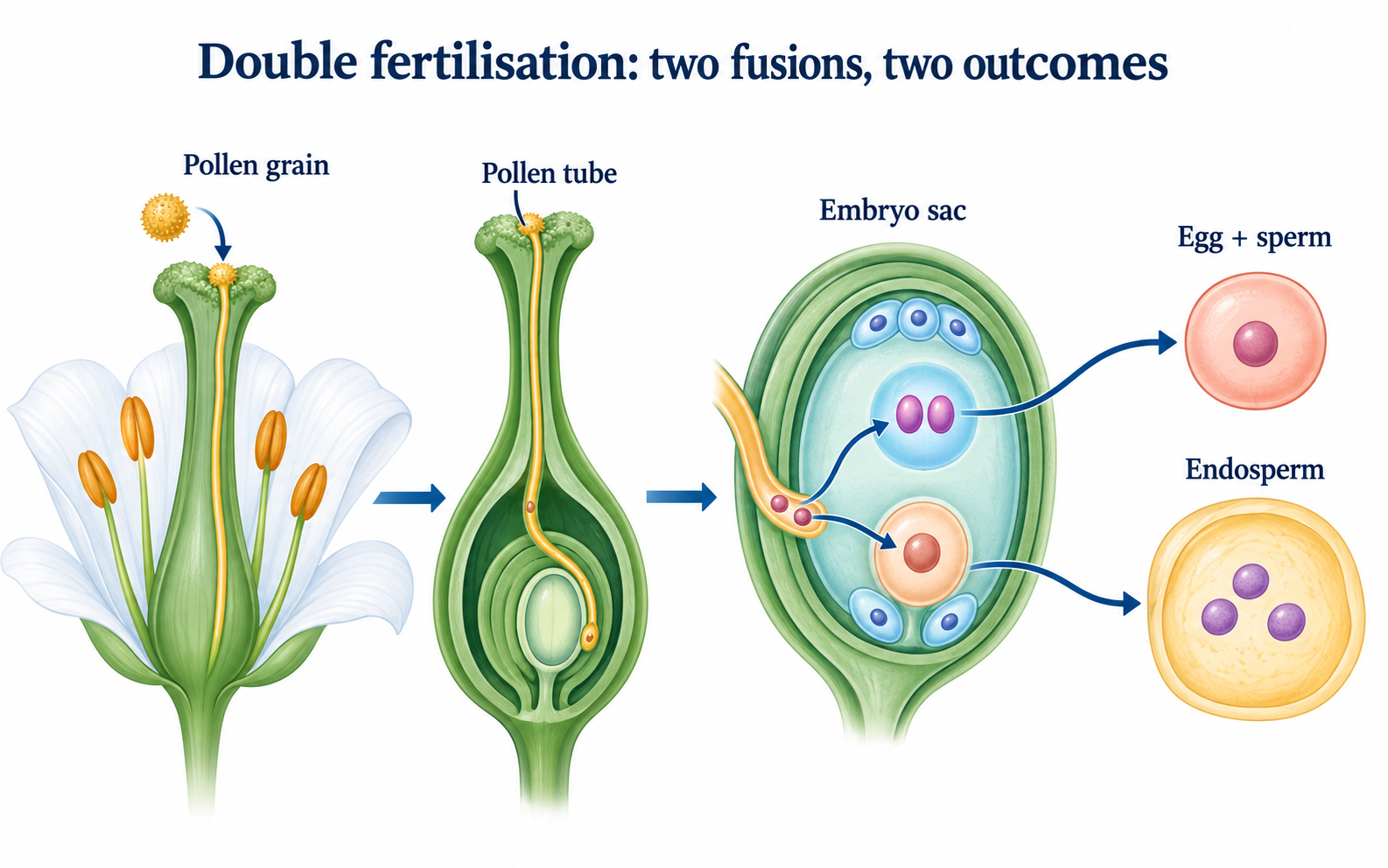
The two-fusion check
Use one question at every stage: which cells meet, and what does their fusion become?
- Pollen grain is the male gametophyte; the embryo sac is the female gametophyte in an ovule.
- Pollen transfer to stigma is pollination, not fertilisation.
- One male gamete plus egg gives the zygote; the other plus polar nuclei gives the primary endosperm nucleus.
- After fertilisation, ovule becomes seed and ovary becomes fruit.
Two sperm does not mean two embryos
The two male gametes enter the same embryo sac, which can make the outcomes look symmetrical. They are not. One fusion initiates the embryo through the zygote; the other produces the endosperm-forming nucleus that supports development.
When a label looks familiar, make it earn its place by naming both the fusion partners and the product. That simple check prevents zygote and endosperm from being swapped.
Flowering-plant reproduction: location to outcome
Read down the route. Each row identifies one location, its event, and the product that follows.
| Location or structure | Event | Direct result | Do not swap with |
|---|---|---|---|
| Anther | Produces pollen grains | Male gametophyte available for transfer | Stigma |
| Stigma and style | Receives pollen and supports tube growth | Pollen tube travels toward an ovule | Fertilisation site |
| Embryo sac | One male gamete fuses with egg | Diploid zygote, then embryo | Primary endosperm nucleus |
| Central cell of embryo sac | Other male gamete fuses with polar nuclei | Typically triploid primary endosperm nucleus | Zygote |
Double fertilisation has two fusion events and two products
Angiosperms show double fertilisation because the two male gametes take part in two separate fusions inside the embryo sac. One male gamete fuses with the egg cell to form the diploid zygote. The zygote later develops into the embryo.
The other male gamete fuses with the two polar nuclei in the central cell to form the primary endosperm nucleus, which is typically triploid. Endosperm nourishes the developing embryo. The two events happen in the same embryo sac, but embryo and endosperm should never be treated as the same product.
After fertilisation, name the structure that changes
Following fertilisation, the ovule develops into a seed and the ovary develops into a fruit. The integuments of the ovule contribute to the seed coats. This structure-to-product map is more dependable than a loose list of post-fertilisation terms.
For a quick recall task, draw a vertical route with five stops: anther, stigma, pollen tube, embryo sac, and seed. Add the two fusion arrows at the embryo sac, then state aloud which fusion produces embryo and which produces its nutritive tissue. Finish by writing ovule to seed and ovary to fruit without looking back.
Common confusions to check
- Pollination is pollen transfer; fertilisation occurs later inside the embryo sac.
- One male gamete fuses with the egg to form zygote, while the other joins polar nuclei to begin endosperm formation.
- An ovule develops into a seed; an ovary develops into a fruit.
Editorial note and disclaimer
Written by: DongFeng. Published by: MedQGo. Last updated: September 20, 2026.
Disclaimer: This guide is a revision aid for NEET-UG aspirants and does not constitute medical advice. For clinical or health-related queries, consult a qualified medical professional.
References
Related revision guides
How to use this guide
Read the relevant NCERT chapter first. Then redraw the relationships or process described here from memory, compare your version with the textbook, and correct only the gaps. This is an independent revision aid, not official NCERT, NTA, or NEET material.