Cell cycle: copy the genome, then share it accurately
The cell cycle is the coordinated sequence in which a cell grows, duplicates its genome and other components, and divides into daughter cells. Interphase is not an empty pause: G1 supports growth and metabolism, S phase is when DNA replication occurs, and G2 prepares the cell for division.
The useful first checkpoint is DNA content versus chromosome number. During S phase, DNA content doubles, but chromosome number does not double because each replicated chromosome still has one centromere and two sister chromatids. Counting the wrong thing is the fastest route into a close-option error.
- G1: active growth before DNA replication.
- S: DNA replication; each chromosome gains a sister chromatid.
- G2: growth and protein synthesis before division.
- M phase: nuclear division followed by cytokinesis in the usual cell cycle.
Mitosis: one division that preserves chromosome number
Mitosis is an equational division: a replicated set of chromosomes is distributed so that the daughter cells retain the parental chromosome number. The nuclear events are described as prophase, metaphase, anaphase and telophase, followed by cytokinesis that separates the cytoplasm.
Use one visual sequence. Chromosomes condense in prophase; they align at the metaphase plate; centromeres split and sister chromatids move to opposite poles in anaphase; nuclei reform in telophase. In animal cells cytokinesis occurs through a cleavage furrow, whereas plant cells form a cell plate from the centre outward.
Count chromosomes by centromeres, not by DNA copies
After S phase, DNA content has doubled, but chromosome number has not doubled because each replicated chromosome still has one centromere. This is why a 2n cell remains 2n after replication even though each chromosome has two sister chromatids.
When a question feels crowded, first ask whether it is counting chromosomes, chromatids, DNA content, or cells. Those are related measurements, not interchangeable ones.
Mitosis and meiosis: identify what separates
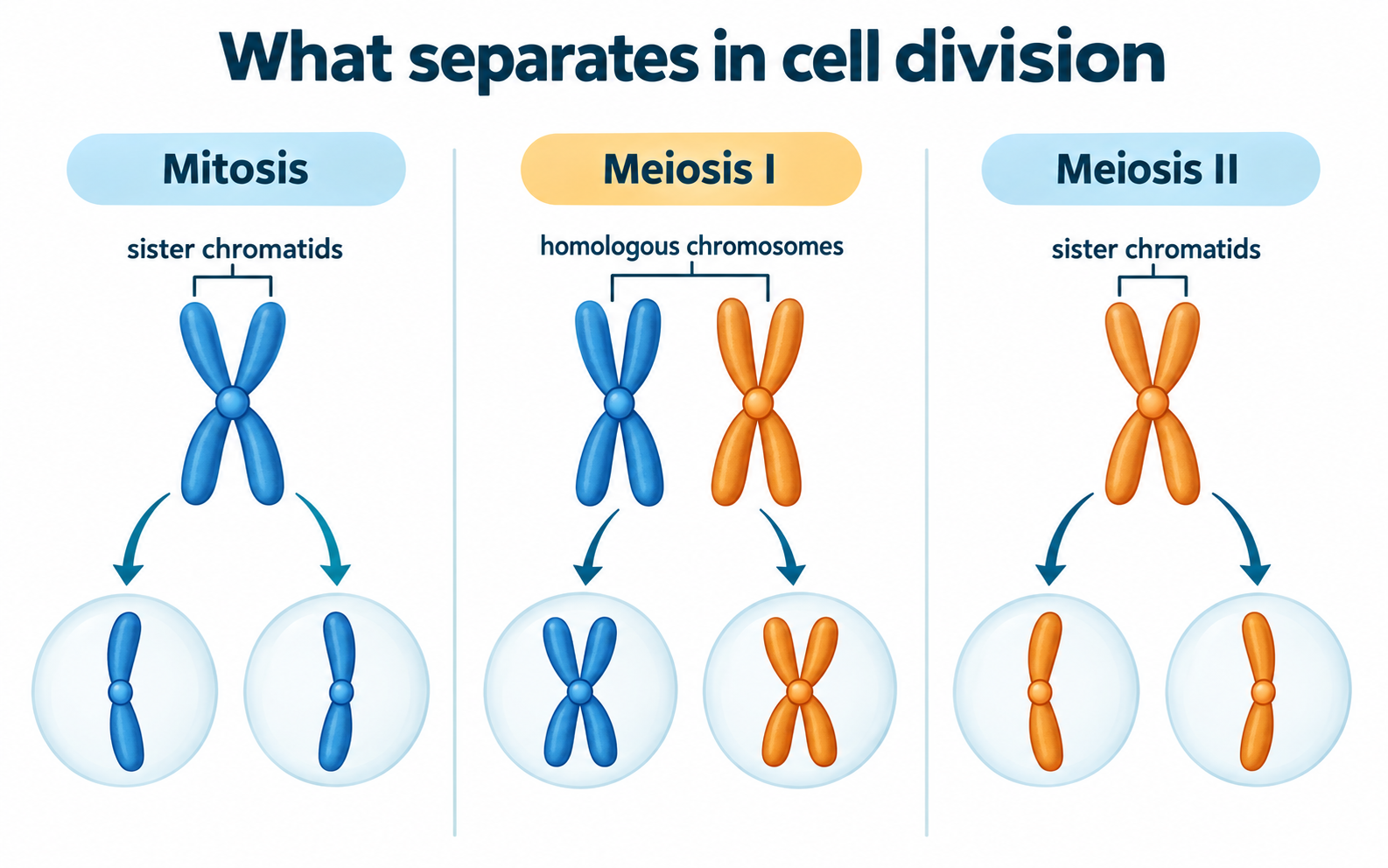
The dependable comparison is not just the number of cells at the end. Follow which chromosome partners separate at each division.
| Checkpoint | Mitosis | Meiosis I | Meiosis II |
|---|---|---|---|
| Main separating units | Sister chromatids | Homologous chromosomes | Sister chromatids |
| Chromosome-number effect | Maintained in daughter cells | Reduced by half | Remains haploid |
| DNA replication before it | One S phase before mitosis | One S phase before meiosis I | No new S phase before meiosis II |
| High-yield purpose | Growth, repair and replacement | Reduction and genetic recombination context | Completes formation of four haploid cells |
Meiosis I: the reduction happens when homologues part
Meiosis begins after a single round of DNA replication but includes two sequential divisions. In prophase I, homologous chromosomes pair. Crossing over occurs between non-sister chromatids of homologous chromosomes during pachytene, producing recombined genetic material before the homologues separate.
The key reduction event is anaphase I: homologous chromosomes move to opposite poles while sister chromatids remain joined at their centromeres. This is why meiosis I reduces chromosome number. A diagram that labels every X-shaped chromosome as a 'chromosome pair' without showing homologues can conceal the actual event.
Meiosis II: a second division without another replication
Meiosis II follows meiosis I without a fresh S phase. Its broad chromosome-separation pattern resembles mitosis because sister chromatids separate, but it starts from haploid cells. By the end, four haploid cells are formed from the original diploid cell.
Do not say meiosis II reduces chromosome number again. The number was reduced in meiosis I. Meiosis II separates the duplicated chromatids so each final cell receives one chromatid from each replicated chromosome present at the start of that division.
A chromosome-accounting recall routine
Draw one diploid pair of homologous chromosomes in two colours. First duplicate each one during S phase. Next show what moves apart in anaphase of mitosis, anaphase I and anaphase II. Label every arrow with either 'sister chromatids' or 'homologous chromosomes'.
Finish by answering three checks without notes: Why does DNA double in S phase without doubling chromosome number? Which stage gives crossing over its named location? Which division first produces haploid cells? These questions test the relations, not a list of stage names.
Common confusions to check
- DNA replication during S phase doubles DNA content but does not double chromosome number.
- Homologous chromosomes separate in anaphase I; sister chromatids separate in anaphase II and mitosis.
- Crossing over occurs between non-sister chromatids of homologous chromosomes during pachytene of prophase I.
Track 2n = 6 through replication and reduction
For an invented diploid cell with 2n = 6, begin before S phase with six chromosomes and six DNA molecules. After replication there are still six chromosomes, now consisting of twelve sister chromatids in total. Replication doubles DNA content without doubling the chromosome count while the sisters remain joined.
After meiosis I, each of the two cells has three chromosomes, each still made of two sister chromatids: three chromosomes and six DNA molecules per cell. After meiosis II, each product has three chromosomes and three DNA molecules. Homologue separation causes the reduction at meiosis I; sister separation occurs at meiosis II.
The statement 'DNA replication makes the cell tetraploid' confuses DNA quantity with chromosome sets. These counts refer to the specified stages and completed divisions; during anaphase, separated chromatids are counted as daughter chromosomes. Use NCERT's Cell Cycle and Cell Division chapter to mark the division boundaries on your sketch.
Editorial note and disclaimer
Written by: DongFeng. Published by: MedQGo. Last updated: September 30, 2026.
Disclaimer: This guide is a revision aid for NEET-UG aspirants and does not constitute medical advice. For clinical or health-related queries, consult a qualified medical professional.
References
Related revision guides
How to use this guide
Read the relevant NCERT chapter first. Then redraw the relationships or process described here from memory, compare your version with the textbook, and correct only the gaps. This is an independent revision aid, not official NCERT, NTA, or NEET material.