Four offspring classes can reveal an arrangement
Two individuals can both be written AaBb and still carry different combinations along their homologous chromosomes. In one arrangement, A shares a homologue with B and a shares its partner with b; the alternative pairs A with b and a with B. The ordinary genotype tells you which alleles are present, but leaves this arrangement, called phase, unstated. That missing detail decides which gametes count as recombinant.
This guide starts with an invented testcross record and works backwards to the gametes that produced it. The aim is to calculate a recombination frequency, defend the choice of numerator and recognise what the result cannot establish. Before using a ratio, write the chromosome arrangement with a slash separating the homologues: AB/ab or Ab/aB.
Why a double-recessive tester makes gametes readable
Cross a double heterozygote with an aabb individual. The tester supplies only ab gametes. Under the stated model of complete dominance at both loci and distinguishable phenotypes, each offspring class therefore identifies the gamete contributed by the heterozygote. An AB gamete makes AaBb; Ab makes Aabb; aB makes aaBb; ab makes aabb.
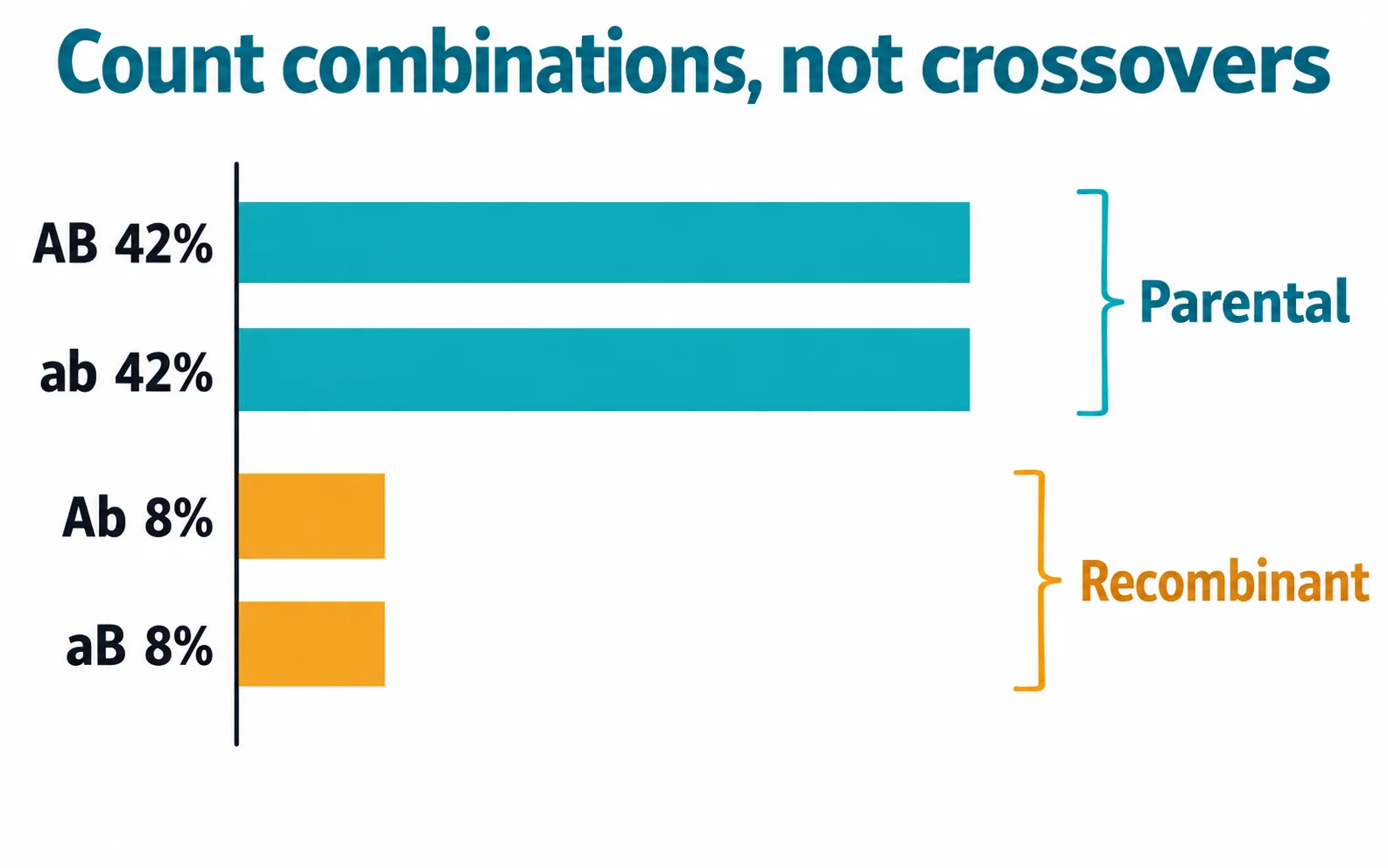
Suppose an AB/ab parent produces the following 500 offspring: 210 AaBb, 210 aabb, 40 Aabb and 40 aaBb. The first two classes preserve AB and ab. The last two contain Ab and aB, the combinations absent from the stated parental homologues. These are the recombinant classes. The illustration converts these counts into percentages so that both the classification and denominator remain visible.
This reading assumes that the classes survive and are detected comparably. If one genotype is less viable, or a phenotype is misclassified, offspring counts can be a biased representation of gametes. An unexplained unequal count is a reason to inspect the experiment, not a licence to treat every departure from an expected ratio as linkage.
Name the reference before calling a combination new
A recombinant label is relative to the starting arrangement. Write the parental phase above the four offspring classes before adding any counts. This makes the classification auditable and prevents uppercase letters or a familiar ratio from silently choosing the numerator.
The same gamete changes category when phase changes
Use the original homologues as the reference. These probabilities assume r = 0.16, reciprocal classes of equal probability and unbiased recovery.
| Gamete from heterozygote | AB/ab parent: class and probability | Ab/aB parent: class and probability |
|---|---|---|
| AB | Parental, 0.42 | Recombinant, 0.08 |
| ab | Parental, 0.42 | Recombinant, 0.08 |
| Ab | Recombinant, 0.08 | Parental, 0.42 |
| aB | Recombinant, 0.08 | Parental, 0.42 |
Calculate the fraction before interpreting its size
Add the two recombinant classes: 40 + 40 = 80. Divide by all offspring, not by the parental classes: 80/500 = 0.16. The recombination frequency is therefore 16%. Each recombinant class contributes 8%; neither class alone represents the whole recombinant fraction.
A result of 8% misses one recombinant class. A result of about 19% comes from dividing 80 by the 420 parental offspring. Both calculations use numbers from the record, but answer the wrong counting question. The denominator must include every scored outcome because the measure asks what proportion of the total is recombinant.
The reciprocal calculation is a useful check. Parental offspring total 420/500 = 84%; 84% plus 16% equals 100%. If the totals fail that check, a class was omitted, counted twice or assigned to the wrong category. Counts need not be identical within each pair in a real finite sample, even when the model predicts equal probabilities.
Change the phase and the labels change with it
For an Ab/aB parent, the parental combinations are Ab and aB. Now AB and ab are recombinant. Capital letters do not make a gamete parental, and recessive alleles do not make it recombinant. The criterion is whether the combination matches one of the original homologues.
If this second arrangement also has a recombination fraction of 0.16, a simple symmetric model predicts Ab and aB at 0.42 each, and AB and ab at 0.08 each. The same four possible gametes occur, but their expected frequencies exchange places. The overall AaBb genotype and total recombinant fraction have stayed the same.
When phase is not supplied, the two abundant reciprocal classes can suggest it in a suitable testcross. State the supporting assumptions before inferring the arrangement. A small or strongly distorted sample may not justify declaring the largest two counts to be the parental pair without further evidence.
Recombination frequency is not a tally of meiotic exchanges
Crossing over exchanges corresponding segments between non-sister chromatids of paired homologues. Recombination frequency is measured from the resulting allele combinations at the loci being followed. One is a cellular event; the other is an observed proportion. They are related, but not numerically interchangeable.
For example, one crossover between two loci involving two of the four chromatids produces two recombinant chromatids and leaves two parental chromatids in that meiotic event. It would be wrong to describe every product as recombinant merely because the cell experienced a crossover. A testcross usually pools products from many meioses.
Multiple exchanges can also leave the outer marker combination looking parental. Two-point offspring scoring does not reveal every exchange within the interval. For this reason, recombination is useful for relative genetic mapping, but an observed percentage is not a direct physical measurement of the DNA between two genes. No conversion to base pairs follows from these counts alone.
What a result near one half can and cannot show
Genes on different chromosome pairs are expected to assort independently, giving a recombinant fraction of one half in the usual two-locus model. Widely separated loci on the same chromosome can also behave as effectively unlinked in this test. A value near 50% therefore does not prove that the genes occupy different chromosomes.
For relatively short intervals, 1% recombination is used as approximately one map unit, or one centimorgan. Our 16% exercise can support an approximate two-point genetic distance under the mapping assumptions. It does not establish a distance of sixteen nucleotides or an exact number of crossing-over events.
Expected two-point recombination fractions range up to 50%. Sampling fluctuation can put a raw estimate slightly above one half; a large excess should prompt a check of phase, class assignment and experimental assumptions. It should not be interpreted as evidence that greater than half is the usual expectation for increasingly distant loci.
Rebuild the record from a blank page
Write AB/ab x ab/ab, then make four rows headed AB, ab, Ab and aB. Without looking back, add the offspring genotypes, mark parental or recombinant and recover the 16% calculation. Change only the heterozygote to Ab/aB and repeat the labels. Your percentage should remain 16% only if the corresponding class frequencies are also rearranged as described above.
Finish with a sentence that the data support and a sentence they do not support. 'Recombinant offspring constitute 16% of this scored sample' is supported. 'Sixteen percent of meiotic cells had exactly one crossover' is not. That final distinction is the point of the exercise: a correct arithmetic result still needs a correctly limited biological interpretation.
NCERT anchor: Principles of Inheritance and Variation, subsection Linkage and Recombination. Use the chromosome-basis guide below for the meiotic mechanism and the Mendelian guide for why a tester reveals gamete contributions.
Common confusions to check
- AB is not automatically a parental combination.
- Both reciprocal recombinant classes belong in the numerator.
- A 50% result does not identify the chromosome locations uniquely.
Editorial note and disclaimer
Written by: DongFeng. Published by: MedQGo. Last updated: September 28, 2026.
Disclaimer: This guide is a revision aid for NEET-UG aspirants and does not constitute medical advice. For clinical or health-related queries, consult a qualified medical professional.
References
Related revision guides
How to use this guide
Read the relevant NCERT chapter first. Then redraw the relationships or process described here from memory, compare your version with the textbook, and correct only the gaps. This is an independent revision aid, not official NCERT, NTA, or NEET material.