One seed contains tissues with different histories
Calling a seed 'the product of fertilisation' is useful shorthand, but it hides an important distinction. Some tissues descend from fusion events; others were already part of the maternal plant. To determine chromosome number or parentage, identify the particular tissue first. An embryo, endosperm and seed coat cannot all be assigned the same origin merely because they occupy one seed.
Use the conventional diploid flowering-plant model with a typical embryo sac. The focus here is tissue ancestry after fertilisation, not the full route from anther to stigma. NCERT Class 12 Biology, Chapter 1, treats this under Double Fertilisation and Post-fertilisation: Structures and Events. Exceptional reproductive routes are useful boundary cases, but they should not be silently inserted into the ordinary model.
Trace each tissue back before adding chromosome sets
An egg nucleus and one male gamete contribute to the zygote. Both are haploid in the stated model, so the zygote is diploid and develops into the embryo. The second male gamete joins the two haploid polar nuclei, or their diploid fusion product, to establish the typically triploid primary endosperm nucleus. Endosperm development follows from this second route.
The integuments belong to the maternal sporophyte and form the seed coat. They do not become triploid when the nearby endosperm does. Nucellus is also maternal tissue; where a remnant persists in the seed, it is called perisperm. The original figure follows these separate origins. Its maternal branch bypasses fertilisation deliberately: protection and residual nourishment can come from tissues that were not created by either fusion.
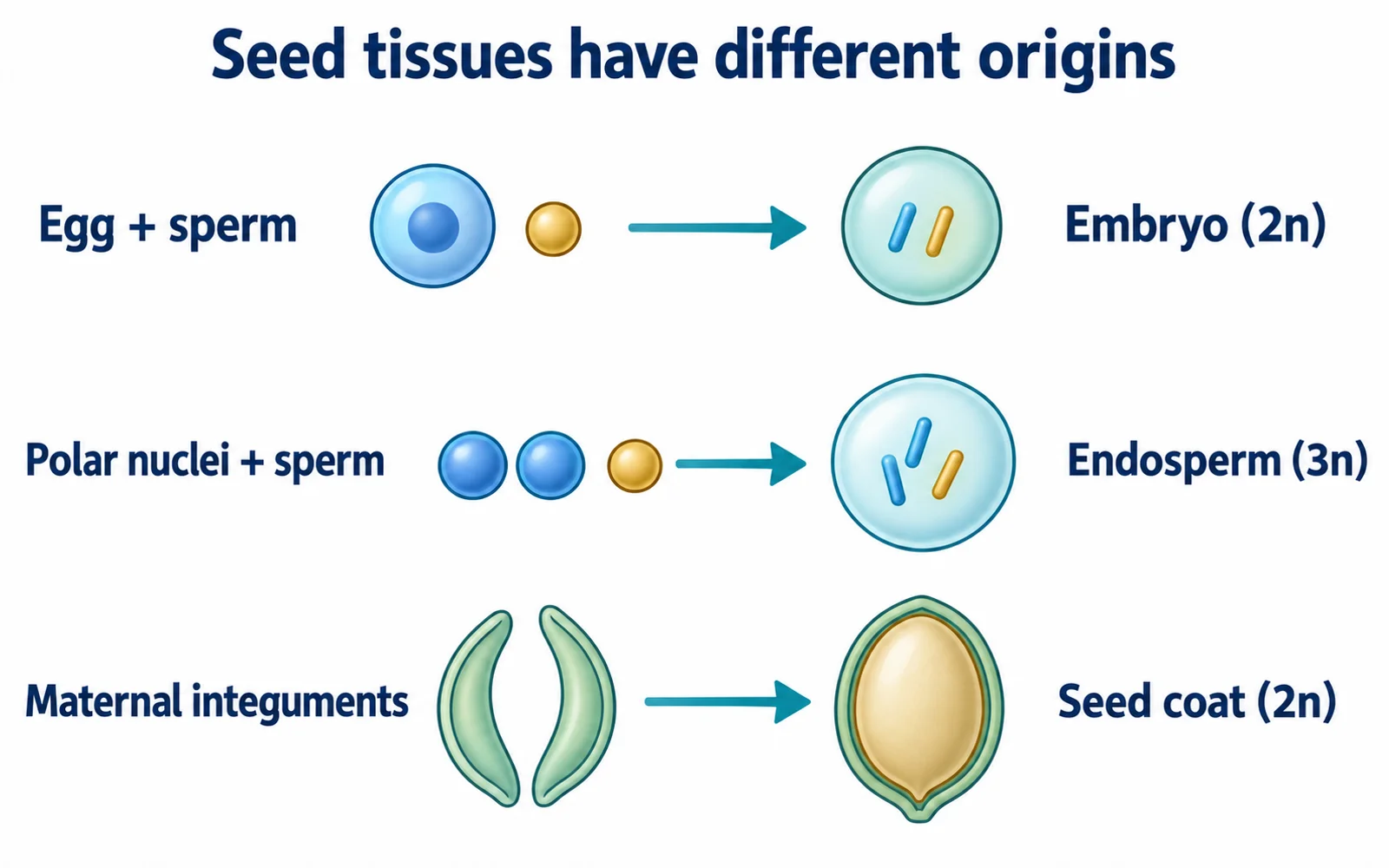
A tissue label is stronger evidence than proximity
Two adjacent seed tissues can differ in origin and chromosome count. Start a ploidy explanation with 'this tissue develops from...' and finish that sentence before adding n symbols. This also exposes an ambiguity when a prompt says only 'seed cells': there is no single tissue history for the entire seed.
Tissue ancestry audit for a conventional diploid plant
The counts assume ordinary meiosis and a typical embryo sac. Shared ploidy does not imply shared developmental origin.
| Seed component | Developmental ancestor | Usual starting ploidy | Paternal nuclear contribution? |
|---|---|---|---|
| Embryo | Zygote following egg-sperm fusion | 2n | Yes: one gametic set |
| Endosperm | Primary endosperm nucleus following triple fusion | 3n | Yes: one of three sets |
| Seed coat | Maternal integuments | 2n | No new paternal contribution |
| Perisperm, if retained | Maternal nucellus | 2n | No new paternal contribution |
A chromosome audit with a maternal number of 18
Here is an independently constructed example. Suppose the maternal plant and pollen donor are both diploid with 2n = 18. Assume ordinary meiosis, a typical embryo sac and normal double fertilisation. Each gametic nucleus then carries n = 9 chromosomes. Write the units as chromosomes per nucleus, rather than counting cells or chromatids.
The zygote receives 9 + 9 = 18 chromosomes. The primary endosperm nucleus receives 9 + 9 + 9 = 27. A seed-coat cell retains the maternal sporophyte count of 18. If nucellus persists as perisperm, its ordinary somatic nuclei also have 18 under this model. The fact that two tissues both have 18 does not establish the same parentage: embryo and seed coat reached that number through different histories.
Check the plausible wrong answer 'the coat has 27 because it encloses triploid tissue.' Position does not transfer chromosome sets between neighbouring tissues. The coat's count follows integument ancestry. Another wrong answer is 'triple fusion makes a triploid embryo.' Triple fusion belongs to the endosperm route; syngamy establishes the zygote. Label the products before calculating.
The numbers are idealised starting counts for this revision exercise. Later endoreduplication in some tissues is a separate biological issue and is not part of the stated assumptions. A careful calculation identifies its model rather than promising that every nucleus in every mature seed must match this simple count.
Maternal contribution means two different things here
In ordinary endosperm formation, two nuclear sets are maternally derived and one is paternally derived. That is not the same as saying endosperm is unchanged maternal sporophyte tissue. It arose through a fusion that included the second male gamete. By contrast, integument-derived seed coat is maternal tissue without that paternal nuclear contribution.
Imagine labelling the maternal sets M and the paternal set P. The embryo account is M + P; the usual endosperm account is M + M + P; the coat continues as maternal sporophyte tissue. These symbols describe origin, not which alleles are dominant or which genes will be expressed. They cannot, by themselves, predict seed colour or the outcome of a cross.
This ancestry method is useful whenever a statement switches between an entire seed and one of its parts. Ask which tissue was observed. A whole-seed description may combine properties of the coat, stored reserves and embryo; it is not automatically a direct reading of the embryo's genotype.
Reserve location can change while the seed develops
Endosperm supports embryo development, but its persistence at seed maturity varies. In albuminous seeds, appreciable endosperm remains; in non-albuminous seeds, the developing embryo has consumed it. Reserve material can be stored in cotyledons. Therefore the absence of a large endosperm in a mature seed does not show that the second fertilisation never occurred.
NCERT contrasts examples such as maize and castor, which retain endosperm, with pea and groundnut, in which it is used during development. The useful distinction is persistence, not a ranking of how successfully fertilisation happened. Perisperm needs its own label because a persistent nucellus is not endosperm left over under another name.
When looking at a seed diagram, separate three questions: where is food stored now, what tissue produced that store, and what is its developmental origin? A food-storage role alone cannot answer all three. This prevents the same shortcut that confuses two unrelated organs merely because both store starch.
Do not exchange the ovule and ovary labels
An ovule normally develops into a seed, while the ovary develops into the fruit and the ovary wall contributes the pericarp. These are nested structures, not interchangeable terms. Other floral parts can contribute to some fruits, so the whole fruit is not always derived from the ovary alone.
Parthenocarpy describes fruit formation without fertilisation. Apomixis concerns seed formation without the ordinary fertilisation route. Neither term means simply that a mature seed lacks persistent endosperm. Keep the definitions at this level: predicting the ploidy of an apomictic embryo would require details of the pathway, and the normal 9 + 9 calculation should not be applied automatically.
Reconstruct a seed from its ancestry labels
Draw four empty boxes marked embryo, endosperm, seed coat and perisperm. Add an origin arrow for each before writing any ploidy symbol. Then complete the 2n = 18 example without looking back. Your self-check is 18, 27, 18 and 18, with a different explanatory origin attached to each appropriate row.
Finish by crossing out two claims and replacing them precisely: 'all seed tissues are fertilisation products' and 'no mature endosperm means no double fertilisation'. The first fails because of maternal tissues; the second ignores developmental consumption. Those explanations are the learning outcome, rather than memorising four isolated numbers.
Common confusions to check
- Triploid endosperm does not make the surrounding seed coat triploid.
- Perisperm is persistent nucellus, not persistent endosperm.
- A mature non-albuminous seed can have undergone ordinary double fertilisation.
- Parthenocarpy concerns fruit; apomixis concerns seed formation.
Editorial note and disclaimer
Written by: DongFeng. Published by: MedQGo. Last updated: October 1, 2026.
Disclaimer: This guide is a revision aid for NEET-UG aspirants and does not constitute medical advice. For clinical or health-related queries, consult a qualified medical professional.
References
Related revision guides
How to use this guide
Read the relevant NCERT chapter first. Then redraw the relationships or process described here from memory, compare your version with the textbook, and correct only the gaps. This is an independent revision aid, not official NCERT, NTA, or NEET material.