Read the plant kingdom through four structural transitions
A long list of plant groups becomes a coherent map when four questions are asked in order. Is the body differentiated into root, stem and leaf? Is vascular tissue present? Are seeds formed? If seeds occur, are they exposed or enclosed within an ovary? These checkpoints separate algae, bryophytes, pteridophytes, gymnosperms and angiosperms without treating every characteristic as equally diagnostic.
Life-cycle dominance provides a second axis. The conspicuous plant may be a gametophyte or a sporophyte, and the two generations differ in chromosome number and reproductive role. Keep this axis beside the structural one: vascular tissue and seed habit describe the body and reproduction, while gametophyte-sporophyte relations describe the life cycle.
- Body plan: thallus or differentiated organs.
- Conducting system: non-vascular or vascular.
- Propagule: spores or seeds.
- Seed position: exposed or enclosed in an ovary.
- Dominant generation: gametophyte or sporophyte.
Algal classes are separated by pigments, reserves and walls
Algae are mostly aquatic, photosynthetic organisms with a relatively simple thallus. In the NCERT treatment, Chlorophyceae, Phaeophyceae and Rhodophyceae are compared through pigment combinations, stored food, flagella and cell-wall features. Habitat alone is not decisive because representatives can occupy marine, freshwater or moist terrestrial settings.
Green algae contain chlorophyll a and b and commonly store starch. Brown algae contain chlorophyll a and c with fucoxanthin and store laminarin and mannitol. Red algae contain chlorophyll a and pigments including phycoerythrin, with floridean starch as the reserve. The visible colour follows the accessory pigment mixture; it does not mean that chlorophyll is absent from brown or red algae.
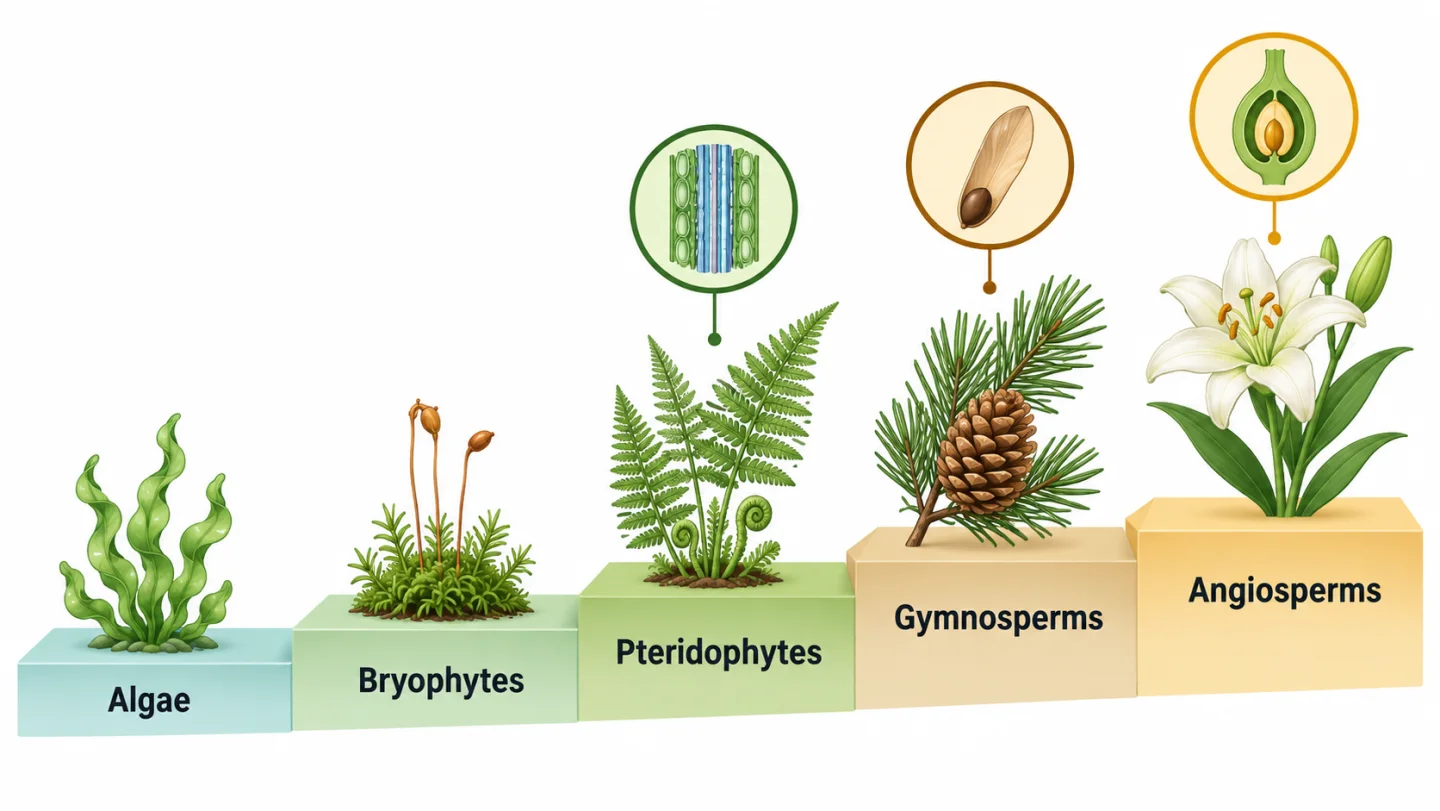
The trait staircase is not a ladder of living species
The five-group sequence is a revision device for comparing features, not a claim that a modern moss changes into a modern fern or that one living group is an unfinished version of another. Present-day lineages share ancestors and retain their own adaptations.
Use the staircase only to track diagnostic innovations such as vascular tissue, seeds and enclosed ovules. Then use the ploidy strip for life cycles. Keeping those two diagrams separate prevents an evolutionary comparison from being mistaken for an individual's developmental sequence.
Plant groups: the feature that changes the classification
Read from body plan to reproduction. The final column is the shortest reliable separator from the previous group.
| Plant group | Vascular system | Reproductive unit | Key separator |
|---|---|---|---|
| Algae | Absent | Spores or gametes; life cycles vary | Mainly aquatic thalloid body |
| Bryophytes | Absent | Spores; gametophyte dominant | Land plants with dependent sporophyte and no true vascular tissue |
| Pteridophytes | Present | Spores; sporophyte dominant | True vascular organs but no seeds |
| Gymnosperms | Present | Exposed ovules and naked seeds | Seed plant without an ovary or fruit |
| Angiosperms | Present | Ovules enclosed in ovary; seeds in fruit | Flowers and double fertilisation |
Bryophytes keep the gametophyte in the foreground
Bryophytes lack true vascular tissues and do not form seeds. Their gametophyte is the dominant, independent plant body. The sporophyte remains attached to and nutritionally dependent on the gametophyte. Rhizoids provide anchorage but should not be renamed true roots with vascular organisation.
Motile male gametes require a film of water to reach the egg, which explains the phrase 'amphibians of the plant kingdom' without implying that bryophytes are animals. Liverworts and mosses differ in body form and development, yet both retain the chapter's central pattern: dominant gametophyte, dependent sporophyte and water-dependent fertilisation.
Pteridophytes add vascular tissue but not seeds
Pteridophytes have true roots, stems and leaves with xylem and phloem. Their dominant plant body is the independent sporophyte, while spores develop into a smaller gametophyte called a prothallus. Fertilisation still generally requires water because the male gametes are motile.
Most pteridophytes are homosporous, but Selaginella and Salvinia are heterosporous, producing microspores and megaspores. Heterospory is important because the two spore types lead toward separate male and female gametophytes and retention of the female gametophyte. It is a step associated with the seed habit, not evidence that these pteridophytes already make seeds.
Gymnosperms package reproduction into pollen, ovules and naked seeds
Gymnosperms are vascular seed plants whose ovules are not enclosed by an ovary before fertilisation; their seeds are therefore described as naked. The dominant plant is the sporophyte, while highly reduced male and female gametophytes develop in association with cones or strobili. Pollen transfer reduces dependence on external water for the movement of male gametes to the female reproductive structure.
Gymnosperm roots, stems and leaves often show adaptations to their habitats. At the chapter level, remember the important conducting-tissue qualifications: xylem generally lacks vessels and phloem lacks companion cells, with named exceptions treated carefully. A cone is not a fruit, because fruit formation requires an ovary.
Angiosperms enclose ovules and link flowers to fruits
Angiosperms bear flowers, with ovules enclosed inside an ovary. After fertilisation, ovules become seeds and the ovary generally develops into a fruit. Double fertilisation produces a zygote and initiates endosperm formation through two different fusion events, a feature specific to flowering plants in this comparison.
Monocots and dicots can be separated by cotyledon number and a suite of vegetative and anatomical patterns, but no single loose observation should replace the whole comparison. The morphology and anatomy guides continue that analysis at organ and tissue level; the plant-kingdom guide is concerned first with the defining reproductive boundary of enclosed ovules and seeds.
Life cycles ask where meiosis and fertilisation change ploidy
In a haplontic cycle, the multicellular plant body is haploid and the zygote is the main diploid stage; meiosis restores haploid spores. In a diplontic cycle, the multicellular body is diploid and meiosis produces haploid gametes, which are the limited haploid phase. In a haplodiplontic cycle, both haploid gametophyte and diploid sporophyte are multicellular.
Do not infer the life cycle from size alone. Mark fertilisation as the transition from n to 2n and meiosis as the transition from 2n to n. Then identify which side grows by mitosis into a multicellular generation. This arrow method is steadier than memorising a circular diagram without ploidy labels.
Build a trait staircase and a ploidy strip
Draw five steps labelled algae, bryophytes, pteridophytes, gymnosperms and angiosperms. Add only the first major checkpoint that separates each step: differentiated land body, vascular tissue, seed, and enclosed ovule. Beside the staircase, mark the dominant generation for bryophytes and vascular plants.
For a second output, draw a straight strip from n to 2n and back to n. Place fertilisation over the upward change and meiosis over the downward change. Use the strip to explain one haplontic, one diplontic and one haplodiplontic example from the chapter. The aim is to reconstruct the logic, not to reproduce a textbook figure.
Common confusions to check
- Pteridophytes have vascular tissue but do not produce seeds.
- Gymnosperm ovules and seeds are not enclosed by an ovary, so cones are not fruits.
- Bryophyte gametophytes are dominant, whereas the conspicuous vascular-plant body is the sporophyte.
Editorial note and disclaimer
Written by: DongFeng. Published by: MedQGo. Last updated: September 22, 2026.
Disclaimer: This guide is a revision aid for NEET-UG aspirants and does not constitute medical advice. For clinical or health-related queries, consult a qualified medical professional.
References
Related revision guides
How to use this guide
Read the relevant NCERT chapter first. Then redraw the relationships or process described here from memory, compare your version with the textbook, and correct only the gaps. This is an independent revision aid, not official NCERT, NTA, or NEET material.