Excretion: organise the chapter as a flow
A reliable NEET revision route is to follow blood through the nephron: filtration at the glomerulus, selective reabsorption along the tubule, secretion of selected substances into tubular fluid, and final urine concentration in the collecting duct. Questions often test the sequence or ask which process explains a change in tubular fluid.
The kidney is not simply a filter that removes everything from blood. Useful substances and much of the water are selectively returned to circulation, while nitrogenous waste and excess ions are regulated through coordinated nephron processes.
Filtration at the renal corpuscle
The glomerulus is a capillary tuft within Bowman's capsule. Its filtration depends on pressure differences across the filtration membrane. The filtrate resembles plasma in many small solutes, but cells and most large plasma proteins normally remain in the blood.
When an option describes filtration, check whether it belongs to the glomerulus or a later tubule segment. Reabsorption is not filtration, and secretion is not the same as movement of a useful substance back into blood.
- Filtration: blood to Bowman's capsule.
- Reabsorption: tubular fluid to peritubular blood.
- Secretion: peritubular blood to tubular fluid.
- Excretion: removal of the final urine from the body.
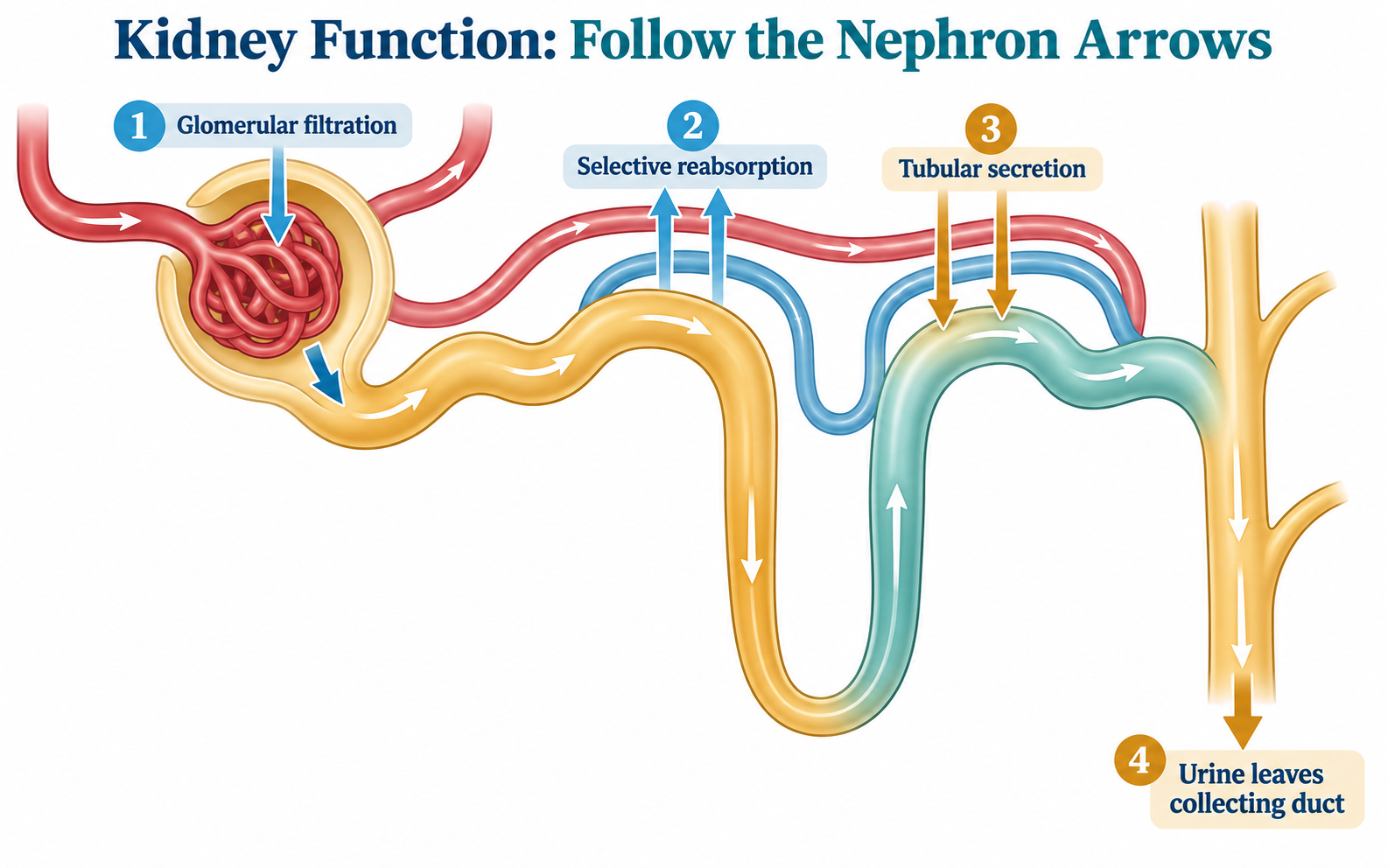
The nephron arrow test
Most kidney mix-ups disappear when you name the two spaces first, then draw the direction of movement.
- Filtration: blood in the glomerulus -> fluid in Bowman's capsule.
- Reabsorption: tubular fluid -> nearby blood, returning useful substances and water.
- Secretion: nearby blood -> tubular fluid, adding selected substances to the forming urine.
- Excretion is the final removal of urine from the body; it is not a substitute word for every nephron step.
Put arrows on every kidney fact
Kidney revision gets much cleaner when every process has an arrow. Filtration points from blood to capsule. Reabsorption points back to blood. Secretion points from blood into the tubule.
If you cannot draw the arrow, you probably do not own the concept yet. That is the moment to return to the nephron diagram instead of memorising another list blindly.
Nephron direction table
Kidney questions become easier when every word has a direction.
| Process | Direction | Main site or idea | Wrong turn |
|---|---|---|---|
| Filtration | Blood to Bowman's capsule | Glomerulus | Confused with reabsorption |
| Reabsorption | Tubule to blood | Useful substances return | Read as removal from body |
| Secretion | Blood to tubule | Selected substances added to filtrate | Treated as filtration |
| Excretion | Final urine leaves body | End result | Used for every earlier step |
Selective reabsorption and the nephron
The proximal convoluted tubule is central to bulk reabsorption. Later segments refine water and ion balance. The loop of Henle contributes to the medullary concentration gradient, while the distal tubule and collecting duct respond to the body's regulatory needs.
Antidiuretic hormone is a high-yield connection: it increases water reabsorption in the distal nephron and collecting ducts when the body needs to conserve water. Do not confuse this with a hormone that directly creates the initial glomerular filtrate.
What to separate in close options
- Urine formation versus urine storage: kidneys form urine; the urinary bladder stores it.
- Glomerular filtration versus tubular reabsorption: their directions are opposite.
- Osmoregulation versus removal of nitrogenous waste: both involve kidneys, but the question may ask for one specific role.
- Urea, uric acid and ammonia: identify the organismal context before selecting the major nitrogenous waste product.
- Hormonal control of water balance versus neural control of micturition.
A 15-minute revision method
Draw a nephron and label the direction of fluid flow. Beside each segment, write one main task rather than a long list: filtration, bulk reabsorption, gradient formation, fine regulation, or final concentration. Then answer a short set by naming the process before looking at the options.
For each error, record whether you mixed up a nephron segment, a direction of transport, or a regulatory hormone. That makes subsequent revision specific and prevents memorising answer letters without understanding the physiology.
Common confusions to check
- Filtration is blood to Bowman's capsule; reabsorption returns substances from tubule to blood.
- The urinary bladder stores urine; kidneys form it.
- ADH supports water conservation in the distal nephron and collecting ducts; it does not create the initial filtrate.
Keep filtration and excretion in different columns
Use a simplified substance account: excreted amount = filtered amount - reabsorbed amount + secreted amount, all measured over the same interval. If 100 arbitrary units enter the filtrate, 98 return to the blood and 3 are added from the blood to the tubule, the final amount in urine is 100 - 98 + 3 = 5 units. These are invented teaching values, not clinical measurements.
The wrong answer 2 ignores secretion. The wrong answer 201 adds all movements without considering direction. Reabsorption moves material from tubular fluid towards blood; secretion moves it into tubular fluid. Neither process means that filtration has happened a second time.
Next consider water regulation: greater ADH action can increase water reabsorption in responsive distal nephron segments, reducing water loss in urine. That is a change in tubular handling, not proof that more blood was filtered. Use the Urine Formation and Regulation of Kidney Function sections in the linked NCERT chapter to label each movement.
Editorial note and disclaimer
Written by: DongFeng. Published by: MedQGo. Last updated: September 30, 2026.
Disclaimer: This guide is a revision aid for NEET-UG aspirants and does not constitute medical advice. For clinical or health-related queries, consult a qualified medical professional.
References
Related revision guides
How to use this guide
Read the relevant NCERT chapter first. Then redraw the relationships or process described here from memory, compare your version with the textbook, and correct only the gaps. This is an independent revision aid, not official NCERT, NTA, or NEET material.