Endocrine control: map gland, hormone and target
Start this NEET chapter with a three-part map for every hormone: the gland or tissue that releases it, its major target, and its principal effect. Mixing up gland and effect is a frequent endocrine error, and this map gives you a quick way to catch it.
Endocrine glands are ductless: they release hormones into the surrounding fluid and then into blood, allowing signals to reach distant target tissues. That route is different from an exocrine gland, which sends a secretion through a duct. The pancreas is a useful reminder that one organ can have both roles: digestive secretions travel through ducts, while insulin and glucagon enter blood.
A hormone can travel widely without acting on every cell. A target cell responds because it has the appropriate receptor. When an option says a hormone affects every tissue equally, pause and check whether it has confused circulation with receptor-based response.
- Hypothalamus: links neural control with endocrine regulation.
- Pituitary: coordinates several endocrine glands, while also releasing hormones with direct effects.
- Thyroid, adrenal glands, pancreas and gonads: high-yield sources of hormones with distinct roles.
Feedback regulation is the central pattern
Many endocrine questions are best solved through negative feedback. When the level or effect of a regulated variable rises sufficiently, the stimulus for further hormone release is reduced. This keeps internal conditions within a useful range rather than allowing a response to increase without limit.
The word negative does not mean harmful. It means that the response counteracts the original change. Use the direction of the loop, not a memorised phrase: ask what changes first, what signal responds, and what result feeds back to the control centre. Positive feedback is an exception used in specific physiological situations, so do not label every hormone sequence as positive feedback.
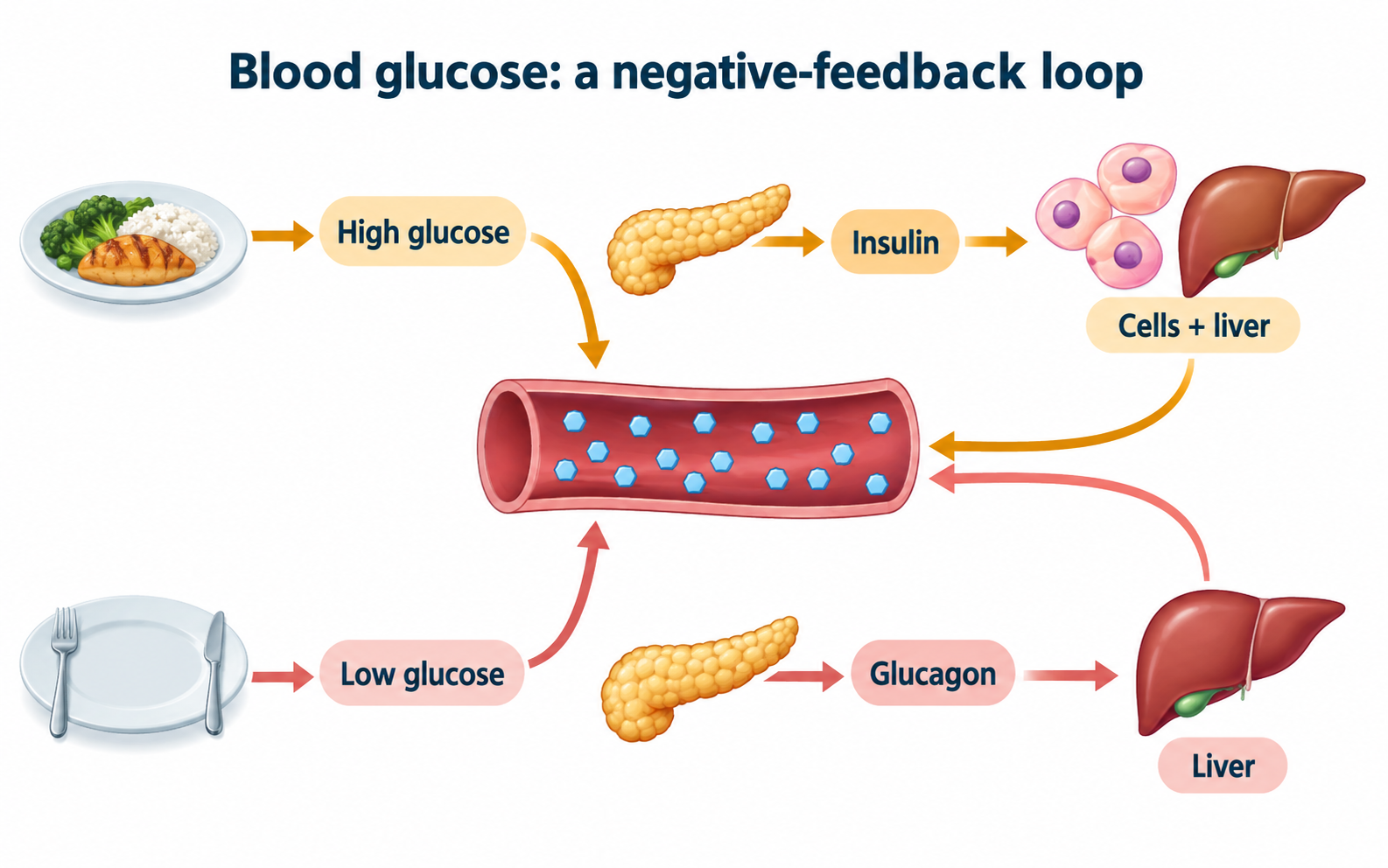
Feedback direction: use the arrow test
A hormone name can look familiar while the direction is wrong. Before accepting an option, say the full sequence aloud and check which change comes next.
- High blood glucose -> insulin release -> uptake and storage of glucose -> blood glucose falls toward its usual range.
- Low blood glucose -> glucagon release -> liver mobilises stored glucose -> blood glucose rises toward its usual range.
- ADH and oxytocin are synthesised in the hypothalamus and stored and released from the posterior pituitary. A shared release site does not mean a shared function.
- Peptide hormones such as insulin act through cell-surface receptors, whereas steroid hormones can enter target cells and act through intracellular receptors.
The three-column rule for hormone questions
In close endocrine options, a real hormone is often paired with the wrong gland or the wrong effect. That is why the three-column rule matters.
For every hormone, force yourself to fill three columns: source, target, effect. If one column is missing, the answer looks right but is wrong. This is especially useful for pituitary questions because the pituitary sits inside several control lines.
A neat example is ADH and oxytocin. Both are released from the posterior pituitary, but they do completely different jobs. The posterior pituitary stores and releases them; it does not make them. They are synthesised in the hypothalamus.
Endocrine quick-reference table: source, action and mix-up
Read each row across. Most close endocrine options keep three facts correct and swap the remaining source, action, or control relationship.
| Source | Hormone or signal | NEET-level action | Quick distinction |
|---|---|---|---|
| Hypothalamus | Regulatory hormones; synthesises ADH and oxytocin | Links neural input with endocrine control | The posterior pituitary releases ADH and oxytocin but does not synthesise them |
| Anterior pituitary | TSH | Stimulates thyroid activity | TSH is a tropic signal; it is not thyroid hormone |
| Posterior pituitary | ADH | Increases water reabsorption when conservation is needed | ADH is not a blood-glucose hormone and is distinct from oxytocin |
| Thyroid | Thyroxine | Supports metabolic regulation and normal development | Do not give thyroxine the calcium-regulation role of calcitonin |
| Parathyroid glands | Parathyroid hormone | Raises blood calcium in the relevant physiological context | Parathyroid glands are not the thyroid; PTH and calcitonin act in opposing directions |
| Pancreatic beta cells | Insulin | Helps lower blood glucose through uptake and storage | The direction is opposite to glucagon |
| Pancreatic alpha cells | Glucagon | Raises blood glucose by mobilising stored reserves | Glucagon is not released to lower blood glucose |
| Adrenal medulla | Adrenaline | Supports a rapid emergency response | Do not confuse medullary adrenaline with steroid hormones of the adrenal cortex |
| Gonads | Sex hormones | Support reproductive functions and participate in feedback relationships | Separate a gonadal hormone from pituitary gonadotropins such as FSH and LH |
Thyroid, pancreas and adrenal connections
Thyroid hormones help regulate basal metabolic activity and support normal development. Iodine availability is an important NCERT connection because the thyroid needs iodine to synthesise thyroid hormones. When calcitonin and thyroxine appear together, read the hormone name before matching an effect: sharing a thyroid location does not give them the same job.
The endocrine pancreas regulates blood glucose. Insulin lowers blood glucose by supporting uptake and storage processes, whereas glucagon raises it by mobilising stored reserves. The adrenal medulla drives rapid emergency responses, while the adrenal cortex releases a different group of steroid hormones.
- Insulin and glucagon act in opposing directions on blood glucose regulation.
- Adrenaline prepares the body for an acute emergency response; it is not a digestive hormone.
- A gland can release more than one hormone, so match the exact hormone before choosing an effect.
Growth, reproduction and water balance
Growth hormone supports normal growth and metabolism, but it should not be confused with thyroxine, insulin or sex hormones merely because each can influence growth-related outcomes. In a question, identify whether the wording points to skeletal growth, metabolic rate, blood glucose, or reproductive function.
For water balance, antidiuretic hormone increases water reabsorption in the kidney when conservation is needed. Oxytocin is a separate high-yield hormone with roles in childbirth and milk ejection. Similar names or a shared pituitary connection do not mean identical targets or effects.
The hypothalamus and pituitary: read the control hierarchy
The hypothalamus connects nervous-system input with endocrine control. It releases regulatory signals that influence the anterior pituitary, while the posterior pituitary releases hormones made in the hypothalamus and transported to it. This is the key split to check whenever ADH or oxytocin appears under a pituitary heading: the posterior pituitary releases them, but does not synthesise them.
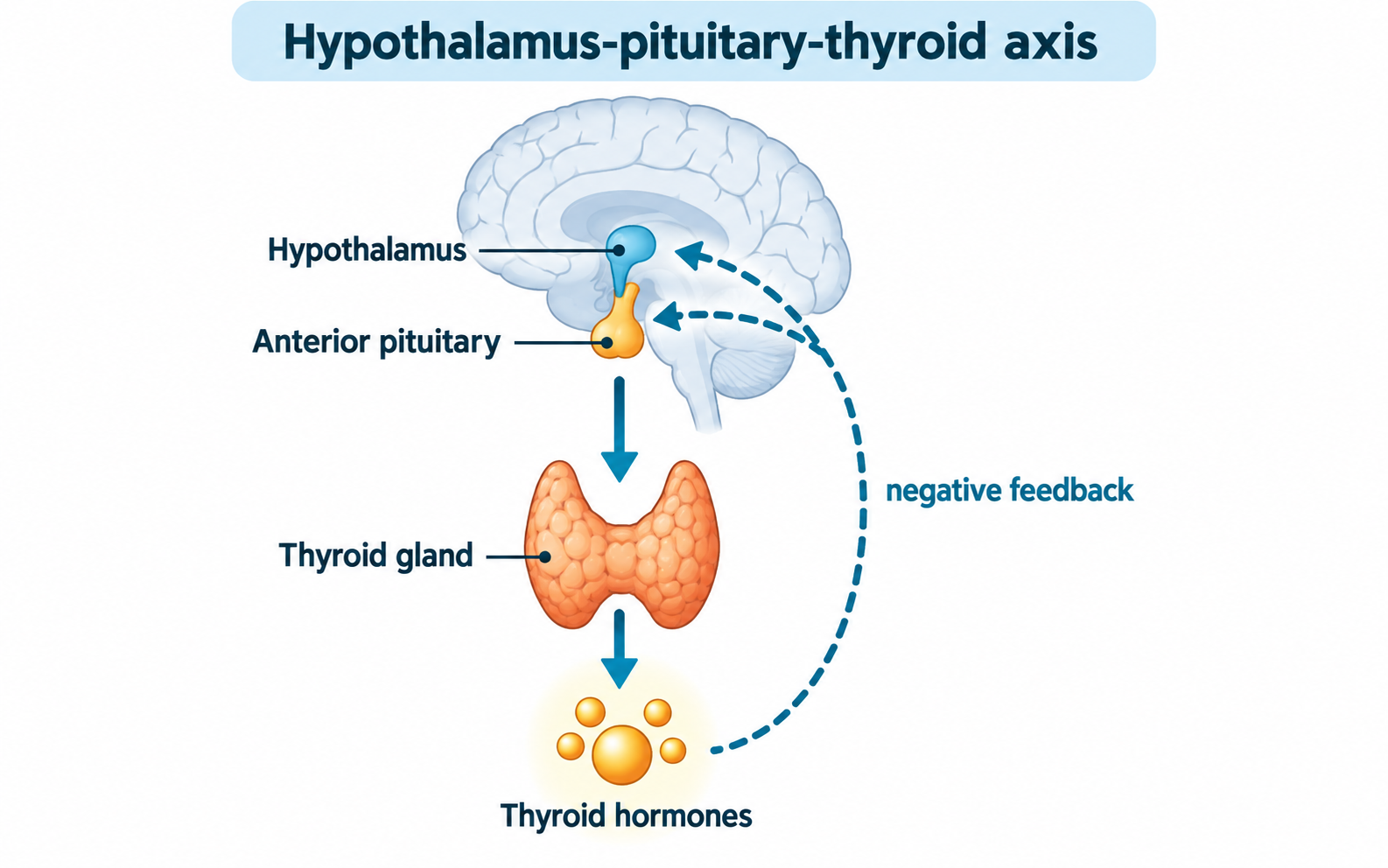
The anterior pituitary releases several hormones that control growth, thyroid activity, adrenal cortex activity and gonadal function. The safer revision method is not to memorise a long isolated list. Instead, draw a control line from hypothalamus to pituitary to target gland, then draw the feedback arrow back. This explains why the same system coordinates several distant organs without every hormone acting on every tissue.
- Control centre: receives information and sends a regulatory signal.
- Tropic hormone: influences another endocrine gland.
- Target gland: releases a hormone that produces a downstream physiological effect.
- Negative feedback: a sufficient downstream effect reduces further stimulation in the control pathway.
Calcium balance and reproductive hormones: separate the comparisons
Calcium regulation is a useful example of why the source, trigger and effect must be kept together. Calcitonin can lower blood calcium in the relevant physiological context. Parathyroid glands release parathyroid hormone to raise blood calcium. Similar gland names do not mean the hormones do the same job.
Reproductive hormones also work through coordinated relationships rather than one hormone-one-event slogans. Gonadotropins influence gonadal activity, while gonadal hormones drive reproductive function and feed back to the pituitary. For revision, first decide whether a statement concerns a controlling hormone, a gonadal hormone, or a physical response. That keeps a pituitary hormone from being placed where a gonadal hormone belongs.
Three self-checks before you close the chapter
Use these as retrieval prompts, not as another list to reread. Cover the table and complete each answer from memory before checking the guide or NCERT.
- Draw one negative-feedback loop from a control centre to a target gland and back. Label the direction of every arrow.
- Write one sentence that separates endocrine secretion from exocrine secretion, then use the pancreas as your example.
- Choose one hormone pair with opposing effects and explain what happens when the regulated variable moves in each direction.
A 15-minute revision method
Set a 15-minute timer. In the first five minutes, draw four columns labelled gland, hormone, target and effect, then fill the cells from memory. The blank cells are the first facts to revisit. In the next five minutes, check the NCERT chapter and rewrite only the cells that were missing or wrong.
Use the final five minutes for two arrows: high blood glucose to insulin to uptake and storage, then low blood glucose to glucagon to liver mobilisation. Add one control line from hypothalamus to anterior pituitary to thyroid, then draw feedback toward the control centres. Label each error as a gland mismatch, hormone-effect mismatch, or feedback-direction error. Once you can name the pattern, the chapter becomes much easier to revise.
Common confusions to check
- The posterior pituitary releases ADH and oxytocin; the hypothalamus synthesises them.
- Peptide hormones such as insulin and ADH act through cell-surface receptors, whereas steroid hormones can act through intracellular receptors.
- Growth hormone, thyroxine, and insulin should be separated by the specific effect named in the statement.
Trace the feedback arrow after thyroid hormone rises
Consider a simplified intact hypothalamus-pituitary-thyroid axis. TRH stimulates pituitary TSH release, and TSH stimulates thyroid hormone production. If thyroid hormone rises while the feedback system remains responsive, its inhibitory effect on the hypothalamus and pituitary tends to reduce further stimulation. The prediction is reduced drive, not an ever-increasing release of TSH.
The wrong explanation 'thyroid hormone raises TSH because both belong to the same pathway' confuses a stimulatory forward arrow with an inhibitory return arrow. Write the sign beside each connection before predicting the next change. This is a control-system exercise; it cannot be used to interpret a person's laboratory results or diagnose a condition.
In NCERT's Chemical Coordination and Integration chapter, relate this example to feedback regulation and the pituitary-thyroid relationship. As a separate distinction, explain why ADH release from the posterior pituitary does not mean ADH is synthesised there: the hypothalamic neurons supply it.
Editorial note and disclaimer
Written by: DongFeng. Published by: MedQGo. Last updated: September 30, 2026.
Disclaimer: This guide is a revision aid for NEET-UG aspirants and does not constitute medical advice. For clinical or health-related queries, consult a qualified medical professional.
References
Related revision guides
How to use this guide
Read the relevant NCERT chapter first. Then redraw the relationships or process described here from memory, compare your version with the textbook, and correct only the gaps. This is an independent revision aid, not official NCERT, NTA, or NEET material.