Read the chapter as a route, not a list of terms
A nerve impulse follows a physical route: a receptor detects a change, a neuron carries the signal, a synapse passes it to the next cell, and an effector produces a response. When a revision prompt feels crowded with terms such as dendrite, axon, synapse and receptor, first ask where in that route the event is taking place.
The neuron is specialised for receiving, conducting and passing on information. Dendrites mainly receive signals toward the cell body, while the axon carries impulses away from it. This is a directional idea, so it is more useful than trying to memorise a diagram as a picture.
Resting potential and the travelling impulse
At rest, the neuronal membrane has an electrical difference across it because ions are distributed unequally. A stimulus strong enough to reach threshold changes membrane permeability and produces depolarisation. The important exam point is the sequence: resting state, depolarisation, recovery of the original state, then readiness for another impulse.
An impulse does not travel because one end of the neuron is permanently charged. Each adjacent portion of membrane is stimulated in turn. In a myelinated fibre, conduction is faster because the impulse effectively jumps between nodes of Ranvier rather than being regenerated continuously along every small section of membrane.
- Threshold: the minimum effective stimulus needed to initiate an action potential.
- Depolarisation: the membrane becomes less negative as ion movement changes the potential difference.
- Repolarisation: the membrane returns toward its resting state after the impulse.
- Myelin increases the speed of conduction; it does not create the impulse itself.
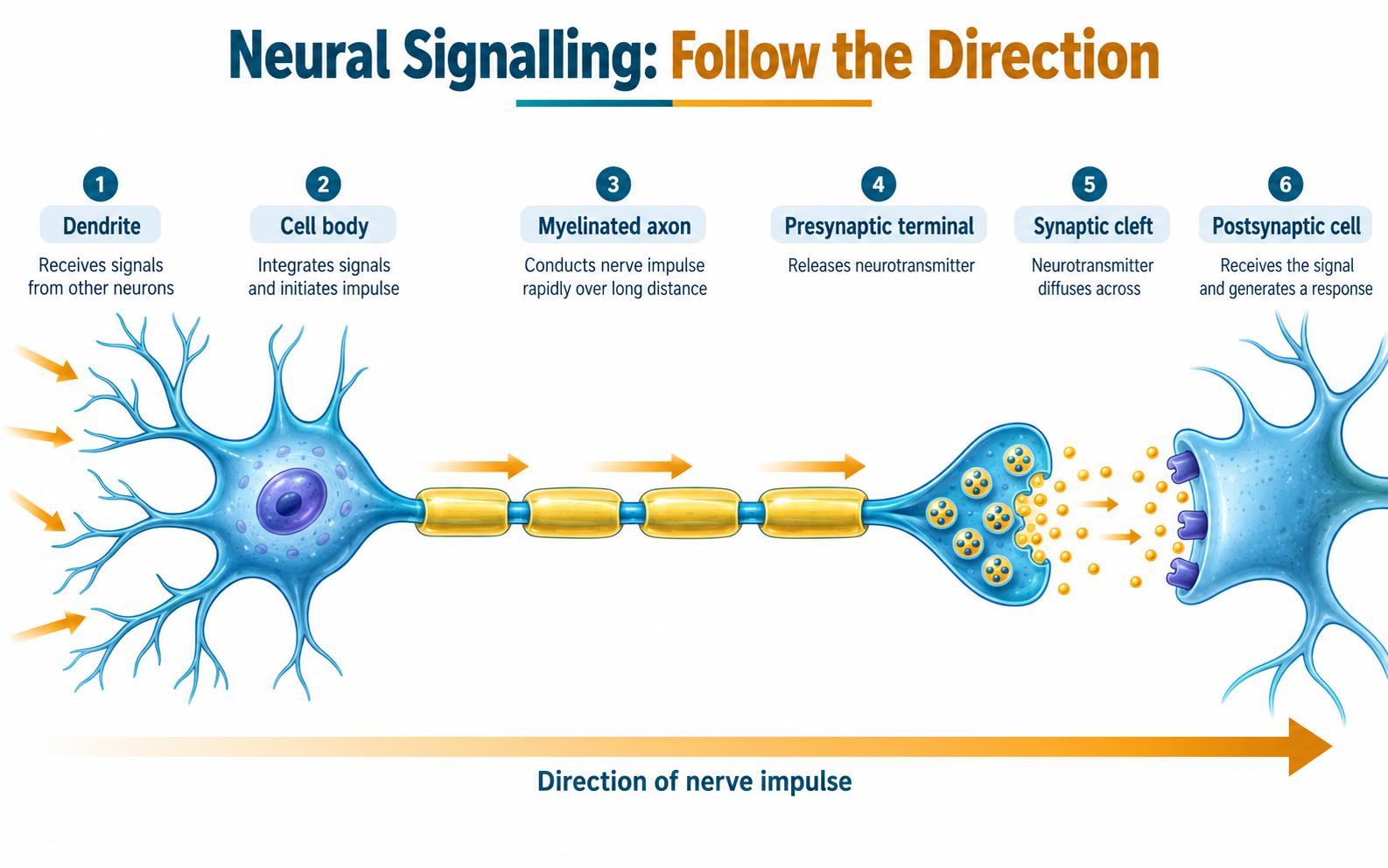
Signal direction: use one continuous route
A diagram becomes easier to remember when every part answers one question: where did the signal come from, where does it go next, and what changes form at the synapse?
- Dendrites receive inputs toward the cell body; the axon carries an impulse away from it.
- Depolarisation and recovery are successive changes of membrane state, not two names for the same instant.
- At a chemical synapse, the presynaptic side releases neurotransmitter and the postsynaptic side carries the corresponding receptors.
- In a reflex arc, the receptor detects the stimulus and the effector carries out the response; neither role belongs to the other.
The route is the memory aid
Neuron vocabulary looks heavy until you treat it as a journey. Signal arrives, moves along the neuron, crosses a synapse, and produces a response.
Once the journey is fixed, dendrite and axon stop being random names. One receives; the other carries away.
Nerve signal route table
This chapter is a route map. If the route is clear, the vocabulary becomes much less scary.
| Part | Role | Direction | Common mistake |
|---|---|---|---|
| Dendrite | Receives signal | Toward cell body | Swapped with axon |
| Axon | Conducts impulse | Away from cell body | Treated as receptor |
| Synapse | Passes signal to next cell | Presynaptic to postsynaptic | Called a direct wire |
| Effector | Produces response | After motor neuron | Confused with receptor |
At the synapse, the signal changes form
Most NEET questions use the chemical synapse model. When an impulse reaches the presynaptic terminal, neurotransmitter is released into the synaptic cleft. It binds receptors on the postsynaptic membrane and can start a new electrical change in the next neuron or target cell.
The synaptic cleft is not a direct electrical wire. This is why chemical synapses normally pass information in one direction: neurotransmitter is released from the presynaptic side and the relevant receptors are concentrated on the postsynaptic side. Keep the names of the two sides separate in close options.
Reflex action: fast does not mean unconscious at every stage
A reflex action is a quick, automatic response to a stimulus. In a simple reflex arc, sensory neurons carry information to the spinal cord, an interneuron may link the pathway, and motor neurons carry the response to an effector. The body can become aware of the event, but the rapid protective response does not wait for a deliberate decision from the cerebrum.
Questions often confuse the receptor with the effector. The receptor detects the stimulus; the effector, such as a muscle or gland, carries out the response. Draw one arrow from stimulus to receptor and another from motor neuron to effector before choosing an answer.
A short revision routine before practice
Sketch a neuron and a synapse from memory, then add arrows showing information flow. On a second line, write only four steps for a reflex arc: receptor, sensory neuron, central connection, motor neuron and effector. Finally, explain why a myelinated axon is faster without using the word 'faster' as the explanation itself.
When you miss a question, sort the error into one of three groups: direction of signal flow, ionic change at the membrane, or role of a structure. The pattern usually becomes obvious after a few questions and tells you exactly what to revise from NCERT.
Common confusions to check
- Dendrites mainly receive signals; axons carry impulses away from the cell body.
- A chemical synapse is a directional signalling junction, not a direct electrical wire.
- A receptor detects a stimulus; an effector produces the response.
Locate the step that makes a chemical synapse directional
An impulse reaches an axon terminal and triggers neurotransmitter release from vesicles. The transmitter crosses the cleft and binds to receptors on the postsynaptic membrane. The receiving membrane's response depends on the receptor and channels involved; transmitter binding is not a guarantee that a new action potential will occur.
Now test the claim 'the same electrical impulse simply jumps across the chemical synaptic cleft'. The gap is crossed by a chemical messenger. Electrical activity before and after the cleft belongs to two membranes, with release and receptor binding between them. The usual direction follows the location of presynaptic release machinery and postsynaptic receptors.
NCERT's Neural Control and Coordination distinguishes chemical from electrical synapses. Explain the chemical route first, then state why a direct current path at an electrical synapse is a different mechanism. Do not extend one synapse's description to every neural junction.
Editorial note and disclaimer
Written by: DongFeng. Published by: MedQGo. Last updated: September 30, 2026.
Disclaimer: This guide is a revision aid for NEET-UG aspirants and does not constitute medical advice. For clinical or health-related queries, consult a qualified medical professional.
References
Related revision guides
How to use this guide
Read the relevant NCERT chapter first. Then redraw the relationships or process described here from memory, compare your version with the textbook, and correct only the gaps. This is an independent revision aid, not official NCERT, NTA, or NEET material.