A change in food can change transcription without changing DNA
An E. coli cell does not need to acquire a new set of genes each time its surroundings change. It can alter how strongly an existing set is transcribed. The lac system is a useful way to reason about that distinction: the DNA instructions remain, while a protein's interaction with a control region changes. Follow the binding events before memorising the names z, y and a.
This guide concentrates on the negative-control model in NCERT Class 12 Biology, Chapter 5, section 5.8.1. Its central question is whether the repressor can occupy the operator and restrict transcription. That question is narrower than asking whether the cell is producing the greatest possible amount of the enzymes. The difference matters when glucose enters the discussion.
Separate the DNA address from the protein that visits it
The promoter and operator are regions of DNA. RNA polymerase recognises the promoter to initiate transcription; the repressor interacts with the operator. The regulatory i gene encodes the repressor protein. Neither the operator nor the promoter is a small protein that travels along the chromosome. The names describe different kinds of objects, even though a compact operon drawing places them close together.
With an active repressor bound, transcription of the structural genes is strongly restricted. When the inducer binds the repressor, it changes the protein's ability to bind the operator. The operator has not vanished, and the structural genes have not been rebuilt. An occupied regulatory site can become available because a binding partner has changed state. In the figure, compare the repressor's location before interpreting the arrow.
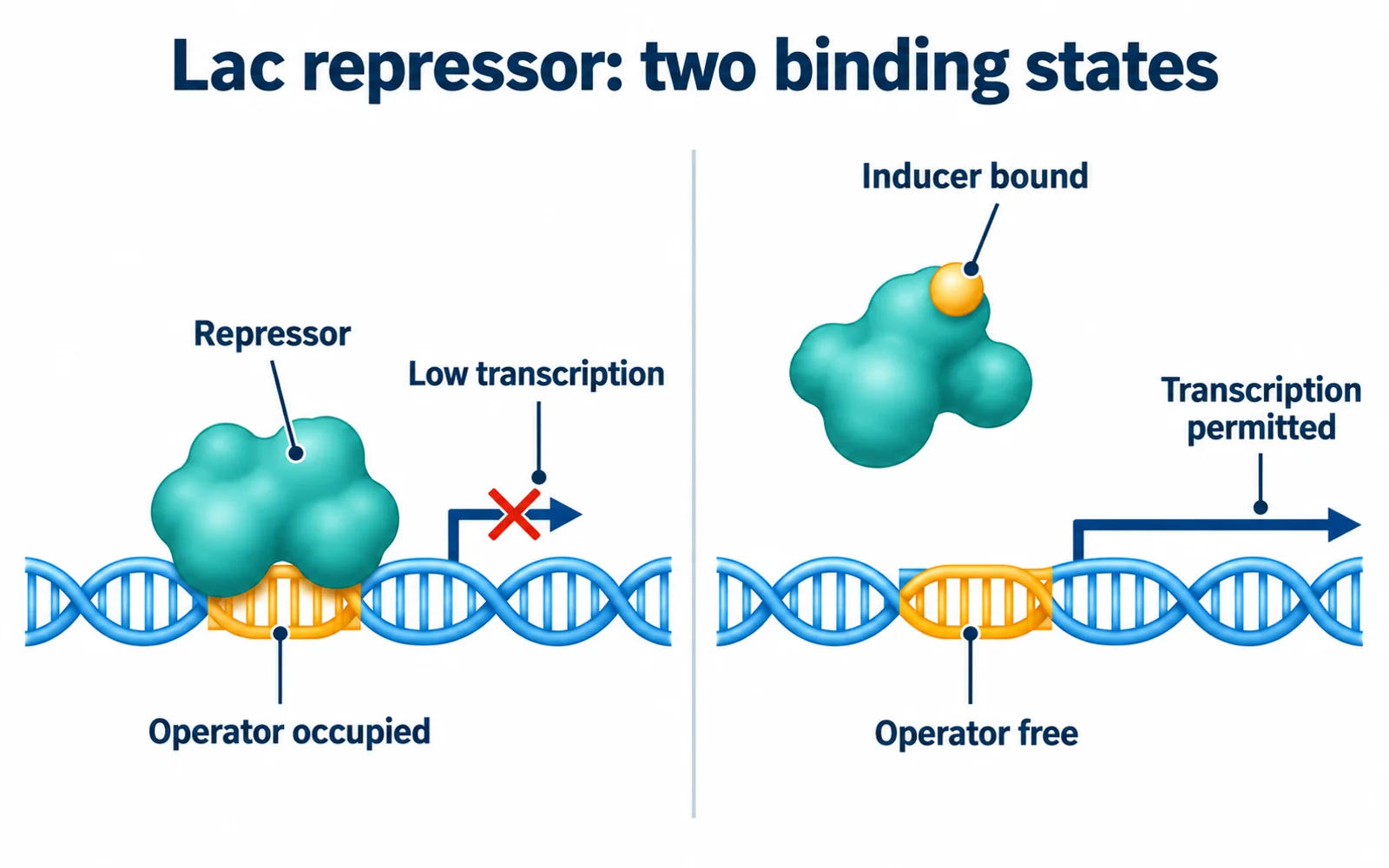
A switch diagram needs a named binding partner
Try erasing the words on and off from your sketch. Can the picture still tell you which molecule binds DNA and which molecule binds that protein? If it cannot, redraw those interactions. The useful simplification is the binding relationship; a switch icon alone hides the mechanism you need to explain.
Which component interacts with which?
Read across to keep DNA sites, regulatory molecules and enzyme products in separate categories.
| Component | Kind of object | Immediate interaction or task |
|---|---|---|
| Promoter | DNA region | Recognised by RNA polymerase for transcription initiation |
| Operator | DNA region | Binding site for the lac repressor |
| Repressor | Protein encoded by i | Operator binding restricts structural-gene transcription |
| Allolactose | Small inducer molecule | Binds repressor and reduces operator binding |
| Beta-galactosidase | Protein encoded by z | Hydrolyses lactose; not the membrane transport protein |
| Permease | Protein encoded by y | Supports beta-galactoside entry; not the operator-binding protein |
| Transacetylase | Protein encoded by a | A distinct structural-gene product, not the repressor |
What z, y and a contribute after the gate opens
The structural genes share transcriptional control, but their products do different jobs. The z product, beta-galactosidase, hydrolyses lactose into glucose and galactose. The y product, permease, supports entry of beta-galactosides into the cell. The a product is transacetylase. Keep that last name attached to a rather than inventing an additional lactose-cutting step for it.
A polycistronic RNA contains information for more than one polypeptide. It is not one giant enzyme with three alternative names. Think of the distinction as one transcriptional message containing several coding regions. Translation can produce different proteins from those regions. The comparison table sorts the system by object and direct interaction, because a list of letters alone does not reveal what can bind what.
Permease also helps explain why transport and chemical breakdown should not be merged. Entry changes where a molecule is available. Hydrolysis changes its chemical structure. A defect in either process could interfere with lactose use, but the immediate failed step would be different. Naming that step is more informative than saying only that the operon is not working.
Lactose in the textbook, allolactose at the binding step
NCERT presents lactose as the inducer in its explanatory model. At the more specific biochemical level, allolactose, formed from lactose, is the physiological molecule that binds the lac repressor. The supplementary OpenStax source makes this distinction explicit. Keep the school-level signal and the immediate binding molecule on different lines of the same explanation rather than treating the descriptions as unrelated pathways.
Induction does not mean the inducer attaches to the operator and pushes a protein away mechanically. It acts through the repressor. Nor does induction mean the regulatory gene stops existing. The change being modelled is reversible protein binding. Basal expression supplies small amounts of relevant proteins, so a strongly repressed state should not be imagined as an absolute, permanent absence of every molecule needed to respond.
An invented binding experiment: predict the failed step
Consider two hypothetical preparations with identical operator DNA and functional transcription machinery. Preparation A contains an ordinary repressor. Preparation B contains a modified repressor that still binds the operator but cannot bind the inducer. Assume the inducer is supplied directly and all other conditions are held constant. This is a reasoning exercise, not a reported experiment or an examination question.
Before inducer is supplied, both repressors can occupy the operator. After it is supplied, A can lose operator occupancy because its repressor responds to the inducer. B remains repressive under the stated assumptions: adding more signal cannot repair the missing signal-binding ability. The discriminating observation is the response to inducer, not merely the presence of the repressor gene.
Now test the tempting explanation 'B must have deleted z, y and a.' Nothing in the setup says those coding regions are missing. The predicted problem lies upstream, in regulatory response. A second wrong explanation is 'the inducer will bind operator DNA instead.' That substitutes the wrong target. Resolve both by writing two pairs: repressor-operator and inducer-repressor.
For a separate hypothetical case, change only the operator so that it cannot bind the ordinary repressor. The negative-control block would be lost even without inducer. This does not establish maximum expression under every nutrient condition. It identifies the consequence of one altered interaction while leaving other controls outside the simplified experiment.
Permitted transcription is not automatically maximum transcription
Glucose availability supplies another layer of regulation. The broader account includes cAMP and CAP, which help promote strong transcription when glucose is scarce. Lactose-derived induction relieves repression; low-glucose signalling supports activation. The two conditions answer different questions. For the NCERT negative-control model, keep attention on repression and induction; use the second layer only to avoid an absolute claim about expression strength.
A statement such as 'lactose present means maximum enzyme production' skips this qualification. A more defensible statement is that an effective inducer reduces lac-repressor binding to the operator. That says exactly which link changed and does not pretend that every other influence has been measured.
Explain induction with five verbs
On a blank page, use encodes, binds, restricts, changes and permits. Construct a short account starting with the regulatory gene and ending with structural-gene transcription. Check that each verb has a physical subject: DNA encodes a protein, a protein binds a DNA region, and an inducer changes the repressor's binding behaviour.
Then cover the text and solve the modified-repressor example again. Your answer should name the unchanged operator, the defective inducer-binding step and the predicted persistence of repression. Finally distinguish permease-mediated entry from beta-galactosidase-mediated breakdown. If you can do these tasks without replacing every component with the word 'switch', the mechanism is secure.
Common confusions to check
- The operator is DNA, not the repressor protein.
- Induction changes regulatory binding; it does not create new structural genes.
- Relief of repression alone does not establish maximum transcription.
Editorial note and disclaimer
Written by: DongFeng. Published by: MedQGo. Last updated: October 1, 2026.
Disclaimer: This guide is a revision aid for NEET-UG aspirants and does not constitute medical advice. For clinical or health-related queries, consult a qualified medical professional.
References
Related revision guides
How to use this guide
Read the relevant NCERT chapter first. Then redraw the relationships or process described here from memory, compare your version with the textbook, and correct only the gaps. This is an independent revision aid, not official NCERT, NTA, or NEET material.