Recombinant DNA is a controlled sequence, not a single tool
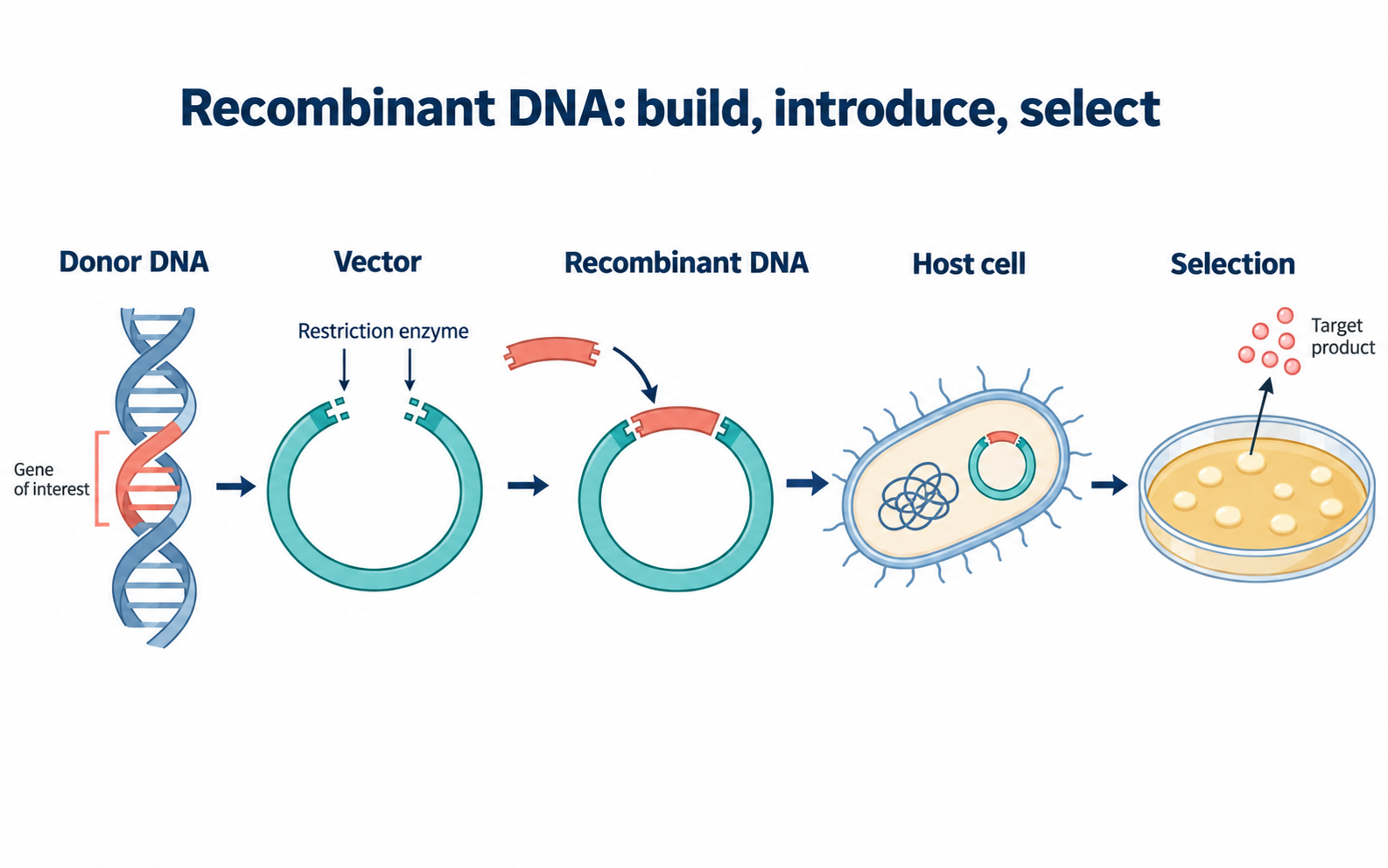
The core idea is to join a chosen DNA fragment with a vector so that the combined DNA can enter a suitable host cell and be copied or expressed. Each tool has one job in the sequence: isolate or prepare DNA, cut at a recognised sequence, join compatible fragments, introduce the construct into a host, and identify cells carrying the desired construct.
Calling every enzyme a restriction enzyme hides the workflow. Restriction endonucleases cut DNA at specific recognition sequences. DNA ligase joins DNA fragments by forming phosphodiester bonds. A vector carries the insert into a host; it is not the host cell itself.
Match the molecular tool to the change it makes
A plasmid is a commonly used vector because it can carry an inserted DNA fragment and replicate in an appropriate bacterial host. When both donor DNA and vector are cut to make compatible ends, the desired fragment can be inserted and ligated to produce recombinant DNA.
An inserted fragment is not automatically present in every host cell. Transformation introduces DNA into host cells, while selection and screening help distinguish cells likely to carry the intended recombinant molecule. This distinction matters: introducing DNA, selecting a transformed cell, and checking the insert are separate stages.
The one-verb workflow
Pair a component with an action to avoid mixing adjacent stages of the process.
- Restriction endonuclease cuts at recognised DNA sequences.
- Ligase joins compatible DNA fragments.
- Vector carries the insert into a host cell.
- Selection and screening distinguish useful transformants from other cells.
One verb per tool keeps the workflow honest
Restriction endonuclease cuts. Ligase joins. A vector carries. A host cell receives and copies. Selection identifies useful cells. When an option gives one of these components a neighbour's action, the error is easier to see than if the tools are memorised as a list.
The workflow also protects against a common overstatement: a cell that has received DNA has not necessarily been shown to carry the intended construct. That is why selection and screening have their own place.
Recombinant DNA workflow: tool, action, checkpoint
The terms are most useful when attached to an action in the workflow rather than learned as a flat list.
| Step | Main tool or component | What happens | Common wrong substitution |
|---|---|---|---|
| Prepare DNA | Restriction endonuclease | Cuts DNA at recognised sequences | DNA ligase |
| Build construct | Vector plus insert and ligase | Insert is joined into carrier DNA | Host cell acting as vector |
| Introduce DNA | Host cell | Recombinant DNA enters a suitable cell | Selection treated as introduction |
| Identify useful cells | Selectable marker or screening step | Desired transformants are distinguished | Assuming every host contains the insert |
| Recover output | Downstream processing | Useful product is separated and purified | Initial DNA cutting |
From host cell to product: copy first, then consider expression
Once a suitable host has taken up the recombinant DNA, the host can multiply the construct along with its own cells. This cloning stage provides many copies of the DNA. If the goal is a gene product, expression depends on the construct and host being arranged so that the inserted gene can be used by the host machinery.
Downstream processing refers to recovering and purifying a useful product after it has been produced. It is not the same as cutting and ligating DNA at the beginning of the workflow. Read whether the wording asks about construction, host introduction, selection, multiplication, or product recovery.
A workflow recall routine
Draw five boxes from left to right: donor DNA, vector, recombinant DNA, host cell, and selected clone or product. Between donor DNA and vector, add restriction endonuclease; between prepared pieces and recombinant DNA, add ligase. Do not add a tool unless you can state its action in one verb.
For a final check, cover the labels and reconstruct the route. Then answer: What carries an insert? What joins DNA fragments? What step puts recombinant DNA into a cell? What happens after a cell carrying the right construct has been identified? This is a process map, not a list of buzzwords.
Common confusions to check
- Restriction endonuclease cuts DNA; DNA ligase joins fragments.
- A vector carries the insert; it is not the host cell that receives the construct.
- Transformation, selection, screening, and downstream processing are different workflow stages.
A selected colony is evidence of a marker, not proof of an insert
In an invented paper model, a plasmid carries an antibiotic-resistance marker outside its cloning site. Two candidate plasmids retain that marker: one has the intended insert and one has closed again without the insert. If either enters a suitable susceptible host and the marker functions, its host can survive the matching selection condition. Survival alone does not distinguish the two plasmids.
The incorrect conclusion is 'every selected colony contains the desired recombinant DNA'. The selection asks whether the relevant marker is functional, while a separate screen must distinguish the insert-bearing construct from the empty vector. This model assumes that the insert does not disrupt the resistance marker; insertional inactivation changes the logic and must be stated explicitly.
Connect this distinction to Cloning Vectors and Insertional Inactivation in NCERT's Biotechnology: Principles and Processes. The broader process guide covers the full production sequence; here the useful output is a narrower evidence statement: what did this selection establish, and what remains untested? This is a conceptual comparison, not a laboratory protocol.
Editorial note and disclaimer
Written by: DongFeng. Published by: MedQGo. Last updated: September 30, 2026.
Disclaimer: This guide is a revision aid for NEET-UG aspirants and does not constitute medical advice. For clinical or health-related queries, consult a qualified medical professional.
References
Related revision guides
How to use this guide
Read the relevant NCERT chapter first. Then redraw the relationships or process described here from memory, compare your version with the textbook, and correct only the gaps. This is an independent revision aid, not official NCERT, NTA, or NEET material.