Classification starts with a combination of clues
Animal diversity is too large for one familiar feature to organise reliably. Colour, habitat and size can describe an organism, but they do not set out the shared structural plan used in the NCERT overview. A useful classification begins by asking how cells are arranged, whether a body has a plane of symmetry, what lies between its body wall and gut, and whether segmentation or a notochord is present.
This is a guide to the comparison logic behind the phyla, not a catalogue of every species. By the end, you should be able to explain why two animals can both be multicellular yet belong on different branches of a classification key, and why a single feature rarely gives a final answer.
The level of organisation asks how work is divided
All animals are multicellular, but their cells are not arranged with the same degree of division of labour. Sponges show a cellular level of organisation: their cells form loose groupings rather than true tissues. Cnidarians show a tissue level, in which similar cells work together. In more complex animals, tissues combine into organs, and organs can coordinate as organ systems.
The sequence cellular, tissue, organ, organ system describes increasing integration. It is not a ladder of moral value or a rule that every body function becomes more efficient in exactly the same way. The question is what structural unit carries a named function. A stomach is an organ, whereas digestion is carried out by an organ system with associated structures.
A quick correction: a multicellular animal is not automatically at organ-system level. If an option only tells you that it is multicellular, there is not enough information to place its level of organisation.
A phylum answer needs two checks
Before settling on a phylum, state two independent supporting features. This small discipline prevents a familiar feature such as radial symmetry, segmentation or an exoskeleton from doing more classificatory work than it can.
Do not let one criterion answer another
Each row asks a different anatomical or developmental question.
| Criterion | What it describes | Useful comparison | Wrong shortcut |
|---|---|---|---|
| Level of organisation | How cells cooperate | Cellular, tissue, organ or organ system | All multicellular animals have organ systems |
| Symmetry | Planes that create matching halves | Asymmetrical, radial or bilateral | Bilateral means coelomate |
| Germ layers | Primary embryonic layers | Diploblastic or triploblastic | Third layer is a body cavity |
| Body cavity | Cavity and its mesodermal lining | Acoelomate, pseudocoelomate or coelomate | Any internal space is a coelom |
| Notochord | Supportive chordate feature | Chordates at some stage | Only vertebrates have a notochord |
Symmetry is a plane test, not a label for body complexity
An asymmetrical body cannot be split into equal halves by any plane through its centre; many sponges fit this description. Radial symmetry permits similar halves through more than one plane around a central axis, as in many cnidarians and adult echinoderms. Bilateral symmetry produces matching right and left halves through one plane and is common in many animal phyla.
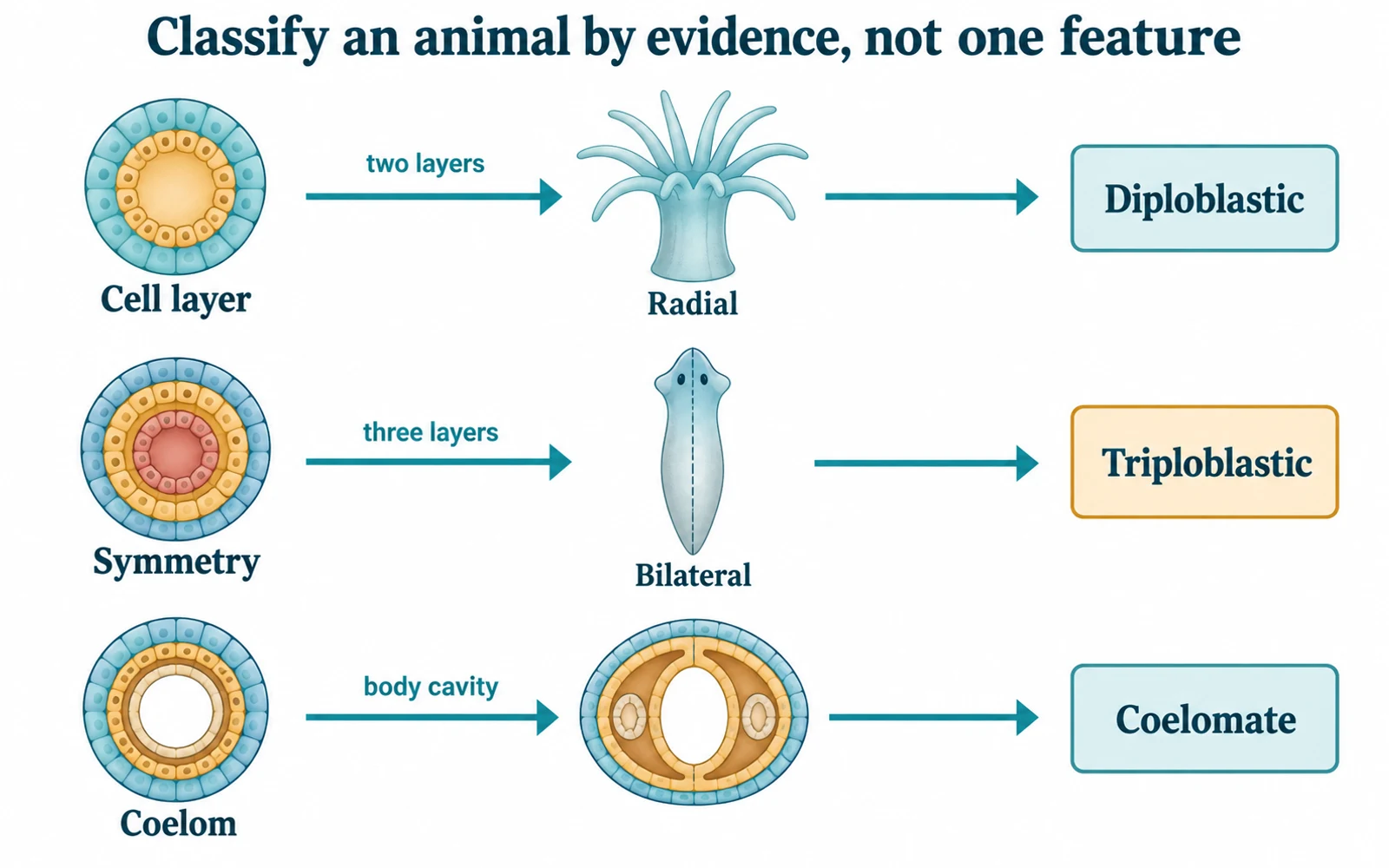
The adult stage matters when using this comparison. Echinoderm larvae are bilateral while adults are radially arranged, so an answer that ignores life stage can be misleading. Similarly, radial symmetry does not itself determine the number of germ layers or the type of body cavity. The diagram places these criteria side by side precisely because they must be checked separately.
For a paper cut-out test, imagine folding a silhouette. If one vertical fold gives matching sides, that supports bilateral symmetry. If several planes through a central axis could do so, radial symmetry is plausible. Do not use 'moves quickly' or 'has a head' as replacements for the plane test.
Germ layers and the body cavity answer different questions
Diploblastic animals develop from two primary germ layers, ectoderm and endoderm, with an intervening non-cellular layer in the introductory comparison. Triploblastic animals have a third germ layer, mesoderm, between ectoderm and endoderm. Germ-layer count concerns early body construction; it is not the same claim as the presence of a coelom.
A coelom is a body cavity lined by mesoderm. In the NCERT comparison, platyhelminthes are acoelomate, nematodes are pseudocoelomate, and annelids onward include coelomate examples. A pseudocoel is not simply 'a smaller coelom'; its relationship to mesoderm is the distinction. If an option uses the word cavity, ask whether it is asking about the cavity itself or its lining.
Consider an invented sorting card: an animal is bilateral and triploblastic, but no information about a body cavity is supplied. You may infer neither coelomate nor acoelomate from those two facts alone. Adding a familiar phylum name from memory would be guessing beyond the evidence.
A complete gut, segmentation and notochord refine the comparison
A blind-sac digestive arrangement has one opening serving as the route for intake and egestion; a complete digestive tract has separate mouth and anus. This feature helps distinguish some groups, but it should be used with other evidence. A digestive opening is not automatically proof of a particular symmetry or cavity type.
Segmentation means a repeated series of body units. It is prominent in annelids and occurs in modified forms in arthropods and chordates. Repetition of body parts is different from simply having many limbs. A notochord is a flexible supporting rod characteristic of chordates at least during development. A vertebral column is not a synonym for the notochord; vertebrates are a chordate subgroup.
Use these features as checkpoints. They make a phylum comparison more precise than a collection of examples, and they prevent the common jump from 'segmented' directly to 'vertebrate'.
Read major phyla through a diagnostic bundle
Porifera have a canal system and cellular level of organisation. Cnidaria are diploblastic with radial symmetry and characteristic stinging cells. Platyhelminthes are dorsoventrally flattened triploblasts without a coelom; nematodes are pseudocoelomate and typically show a complete digestive tract. Annelids are segmented coelomates.
Arthropods combine segmented organisation with jointed appendages and an exoskeleton. Molluscs have a soft body that often includes a muscular foot and mantle. Adult echinoderms show radial symmetry and a water vascular system. Chordates are defined by a set of characters including a notochord, dorsal hollow nerve cord, pharyngeal gill slits and post-anal tail at some stage; no single one should replace the full set.
These are broad study anchors, not rules for identifying animals in the field. An answer should state the named feature and its comparison, rather than treating a familiar example as the definition of its entire phylum.
Build a three-pass classification answer
First write the evidence in separate rows: organisation, symmetry, germ layers, coelom, gut, segmentation and chordate characters. Second, cross out any phylum whose diagnostic bundle contradicts the evidence. Third, explain the remaining choice in one sentence using two independent features. That final sentence makes it easier to notice when you have relied on one attractive but insufficient clue.
NCERT anchor: Animal Kingdom, sections 4.1 and 4.2 in the 2025-26 reprint. Study five-kingdom classification first for the kingdom boundary, then use structural organisation in animals to move from broad phyla to tissues and organs. This guide does not provide wildlife identification or veterinary advice.
Common confusions to check
- Bilateral symmetry does not prove an animal is coelomate.
- A vertebral column is not the definition of a notochord.
- Multicellular does not automatically mean organ-system level.
Editorial note and disclaimer
Written by: DongFeng. Published by: MedQGo. Last updated: September 24, 2026.
Disclaimer: This guide is a revision aid for NEET-UG aspirants and does not constitute medical advice. For clinical or health-related queries, consult a qualified medical professional.
References
Related revision guides
How to use this guide
Read the relevant NCERT chapter first. Then redraw the relationships or process described here from memory, compare your version with the textbook, and correct only the gaps. This is an independent revision aid, not official NCERT, NTA, or NEET material.