A disappearing leaf has more than one possible destination
A leaf placed on damp soil gradually becomes difficult to recognise. Some of it may have been broken into smaller pieces, some dissolved material may have moved with water, and some compounds may have been transformed by organisms. A photograph showing a smaller leaf cannot tell you how much of each process occurred.
Decomposition is easier to understand when appearance, chemical change and transport are recorded separately. The question in this guide is not how energy pyramids are shaped. It is what has actually happened to detritus, and what evidence would support an inference about nutrient release.
Fragmentation changes size; mineralisation changes chemical form
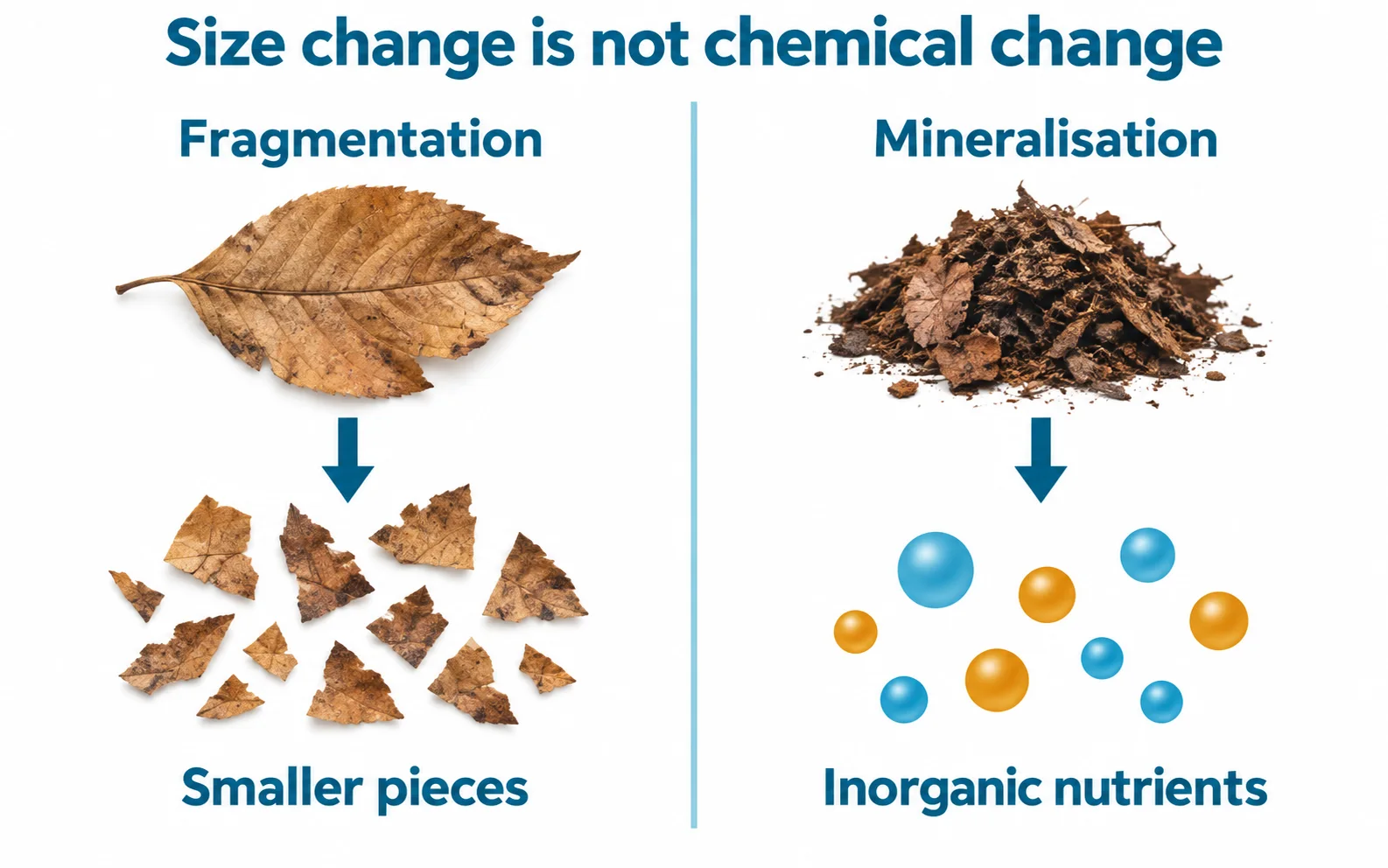
Detritus includes dead biological material and organic wastes. Detritivores can break this material into smaller particles, increasing the surfaces accessible to further activity. The particles remain organic material: making a leaf smaller does not by itself turn its compounds into inorganic nutrients.
Mineralisation refers to the release of nutrients in inorganic form through breakdown of organic matter. It is therefore a chemical distinction, not a measurement of fragment size. The two panels in the illustration deliberately show different outcomes rather than consecutive compulsory stages. A litter sample can undergo several processes at once.
The distinction suggests two different observations. Sieving or imaging could describe particle sizes; chemical measurements would be needed to establish a change in nutrient forms. Neither method on its own answers the other question. That separation is useful when reading any experimental description about decomposing material.
Write the measurement before the explanation
A smaller recovered mass is an observation. Mineralisation is one possible process requiring chemical evidence. Keeping those statements separate lets you calculate confidently while remaining honest about what the experiment has not measured.
Match the process to the evidence you would measure
These are overlapping processes, not five compulsory stations that every piece of litter visits in order.
| Process | Observable change | Useful measurement | What it does not establish |
|---|---|---|---|
| Fragmentation | Organic particles become smaller | Particle-size distribution | Nutrients have become inorganic |
| Leaching | Soluble substances move with water | Solutes in water leaving the litter | Nearby plants absorbed those substances |
| Catabolism | Enzymatic transformation of compounds | Change in substrates and products | A fixed quantity of mineral release from appearance alone |
| Humification | Relatively persistent organic material accumulates | Characterisation of the organic pool | All nutrients are immediately plant-available |
| Mineralisation | Organic-bound nutrients are released in inorganic form | Nutrient-form measurements | All lost litter mass became mineral nutrients |
Water can transport material without finishing its breakdown
Leaching moves soluble substances with water. In the NCERT treatment, water-soluble inorganic nutrients can be carried into deeper soil and become unavailable through precipitation. Movement away from the original litter is therefore not equivalent to immediate uptake by nearby roots.
Catabolism concerns enzymatic breakdown. Fungi and bacteria contribute enzymes that transform compounds in detritus. A smaller particle can offer more accessible surface, but physical fragmentation and enzymatic transformation still name different actions. It is useful to record the agent and the result separately: who or what acted, and what changed?
A strict five-box conveyor belt is misleading here. Fragmentation, leaching and microbial breakdown can overlap in time, and different portions of one leaf may follow different routes. A diagram should not require every fragment to become humus before any nutrient is released.
Humus is a persistent organic pool, not a bag of mineral salts
Humification produces relatively resistant organic material described in NCERT as dark, amorphous humus. Its persistence helps distinguish it from readily decomposed litter. It can act as a nutrient reservoir, but a reservoir is not the same thing as nutrients already present in immediately available inorganic forms.
Further microbial breakdown can release inorganic nutrients through mineralisation. Some material therefore persists while other material is transformed more quickly. Humification and mineralisation need not be competing labels for the entire soil sample; both can describe processes occurring within it.
The wrong inference is 'humus is dark, so its nutrients are already mineralised'. Colour supplies no such chemical proof. Instead ask whether the nutrient remains associated with organic material or has been released in an inorganic form. This also explains why a visible organic layer cannot be translated directly into a measurement of nutrient availability.
Work a litter-bag result before explaining its cause
Consider an invented comparison using identical litter initially weighing 12 g dry in each bag. After the same exposure period, bag A contains 9 g dry material and bag B contains 6 g. A has lost 3 g, or 25% of its initial dry mass; B has lost 6 g, or 50%. The proportional loss in B is twice that in A over this interval.
That calculation does not show that B released 6 g of mineral nutrients. Mass can leave through dissolved substances, escaped fragments or gases produced during metabolism. Material can also be incorporated into organisms. Without additional measurements, the result establishes loss of recovered litter mass, not the chemical destination of every missing gram.
Use dry mass because different water contents would confound a wet-mass comparison. Keep litter type, starting mass, bag mesh, exposure interval and drying method comparable. If the two bags also differ in temperature and moisture, the result cannot isolate which variable explains the difference.
A defensible conclusion is 'B showed greater proportional dry-mass loss under the stated conditions'. A stronger conclusion about microbial activity, mineralisation or a temperature effect needs corresponding controls and measurements. The arithmetic is the beginning of interpretation, not permission to invent the mechanism.
Moisture helps until oxygen becomes limiting
Temperature and moisture influence decomposer activity. The textbook pattern is faster breakdown under suitably warm, moist conditions and slower breakdown in cold or oxygen-poor conditions. Waterlogging can restrict oxygen supply, so 'wetter always means faster' is not a reliable rule.
Composition matters too. Under otherwise comparable conditions, detritus rich in resistant components such as lignin or chitin generally breaks down more slowly than material richer in readily usable soluble compounds and nitrogen. Comparing a woody fragment with a soft leaf while changing their environments would combine two explanations.
To test a moisture hypothesis conceptually, hold litter and temperature constant, compare several moisture conditions, and include replicate samples. Do not assume the warmest or wettest treatment must win. The mechanism predicts a suitable range of conditions, not unlimited acceleration at either extreme. No handling of unknown microbes is needed for this paper-based reasoning exercise.
Nutrient return does not send energy back into leaves
Nutrients released from organic matter can re-enter biological use, while decomposer metabolism dissipates energy as heat. These are different fates. Labelling an arrow from soil nutrients to plant roots as recycled energy would confuse a material transfer with an energy process.
Nor does decomposition guarantee that every released nutrient reaches a plant. Transport, soil chemistry and uptake by other organisms affect its destination. The useful study boundary is to distinguish release from availability and availability from actual uptake. The linked ecosystem guide explains the separate energy-flow account in more detail.
Audit a claim in four lines
Write these four entries for the litter-bag example: observation, calculation, supported conclusion and missing evidence. Your observation is a change in recovered dry mass; your calculation is 25% versus 50%; your conclusion concerns relative mass loss over the same interval. Missing evidence includes chemical measurements needed to assign that loss specifically to mineralisation.
Then classify three independent observations: smaller organic particles indicate fragmentation; dissolved material moving downward indicates leaching; release of inorganic nutrients from organic matter supports mineralisation. A single sample may show all three. This recall task tests the meaning of the processes without forcing them into a rigid order.
NCERT anchor: Class 12 Biology, Ecosystem, section 12.3, Reprint 2025-26. OpenStax's treatment of biogeochemical cycles supplies a complementary nutrient-return perspective. All quantities in the litter-bag example are invented for reasoning practice, not reported field measurements.
Common confusions to check
- Lost litter mass is not a direct measure of mineral nutrients.
- Humus remains an organic pool.
- Decomposition processes can overlap instead of following a fixed sequence.
Editorial note and disclaimer
Written by: DongFeng. Published by: MedQGo. Last updated: September 26, 2026.
Disclaimer: This guide is a revision aid for NEET-UG aspirants and does not constitute medical advice. For clinical or health-related queries, consult a qualified medical professional.
References
Related revision guides
How to use this guide
Read the relevant NCERT chapter first. Then redraw the relationships or process described here from memory, compare your version with the textbook, and correct only the gaps. This is an independent revision aid, not official NCERT, NTA, or NEET material.