Identify a floral pattern from its diagnostic structure
The NEET-UG 2026 Biology syllabus names five flowering-plant families for study: Malvaceae, Cruciferae, Leguminosae, Compositae and Gramineae. Their alternate botanical names are useful when reading references: Cruciferae is Brassicaceae, Leguminosae is Fabaceae, Compositae is Asteraceae, and Gramineae is Poaceae. The pair of names refers to one family in each case, not two separate syllabus groups.
A productive identification path begins with a high-contrast feature rather than a long list. Look for a grass spikelet, a head made of many florets, a papilionaceous pea flower, four cruciform petals, or the staminal tube typical of the familiar Malvaceae example. Then verify the ovary, fruit or stamen arrangement before settling on a family.
The original visual is a diagnostic route map, not a set of complete flower dissections. It highlights one recognition clue per family. The comparison table carries the supporting characters and common confusions that a small mobile illustration should not try to encode all at once.
Five families, five different recognition anchors
Malvaceae can be recognised in the syllabus-level Hibiscus example by an epicalyx outside the calyx and numerous stamens whose filaments unite into a tube. The stigma and superior ovary complete a useful floral check. Do not confuse the epicalyx with the true calyx: they are separate whorls or structures.
Cruciferae, also called Brassicaceae, is associated with four petals arranged like a cross and six tetradynamous stamens: four are longer and two are shorter. The superior ovary and siliqua-type fruit provide a second check. 'Four petals' is a count; 'cruciform' describes their arrangement.
Leguminosae or Fabaceae is exemplified by pea. Its papilionaceous corolla has a standard, two wings and a keel; the vexillary arrangement describes how these petals overlap in the bud. A common androecium pattern is nine stamens united with one free, and the fruit is a legume. Do not transfer the pea flower pattern to every legume without checking the floral form being asked about.
Compositae or Asteraceae is not identified by one large flower: its capitulum is a head containing many small florets. In a typical sunflower-type account, the ovary is inferior and the calyx can be modified into a pappus. Ray and disc florets can differ within one head, so describe the inflorescence before assigning a single flower's traits to the entire head.
Gramineae or Poaceae is recognised through spikelets and highly reduced grass florets. Glumes surround the spikelet, while lemma and palea are associated with each floret; lodicules represent a reduced perianth. A caryopsis is the characteristic fruit type, with the fruit wall closely associated with the seed coat. Identify the spikelet level before counting florets.
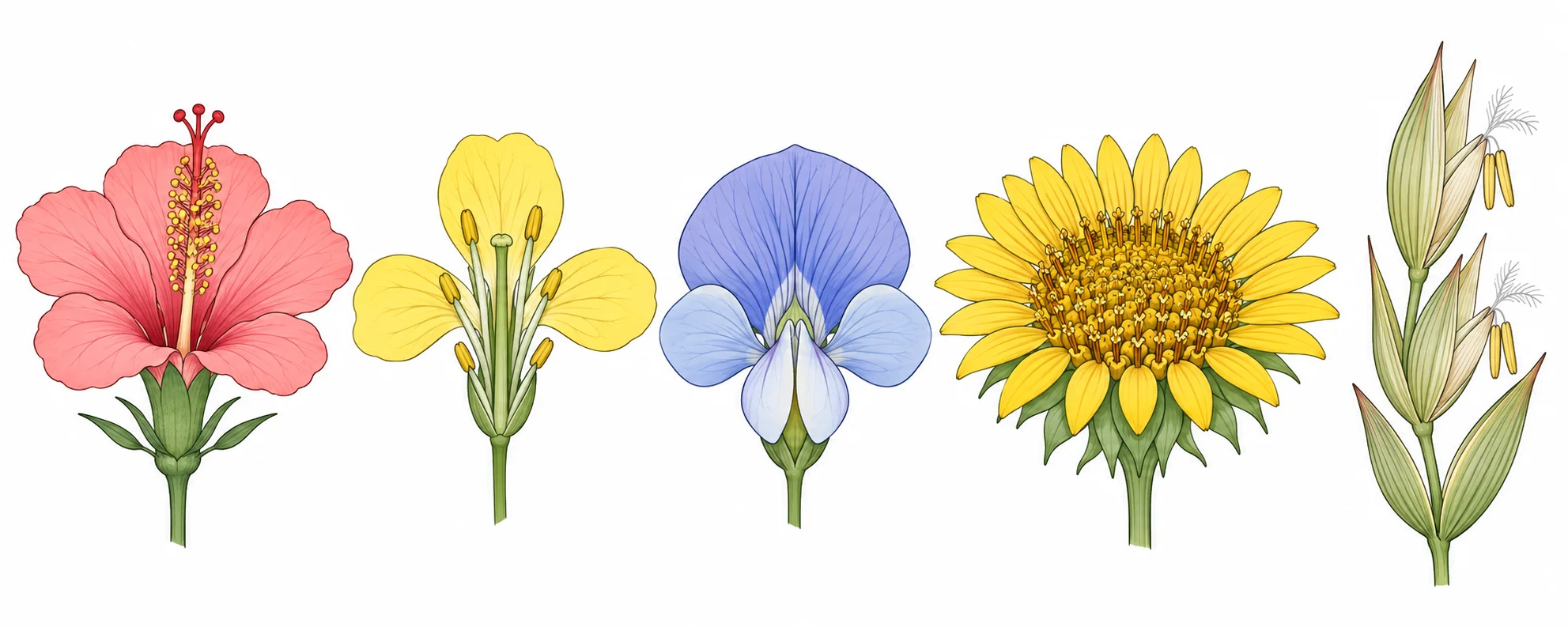
The five-clue recall strip
Rebuild a family label from the strongest structural clue, then verify it with a second character.
- Malvaceae: epicalyx and a staminal tube.
- Cruciferae: four cruciform petals plus six tetradynamous stamens.
- Leguminosae: standard, wings and keel; check the fruit is a legume.
- Compositae: a capitulum composed of florets.
- Gramineae: spikelets, glumes, lemma and palea; check the caryopsis.
One visible head can contain many flowers
For Asteraceae, name the capitulum as an inflorescence and the small units as florets. If a prompt shifts to ray or disc floret details, stay at that level; a feature of one floret should not silently become a description of the whole head.
Five families: compare the unit, floral clue and fruit
Use a clue bundle rather than one isolated word. Floral structures can be described at the whole-inflorescence, floret or individual-flower level.
| Family and familiar name | Strong recognition clue | Second check | Common mix-up to avoid |
|---|---|---|---|
| Malvaceae (Hibiscus) | Epicalyx; numerous stamens united into a tube | Superior ovary | Epicalyx is not the true calyx |
| Cruciferae / Brassicaceae (mustard) | Four cruciform petals | Six tetradynamous stamens; siliqua fruit | Four petals alone are weaker than the count plus arrangement |
| Leguminosae / Fabaceae (pea) | Standard, wings and keel | Vexillary aestivation; legume fruit | A papilionaceous flower is not the same thing as any pea-like leaf |
| Compositae / Asteraceae (sunflower) | Capitulum composed of florets | Typical inferior ovary; pappus may represent modified calyx | The visible head is an inflorescence, not one large flower |
| Gramineae / Poaceae (wheat) | Spikelets with glumes; florets with lemma and palea | Reduced perianth; caryopsis fruit | Glumes belong around a spikelet, not each individual floret |
Use paired clues rather than a single memorised word
Suppose a specimen description mentions a compound-looking head and many small units. The first question is whether those units are florets: if so, a capitulum supports Asteraceae. A 'head' in casual language is not enough; the unit of inflorescence must be specified.
If the clue is six stamens, ask whether four are long and two short. That arrangement is tetradynamous and supports Cruciferae. If instead filaments form a tube around the style and an epicalyx is present, the clue bundle points toward Malvaceae. The number alone is weaker evidence than number plus arrangement.
If a flower has a standard, wings and keel, keep the petal arrangement and fruit in the same account: a legume fruit supports Fabaceae. If the description instead uses lemma, palea and glumes, it has moved to the grass-floret scale. These terms name bracts and floral parts at different organisational levels.
A worked identification without an answer bank
Consider an invented field note: a plant bears a flower head made from many small florets; some florets at the margin are strap-shaped, and the ovary of a typical floret is inferior. Start with the head as the inflorescence-level clue, then verify the florets. The combination supports Compositae/Asteraceae rather than a single large flower with many petals.
A tempting but incorrect shortcut is to see the word 'sunflower' and record 'one flower'. The visible head is an inflorescence composed of florets. Another error is to use the strap-shaped ray florets to describe every floret in the head; disc florets can have a different form. State the level being described before writing the family name.
Now contrast an invented description of four petals in a cross and six stamens, four long and two short. Those paired clues support Cruciferae. A four-petal count by itself would be weaker because floral part counts can recur in different groups.
Keep the level of observation consistent
A family description may mix whole-plant habit, inflorescence, individual-flower characters, ovary position and fruit. These observations can all help, but they do not refer to the same unit. A capitulum is an inflorescence; a floret is an individual flower within it; a caryopsis is a fruit type. Mixing these levels makes a correct clue sound contradictory.
The table below selects a small set of discriminating characters rather than claiming that every member of a large family is identical in every feature. Common names are orientation aids, not taxonomic evidence. When a prompt names a particular species or subgroup, follow that information instead of forcing a family stereotype.
For the organs and whorls used in these descriptions, revisit the flowering-plant morphology guide. For internal tissue and vascular organisation, the anatomy guide is the relevant next step. This family note focuses on external diagnostic comparison and does not repeat the complete organ-by-organ morphology account.
Reconstruct the five-way recognition grid
From memory, write five family names down the page. Add one column each for signature flower or inflorescence, stamen clue, ovary or fruit clue, and one named example. Check that the grass row is at the spikelet/floret level and that the sunflower row distinguishes a head from a single flower.
Then cover the family names and identify each row using only its strongest clue. Finally cover the clues and rebuild them in your own words. A correct family label with the wrong level of observation is not yet a reliable identification.
Common confusions to check
- A sunflower capitulum is an inflorescence composed of florets, not one large flower.
- Cruciferae has six tetradynamous stamens: four long and two short.
- Glumes surround a grass spikelet; lemma and palea are associated with individual florets.
Editorial note and disclaimer
Written by: DongFeng. Published by: MedQGo. Last updated: October 9, 2026.
Disclaimer: This guide is a revision aid for NEET-UG aspirants and does not constitute medical advice. For clinical or health-related queries, consult a qualified medical professional.
References
- National Medical Commission / NTA, NEET-UG 2026 Biology syllabus, Unit 2: Structural Organisation in Animals and Plants
- NCERT Class 11 Biology, Chapter 5: Morphology of Flowering Plants (2026-27 reprint)
- Virginia Tech Extension: Botanical characteristics of Poaceae and other plant families
- Royal Botanic Gardens, Kew: Asteraceae flower heads and florets
Related revision guides
How to use this guide
Read the relevant NCERT chapter first. Then redraw the relationships or process described here from memory, compare your version with the textbook, and correct only the gaps. This is an independent revision aid, not official NCERT, NTA, or NEET material.