A specimen label contains several different claims
Imagine receiving three specimen records with a common name, a scientific name and a family on each. Before comparing them, ask which field identifies the organism and which places it within a larger group. A familiar name is not enough: different regions can use different common names, while similar-looking organisms need not belong to the same species. Taxonomy makes these comparisons explicit.
The practical goal here is to read a classification record without asking it to prove too much. You should be able to distinguish a rank from the group occupying it, extract the two parts of a species name, and work out which shared categories follow from the information supplied. These are the foundations needed before learning the diagnostic characters of kingdoms and phyla.
Read the hierarchy as nested membership
The standard NCERT sequence runs from species through genus, family, order, class and phylum to kingdom. Division is the corresponding term commonly used for plants. Moving upward broadens the group under discussion; moving downward narrows it. These are levels of classification, not stages through which an individual grows.
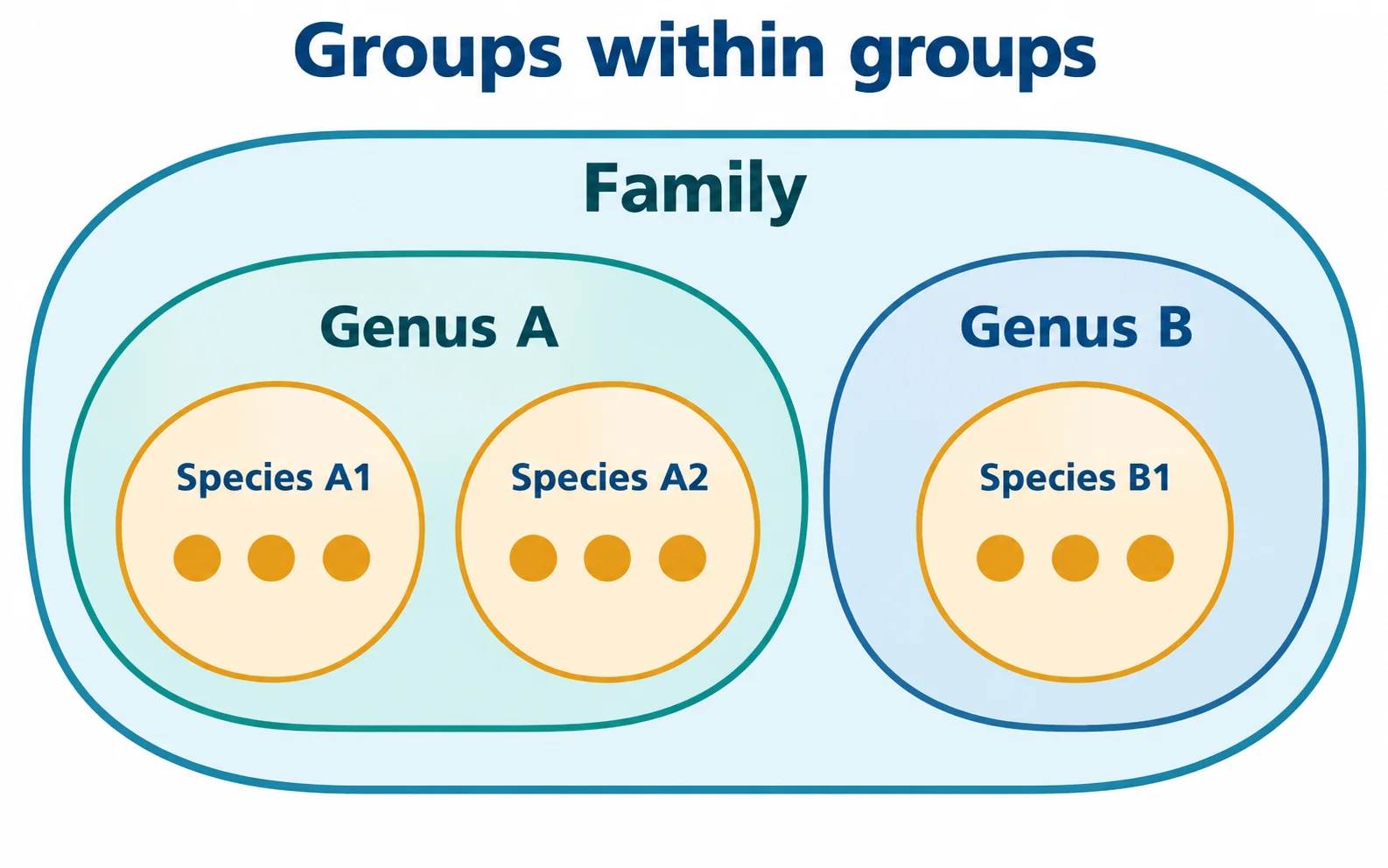
In a given classification, two organisms assigned to the same genus also share its family and the categories above that family. The reverse inference fails: sharing a family leaves open the possibility of different genera. The illustration deliberately shows only family, genus and species so that this one-way implication stays visible. It is a containment model, not a proposed family tree of named organisms.
Broader groups generally share fewer diagnostic features across all their members than narrower groups do. That does not make a kingdom less real or a species more evolved. Nor can the names of ranks tell you an exact percentage of shared DNA. A rank answers where a group sits in the classification, not how much molecular difference separates every pair of members.
Try the inference backwards
When a classification statement seems obvious, reverse it. Shared genus implies shared family, but shared family does not imply shared genus. Finding where the reversal fails is a quick way to test whether you understand the nesting rather than only remember the rank order.
What does a shared label permit you to infer?
Apply these statements within the same classification framework; the direction of implication matters.
| Information supplied | Conclusion permitted | Conclusion still unsupported |
|---|---|---|
| Same genus | Shared family and higher categories | Same species |
| Same family | Shared order and higher categories | Same genus |
| Same complete species name | Same named species, if identification is correct | Same individual specimen |
| Same specific epithet alone | The second words match | Same species or genus |
| Correctly formatted binomial | Naming format follows the convention | Specimen was correctly identified |
Rank is the address field; taxon is its entry
Genus is a rank. A named genus, such as Panthera, is a taxon at that rank. Family is another rank; Felidae is a named group placed there. Using this distinction, 'What category is Panthera?' and 'Which genus is listed?' are different questions even when both concern the same record.
Taxon is singular and taxa is plural. The term is not reserved for species: a genus, family or kingdom can also be a taxon. A useful annotation is to write a field and its value together, for example genus: Panthera. This prevents a list of rank words from being mistaken for the actual classification of an organism.
Taxonomic placements can be revised when evidence changes. When comparing two sources, first check that they use compatible classifications. An apparent contradiction between records may reflect a revision, not a rule that organisms can freely move between categories during their lifetime. For revision work, use the classification framework specified by the source rather than silently mixing systems.
The second word is not the complete species name
A binomial combines a generic name with a specific epithet. In Panthera leo, Panthera names the genus and leo is the epithet; the complete combination identifies the species. The genus begins with a capital letter, the epithet with a lower-case letter. Scientific binomials are conventionally italicised in print and their two words separately underlined when handwritten.
An epithet can recur in different genera, so matching the second word alone does not establish that two records describe one species. Conversely, matching the genus but finding different epithets normally identifies different species within that genus. Read both words before counting names.
An abbreviated author name may follow a binomial. It records naming authorship and is not a third part of the binomial or the name of a subspecies. Likewise, shortening the genus to an initial is useful only when the context makes that genus unambiguous. A revision list with several genera beginning with the same letter should retain enough information to avoid confusion.
Sort a small register without inventing relationships
Use this invented register: samples 1 and 2 belong to species A1 in genus A; sample 3 belongs to species A2 in genus A; sample 4 belongs to species B1 in genus B. Both genera are assigned to family F. These are symbolic labels for the exercise, not newly proposed scientific names.
The register contains four samples, three species, two genera and one family. Count distinct memberships rather than rows. Samples 1 and 2 do not create two species simply because they were collected separately. Samples 1 and 3 share genus A but not a species; samples 1 and 4 share family F but not a genus.
Now remove the genus entry for sample 4 while retaining its family. Could you still conclude that it belongs to genus B? No. That information was lost. It could belong to another genus within F. The defensible statement is only that its family is shared. This small deletion test reveals whether an answer comes from the supplied evidence or from an assumption added by the reader.
A tempting wrong answer is 'one family, therefore one genus'. The illustration supplies a counterexample: both genus A and genus B fit inside the same family. One valid counterexample is enough to defeat that proposed implication.
Identification, naming and grouping do different work
Identification connects a specimen with a recognised organism or group using evidence. Nomenclature supplies the rules for names. Classification organises organisms into groups, while systematics also considers their evolutionary relationships. They cooperate, but succeeding at one task does not automatically complete the others.
A label can be correctly capitalised yet attached to the wrong specimen. That is an identification problem, not a typography problem. Conversely, an organism may be correctly recognised while its label uses a local common name that another reader cannot interpret. That is why a useful record needs both biological evidence and a standard naming convention.
Similarity should also be interpreted cautiously. Sharing a habitat, colour or use to humans is not by itself a sufficient basis for a taxonomic placement. The next step is to examine diagnostic characters; the five-kingdom guide develops that evidence-based comparison rather than repeating this hierarchy exercise.
Reconstruct a label, then test its limits
Close the guide and write the seven standard ranks from narrowest to broadest. Beneath genus, add a named example and label which part is the rank and which is the taxon. Then write a complete binomial and identify its generic name and specific epithet. Finally give one conclusion allowed by shared genus and one conclusion not allowed by shared family.
Check your last two statements against these criteria: common genus supports common family within the same classification; common family does not force common genus. This is a stronger check than repeating a rank mnemonic because it tests what the hierarchy lets you infer.
NCERT anchor: Class 11 Biology, The Living World, sections 1.1 and 1.2, Reprint 2026-27. This note focuses on names and nested categories. Kingdom characters and plant-group life cycles are separate study tasks linked below.
Common confusions to check
- A matching epithet alone does not identify the same species.
- Sharing a family does not require sharing a genus.
- Taxonomic ranks are not stages of individual development.
Editorial note and disclaimer
Written by: DongFeng. Published by: MedQGo. Last updated: September 26, 2026.
Disclaimer: This guide is a revision aid for NEET-UG aspirants and does not constitute medical advice. For clinical or health-related queries, consult a qualified medical professional.
References
Related revision guides
How to use this guide
Read the relevant NCERT chapter first. Then redraw the relationships or process described here from memory, compare your version with the textbook, and correct only the gaps. This is an independent revision aid, not official NCERT, NTA, or NEET material.