PCR selects a region rather than copying an entire organism
A DNA sample can contain far more sequence than the region you want to study. PCR, the polymerase chain reaction, increases the amount of a selected region by repeated copying. The key reasoning questions are where copying starts, which templates can be used again, and what assumptions justify a numerical prediction. A positive signal is a separate question from whether a sequence has the identity or biological meaning you expect.
This guide develops the amplification part of NCERT Class 12 Biology, Chapter 9. The molecular-tools overview compares cutting, copying and separating; here we follow copying across cycles. No clinical test interpretation or laboratory recipe is intended. Exact reaction settings depend on the target, primers and enzyme, so memorising a universal set of temperatures would obscure the mechanism.
Three operations change what can pair with the template
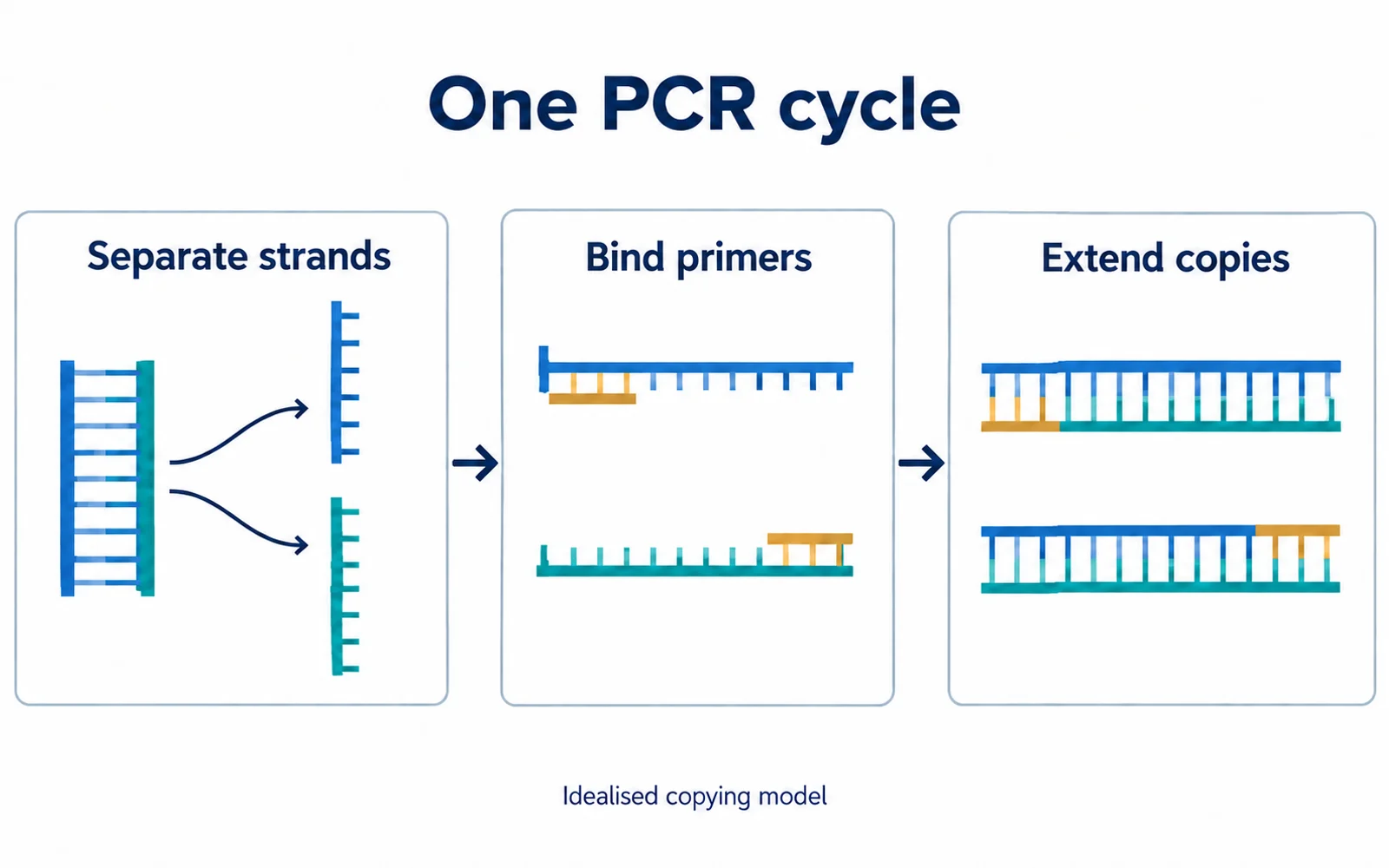
Denaturation separates the paired DNA strands. It does not chop the DNA backbone into restriction fragments. When the temperature is lowered appropriately, primers can anneal to complementary sequences on the templates. Extension then uses DNA polymerase and nucleotides to build new complementary DNA from the primer ends. Repeating the temperature cycle makes the new molecules available as templates in later rounds.
The original figure is a simplified one-cycle account. Blue and teal distinguish the two complementary strands; amber marks the short primers. Each separated template receives a complementary strand, producing two duplexes. The purpose is to distinguish separating strands, positioning primers and making DNA. It omits strand-end notation, enzyme movement and early-cycle length differences, which are explained in the text rather than guessed from icon shapes.
Write the counted object beside the exponent
The expression 2^n cannot tell you whether a problem means strands, duplexes, added molecules or exactly bounded products. Specify that object before substituting a cycle count. A correct multiplication with an unstated unit can answer a different question from the one posed.
Which missing input breaks which part of the explanation?
These are conceptual roles, not a reaction-preparation protocol. A failed result can have more than one cause.
| Input or operation | Role in the copying account | Misleading substitute |
|---|---|---|
| Template DNA | Provides sequence information for complementary copying | A gel band is the measurement, not the starting sequence definition |
| Primer pair | Supplies extension starts and defines the amplified interval | Polymerase alone does not choose the target |
| Thermostable DNA polymerase | Extends new DNA through repeated cycling | A primer is not a copying enzyme |
| Nucleotides | Supply building material for new strands | Heating alone cannot manufacture complementary DNA |
| Denaturation | Separates paired strands | Not restriction cutting of the backbone |
| Post-amplification separation | Compares product migration and size | Not a substitute for sequence identification |
Primers supply starting ends and define the target boundaries
A DNA polymerase extends an existing strand from an available 3-prime end; it does not choose a target merely because the whole sample contains it. Two primers bind opposite template strands so that extension proceeds into the region between them. New DNA is made in the 5-prime to 3-prime direction. Primer sequence and placement therefore matter to which region becomes amplified.
Think of two bookmarks that identify opposing boundaries, rather than two labels attached anywhere on a chromosome. If both proposed extension directions point away from the desired interval, calling the molecules 'forward' and 'reverse' does not fix their geometry. This is a conceptual orientation check, not instructions for designing an assay.
Thermostable polymerase can withstand the repeated heating that separates templates. Taq polymerase is the familiar textbook example. Heat separates the strands in PCR; helicase has that role in ordinary cellular replication. Confusing these two contexts can lead to the incorrect claim that adding helicase is what makes a PCR cycle work.
An ideal count begins with an explicit starting definition
Use an invented model starting with five double-stranded, target-length DNA molecules whose boundaries already match the intended product. Assume every molecule is copied successfully once during every cycle, both strand-derived products become usable templates, and no material is lost. Under perfect doubling, the molecule count after n cycles is N0 x 2^n.
After six ideal cycles, the count is 5 x 64 = 320 double-stranded molecules. That is the final total, not the number added. The net increase is 320 - 5 = 315. After three cycles there are 40; after three more there are 320. The second group of cycles acts on the enlarged pool, not just on the original five.
Two wrong calculations reveal different mistakes. Multiplying 5 by 2 by 6 gives 60 and treats each cycle as an identical addition rather than growth of the current pool. Reporting 640 double-stranded molecules counts the strands as though each were a complete duplex. There would be 640 individual strands in 320 duplexes, but the requested unit must stay unchanged.
If the starting material is a longer DNA template, the earliest products can extend beyond a primer-defined target boundary. Exactly bounded products accumulate through subsequent cycles. Our initial definition avoids pretending that every early molecule is already the exact amplicon. The common doubling equation is a useful idealised amplification model; the object being counted must be stated.
Efficiency changes the multiplier before it changes the answer
Real reactions do not double indefinitely. Reagent limitations, enzyme behaviour and competing reactions can reduce amplification efficiency and eventually produce a plateau. A hypothetical constant efficiency E gives the model Nn = N0 x (1 + E)^n, where E = 1 means perfect doubling. This relation is an explanatory extension, not a claim that a real run has constant efficiency.
For an independent arithmetic check, begin with 100 target-length molecules and assume E = 0.8 for two cycles. The multiplier is 1.8, giving 100 x 1.8 x 1.8 = 324 expected molecules, compared with 400 under perfect doubling. The expected increase per cycle is 80% of the current pool; 80% is not the fraction of DNA left after each cycle.
The calculation demonstrates sensitivity to an assumption. It cannot estimate an unknown sample's starting quantity from an endpoint band alone. That would require an appropriate measurement method and calibration, with the model's limitations considered. The labels total copies, newly added copies and expected copies should not be exchanged mid-solution.
A band answers less than a complete identification claim
Gel electrophoresis can help compare product sizes after amplification; it is not the copying step. A band near an expected size is compatible with the intended product, but size alone does not establish sequence identity. Similarly sized unintended products can exist. Amplification and identification are therefore related but distinct tasks.
Reason through a hypothetical control: a reaction intended to contain no template nevertheless produces a band. That finding calls the interpretation into question; contamination or primer-related products are possibilities, not conclusions that can be distinguished from the band statement alone. Conversely, no visible band in a sample reaction can reflect several causes and does not, by itself, prove that the original biological sample contained no target.
Ordinary DNA PCR does not directly copy RNA. When RNA is the starting information, conversion to complementary DNA precedes DNA amplification in a reverse-transcription approach. Keep this distinction conceptual: a method name is not enough to interpret a person's diagnostic result.
Explain each answer with an input, an operation and a unit
Close the diagram and reconstruct the three operations without temperature numbers. Identify what separates, what binds and what extends. Then explain why primers and polymerase are different inputs, why a new product can become a template, and why a gel is outside the copying cycle.
Redo the five-molecule calculation, explicitly writing double-stranded molecules beside 320 and net increase beside 315. Finally reject the sentence 'the expected-size band proves the sequence' by naming the missing identity evidence. These checks separate mechanistic understanding from a memorised power of two.
Common confusions to check
- Denaturation separates strands rather than cutting the backbone.
- Final total and net increase are different counts.
- Perfect doubling is an assumption, not an unlimited experimental guarantee.
- A band at the expected size does not by itself establish sequence identity.
Editorial note and disclaimer
Written by: DongFeng. Published by: MedQGo. Last updated: October 8, 2026.
Disclaimer: This guide is a revision aid for NEET-UG aspirants and does not constitute medical advice. For clinical or health-related queries, consult a qualified medical professional.
References
Related revision guides
How to use this guide
Read the relevant NCERT chapter first. Then redraw the relationships or process described here from memory, compare your version with the textbook, and correct only the gaps. This is an independent revision aid, not official NCERT, NTA, or NEET material.