Two leaves grow by the same area. Did they grow equally?
Suppose a small leaf increases from 4 to 8 square centimetres over two days, while a larger leaf increases from 20 to 24. Both gain 4 square centimetres, but only the small leaf doubles. A description of plant growth can therefore be numerically correct and still incomplete: absolute increase and increase relative to the starting size answer different questions.
Growth is an irreversible increase in size associated with living processes. Development is broader, including changes in form and function as well as growth. A plant becoming taller, a cell acquiring a specialised role and a bud entering dormancy are not three measurements of the same event. This note separates those events before considering the regulators that coordinate them.
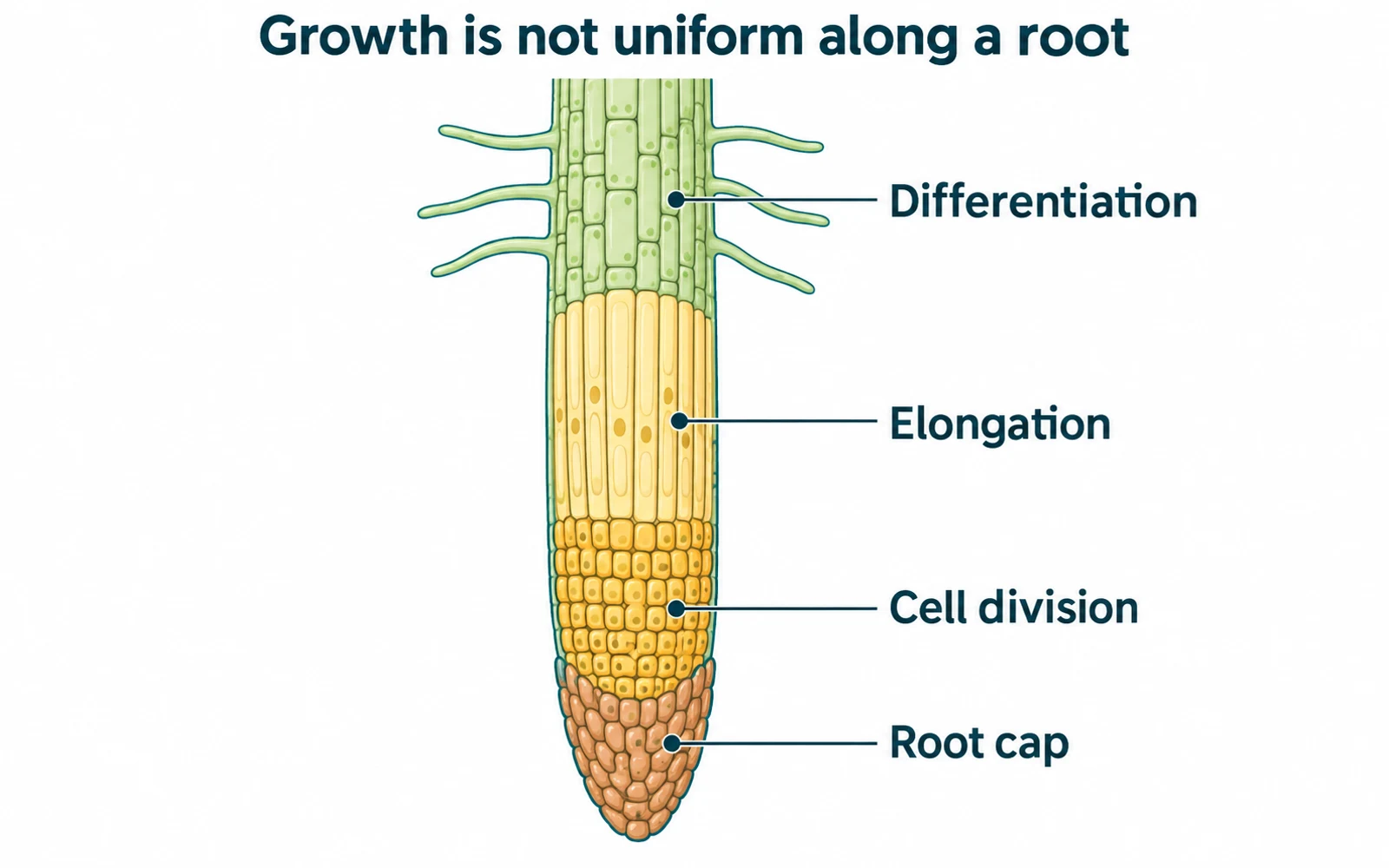
Read a root from its protective tip towards older cells
The root cap protects the tip. Immediately behind it is a region with actively dividing cells; farther back, cells elongate, and then acquire mature features. Root hairs belong to the differentiation region, not the protective cap. The diagram deliberately separates position from activity so that the word 'tip' does not become a substitute for identifying the correct zone.
Cell division increases cell number; elongation increases cell dimensions. A longer root can result from both. Differentiation supplies specialised structure and function rather than simply adding another equal increment of length. The zones are a useful developmental map, not sharply fenced compartments with identical boundaries in every root.
Meristems allow plants to retain growing regions through much of life. This indeterminate capacity does not mean every leaf grows forever or every mature cell continues dividing. Particular organs can stop increasing in size while other regions of the same plant remain active. Whole-plant potential and the behaviour of one organ must be described separately.
Decide what your denominator means
For a percentage increase, divide the change by the starting size. For a rate, also state the time interval. A logarithmic relative rate uses a different calculation. Writing the denominator before inserting numbers prevents three distinct measures from being called simply 'growth'.
A regulator claim needs a qualifying context
These associations guide revision; they are not treatment or crop-application instructions.
| Regulator | Useful association | Overstatement to avoid |
|---|---|---|
| Auxin | Apical dominance and context-dependent elongation | It promotes every tissue at every concentration |
| Gibberellins | Axis elongation and bolting in suitable plants | It is the only signal required for growth |
| Cytokinins | Cell division and delayed senescence | All mature cells must begin dividing |
| Ethylene | Ripening; some elongation responses | It always inhibits growth |
| Abscisic acid | Dormancy and water-stress responses | Dormancy means the seed is dead |
Work the leaf calculation in two different ways
Return to the invented leaf records. The mean absolute area-growth rate for either leaf is (final area - initial area)/time = 4/2 = 2 square centimetres per day. On this measure they are equal. The fractional increase over the interval is 4/4 = 1, or 100%, for the small leaf, and 4/20 = 0.2, or 20%, for the large leaf. On that measure they are not equal.
These percentages describe the whole two-day interval. They are not automatically a continuously compounded relative growth rate. If a problem explicitly requests that logarithmic measure, use (ln final size - ln initial size)/time: ln(2)/2 is about 0.347 per day for the small leaf, whereas ln(1.2)/2 is about 0.091 per day for the large one. Do not silently switch between definitions.
A tempting mistake is to choose the larger final leaf as the faster grower. Final size includes its head start. Another is to compare a mass increase in one plant with a length increase in another. Choose one measurement, one interval and an explicit definition before ranking growth.
What a growth curve can and cannot tell you
Arithmetic growth adds a constant amount per unit time in the idealised model, producing a straight size-time relationship. Geometric growth increases in proportion to the amount already present under favourable conditions. Its increments become larger as the growing system becomes larger. Constant addition and constant proportional increase should not be used as synonyms.
Unlimited geometric growth is not a realistic lifetime description of an organ. Resource and developmental limitations can produce an S-shaped, or sigmoid, pattern with an initially slow phase, a rapid phase and a levelling phase. Levelling indicates that the measured increase has slowed; it does not show that every cell has died.
A curve alone rarely identifies the controlling hormone. Similar changes in size can arise from water availability, nutrition, temperature or developmental state. To infer a regulator's effect, compare suitable controls and specify the tissue, dose and conditions rather than reading a hormone name directly off a graph.
A change of cell role is not necessarily a size increase
Differentiation gives cells characteristics suited to particular functions. Dedifferentiation describes differentiated living cells regaining the capacity to divide under appropriate circumstances. Redifferentiation follows when the resulting cells specialise again. The sequence is about developmental capacity and identity, not a plant reversing its chronological age.
For an original diagram exercise, draw a mature living cell, then a dividing population, then specialised descendants. Label the first transition dedifferentiation and the second redifferentiation. Do not draw a dead conducting element returning to division: the word living is essential to this explanation. Growth may accompany these transitions, but extra size alone would not prove either one.
Development integrates such changes with growth and environmental responses. Plasticity means that form can vary with developmental stage or surroundings. It is not evidence that the plant's inherited information has necessarily changed whenever the shape of a leaf differs.
Give each regulator a context instead of a personality
Auxin is associated with processes including shoot elongation and apical dominance, but its effect depends on tissue and concentration. Removing an apical bud can release lateral buds from suppression; that observation is about branching control, not proof that auxin inhibits all growth. A root and a shoot need not respond identically to the same concentration.
Gibberellins can promote axis elongation and bolting in suitable plants. Cytokinins are associated with cell division and can delay senescence. Neither label means a hormone acts alone: responses depend on other signals and the developmental state of the target tissue. A named association is the beginning of an explanation, not a universal instruction to every cell.
Ethylene is gaseous and is associated with fruit ripening, among other responses. Calling it only an inhibitor misses contexts where it promotes growth, such as elongation responses in deep-water rice. Abscisic acid is important in dormancy and water-stress responses, including stomatal closure. These are biological relationships for revision, not recommendations for applying growth regulators to crops.
Test a prediction against what was actually measured
Imagine two otherwise comparable shoots, one retaining its apical bud and the other having that bud removed. More lateral branching in the second supports release from apical dominance. It does not show that every cell in that shoot divided faster, because the observation concerns which buds developed. Matching the conclusion to the recorded outcome prevents an overclaim.
Close the note and sketch a root with its cap, division, elongation and differentiation regions. Then explain why equal absolute leaf-area gains can represent unequal proportional growth. Finally, give one reason why 'ethylene always suppresses growth' is too broad. These tasks check location, measurement and conditional reasoning rather than another isolated hormone list.
NCERT anchor: Plant Growth and Development, sections 13.1-13.4 in the 2025-26 reprint. Pair this with plant anatomy to identify the tissues being discussed and with flowering-plant reproduction to follow the later developmental outcome. Section numbers can change between editions; use headings as well as numbers when locating the passage.
Common confusions to check
- Equal absolute increases need not mean equal relative growth.
- Indeterminate growth does not mean every organ grows indefinitely.
- Ethylene is not exclusively growth-inhibiting.
Editorial note and disclaimer
Written by: DongFeng. Published by: MedQGo. Last updated: September 23, 2026.
Disclaimer: This guide is a revision aid for NEET-UG aspirants and does not constitute medical advice. For clinical or health-related queries, consult a qualified medical professional.
References
Related revision guides
How to use this guide
Read the relevant NCERT chapter first. Then redraw the relationships or process described here from memory, compare your version with the textbook, and correct only the gaps. This is an independent revision aid, not official NCERT, NTA, or NEET material.