Three special modes answer three different questions
After ordinary pollination and fertilisation, a flowering plant can show special developmental outcomes that are easy to collapse into one phrase. Ask what is developing, whether fertilisation is required for that development, and how many embryos are present. Those questions point to seed formation, fruit formation, and embryo number respectively.
Apomixis is seed formation without fertilisation. It is a form of asexual reproduction through seeds, but the cellular route can vary: an embryo may arise without the usual fertilisation event, and in some plants embryos can arise from somatic ovular tissue. Do not assume every apomictic seed follows one identical cell lineage. The useful boundary is that fertilisation is bypassed in seed reproduction.
Parthenocarpy describes fruit development without fertilisation and commonly results in fruits without seeds. It names the fruit-development outcome, not a way of making an embryo. A seedless fruit is compatible with parthenocarpy, but the observation 'no seeds' alone does not identify the developmental cause.
Polyembryony means that more than one embryo occurs in a single seed. In nucellar embryony, additional embryos can arise from nucellar cells; citrus is a familiar example. Polyembryony describes embryo number, not by itself whether every embryo originated after fertilisation. These terms are therefore not three mutually exclusive bins: an apomictic route can also produce multiple embryos.
Trace the structure before you name the special mode
Start with the ovule and ovary as separate structures. The ovule is the seed precursor; the ovary is the fruit precursor. Fertilisation normally begins embryo development from the zygote and is associated with endosperm formation in angiosperms. A special mode changes one part of this expected route, so identify which structure still develops and which event is absent or repeated.
A useful way to read a short description is to underline the noun first. If it says 'seed develops without fertilisation', test apomixis. If it says 'ovary forms a fruit without fertilisation', test parthenocarpy. If it says 'one seed contains several embryos', test polyembryony. Only then check the stated cellular origin; don't infer it from the label alone.
These distinctions also prevent a false inference from the final product. A seedless fruit does not establish that a seed formed apomictically, because in that case no seed may have formed at all. Conversely, a seed can contain embryos even when their origins differ. Follow the developmental account, not just the harvest description.
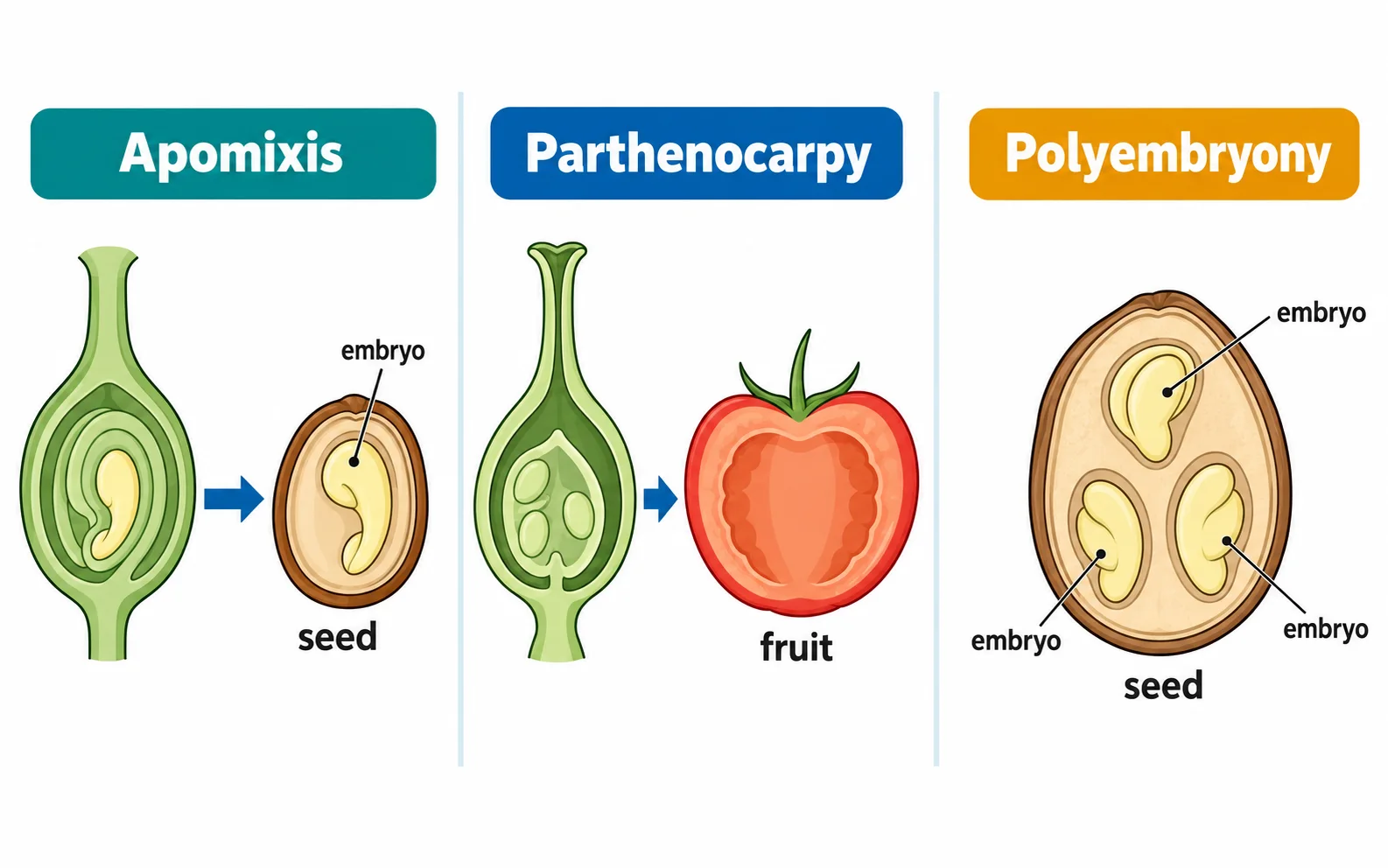
The structure-first check
Name the developing structure and the event before choosing a special-mode label.
- Seed develops without fertilisation: apomixis.
- Ovary develops into a fruit without fertilisation: parthenocarpy.
- More than one embryo occurs in one seed: polyembryony; check each embryo's origin separately.
- An apomictic seed can also be polyembryonic because reproductive route and embryo count are different axes.
Name both the missing event and the developing structure
'Without fertilisation' is not enough to identify a term. Ask whether the account is about a seed, a fruit, or the number of embryos in a seed. Apomixis, parthenocarpy and polyembryony answer those different questions, and an apomictic seed can also be polyembryonic.
Classify the developmental event, not just the final product
Apomixis and parthenocarpy both bypass fertilisation in a stated developmental route, while polyembryony counts embryos within one seed. These labels can describe different axes.
| Term | What is being described? | Fertilisation relation | Check that prevents a mix-up |
|---|---|---|---|
| Apomixis | Seed reproduction / embryo route | Seed forms without fertilisation | A seed is part of the outcome; it is not simply a seedless fruit |
| Parthenocarpy | Fruit development | Fruit develops without fertilisation | Names ovary-to-fruit development, not embryo formation |
| Polyembryony | Embryo number per seed | Origin must be checked separately | More than one embryo can occur in one seed; additional embryos may be nucellar |
Work through three independent descriptions
Description A says that an ovary grows into a fruit although fertilisation did not occur, and no seed is described. The named outcome is parthenocarpy. Calling this apomixis would confuse fruit with seed: apomixis concerns seed reproduction without fertilisation.
Description B says one seed contains a zygotic embryo plus additional embryos that developed from nucellar cells. The seed is polyembryonic because it contains multiple embryos. The nucellar origin identifies the additional route; embryo count is the classification requested. Do not replace that count with 'multiple seeds'.
Description C says a seed embryo develops without fusion of male and female gametes. That is apomictic seed formation. If the description also reports several embryos in that seed, polyembryony can apply as a second descriptor. The labels answer different questions, so using both is not a contradiction.
Keep the reproductive sequence and the exception in view
Apomixis matters conceptually in plant breeding because seed-based reproduction can preserve a selected genotype without the segregation expected after repeated sexual reproduction. This is a potential advantage of an apomictic system, not a guarantee that every crop hybrid can be propagated this way or a claim about a particular commercial variety.
Parthenocarpy changes fruit formation rather than the inheritance route of a seed. Polyembryony changes how many embryos share one seed, and embryo origin must be specified before discussing genetic similarity. These are different axes: reproductive route, developing organ, and embryo count.
A three-column retrieval check
Cover the table below and draw three columns labelled developing structure, fertilisation status, and embryo count. Place one definition in each column, then add the citrus nucellar example where appropriate. Finish by explaining aloud why seedlessness alone cannot prove apomixis.
For the prerequisite sequence, revisit the guide to double fertilisation and post-fertilisation events. For tissue origin in a mature seed, continue to the seed-development guide. This note stays with developmental exceptions and does not replace the full flowering-plant reproductive sequence.
How to avoid a convincing but wrong label
A tempting answer is 'seedless means apomixis'. It fails because apomixis still describes seed formation, whereas parthenocarpy can produce a fruit when fertilisation has not taken place. Check whether a seed exists before naming a seed-reproduction route.
Another tempting answer is 'multiple embryos means multiple fertilisations'. That is not required: additional embryos can arise from nucellar tissue. Use the stated origin and count, and keep the zygotic embryo distinct from extra embryos.
Common confusions to check
- A seedless fruit does not by itself prove apomictic seed formation.
- Polyembryony describes multiple embryos in one seed; it does not name their origin.
- Apomixis can produce a seed without fertilisation and may overlap with polyembryony.
Editorial note and disclaimer
Written by: DongFeng. Published by: MedQGo. Last updated: October 9, 2026.
Disclaimer: This guide is a revision aid for NEET-UG aspirants and does not constitute medical advice. For clinical or health-related queries, consult a qualified medical professional.
References
Related revision guides
How to use this guide
Read the relevant NCERT chapter first. Then redraw the relationships or process described here from memory, compare your version with the textbook, and correct only the gaps. This is an independent revision aid, not official NCERT, NTA, or NEET material.