A biotechnology product is the end of a chain, not the beginning
A useful biotechnology explanation begins with a defined biological task: obtain a DNA fragment, place it in a suitable carrier, introduce the construct into a host, identify the desired cells, and recover the intended product or information. The final product is important, but it cannot explain why a vector, selection marker or downstream processing step was needed.
This guide focuses on the NCERT process logic behind recombinant DNA technology. It does not reproduce a laboratory protocol or provide instructions for creating modified organisms. The learning aim is to distinguish the purpose of each component in a conceptual workflow and to catch steps that are placed in the wrong order.
Start by naming the jobs, not the brand of tool
The central operations are isolation of genetic material, cutting DNA at defined sites, amplification where needed, joining a DNA fragment to a vector, introducing recombinant DNA into a host, selecting or screening suitable cells, and using the resulting material. One enzyme or device may support more than one operation, but the operation itself is the stronger revision anchor.
A restriction endonuclease identifies a specific DNA target and cleaves its backbone. DNA ligase then makes a covalent link between prepared fragments. These actions are complementary, not interchangeable. A restriction enzyme does not seal an inserted fragment into a vector, and ligase does not create the initial site-specific cuts.
The diagram shows one simplified order. It does not claim that all projects use a circular plasmid, that every cut forms sticky ends, or that introducing DNA alone guarantees expression. The purpose of a concept map is to preserve essential dependencies without pretending every laboratory system is identical.
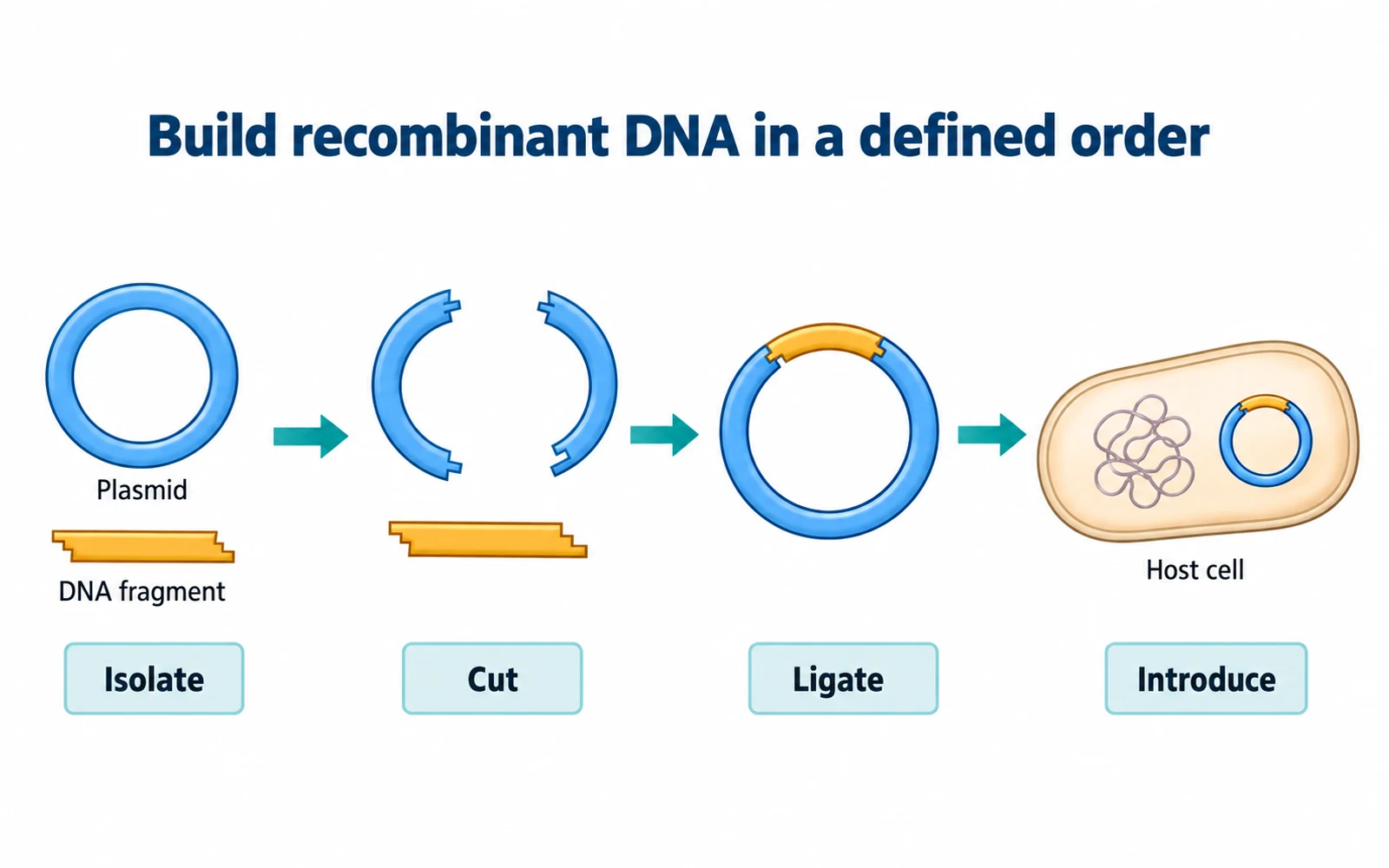
Trace dependencies, not an equipment list
A biotechnology workflow is easier to reconstruct when each stage supplies a condition for the next. Start with the desired DNA and ask what must be true before a host can be selected or a product can be recovered.
One workflow, distinct jobs
A correct term in the wrong stage is still a wrong explanation.
| Component or stage | Immediate job | What it does not establish | Quick check |
|---|---|---|---|
| Restriction endonuclease | Cuts DNA at recognised sequences | That fragments are permanently joined | Creates ends; does not ligate |
| DNA ligase | Forms covalent DNA junctions | That the right host cell was selected | Seals a prepared junction |
| Vector origin | Supports replication in a host | That an insert is present | Lets the carrier persist |
| Selectable marker | Enriches for relevant host cells | That every clone has the desired insert | Selection is not full screening |
| Downstream processing | Recovers and purifies output | That recombinant DNA was constructed | Occurs after production |
A vector is a carrier with usable control points
A cloning vector carries a chosen DNA fragment into a host and has features that make the construct manageable. NCERT highlights an origin of replication, selectable marker and cloning sites. The origin supports replication in the host; a selectable marker helps distinguish cells associated with the vector; suitable cloning sites allow insertion without destroying a necessary function.
A plasmid is a common vector in the introductory model, but vector and plasmid are not synonyms. A plasmid can be used as a vector, while other systems can carry DNA for different purposes. Likewise, a selectable marker helps identify a useful population; it is not a statement that every selected cell contains the intended insert in the intended orientation.
Here is a reasoning check. If a construct has an origin and an insert site but no way to distinguish host cells that received the vector, the missing function is selection or screening, not cutting. Identify the missing job before naming a molecule.
Compatible ends help joining, but they are not the final product
When a vector and a DNA fragment are cut so their ends can pair through complementarity, the temporary association positions them for joining. Ligase then establishes the covalent linkage. The fact that two ends can align does not mean a stable recombinant molecule has already been produced.
For an invented paper model, imagine a circular vector opened once and one fragment whose ends match the vector ends. After pairing, there are two junctions to be joined. A final circular recombinant vector therefore needs both junctions sealed; one joined side and one open side is not a complete circular construct. This is a logic exercise, not an experimental instruction.
The misleading statement is 'sticky ends are enzymes that join DNA'. Sticky ends describe DNA end geometry. Restriction enzymes can generate particular ends, and ligase performs the joining. Keeping material, recognition and catalytic action in separate boxes prevents this mix-up.
Host entry, selection and expression are separate checkpoints
Introducing recombinant DNA into host cells is commonly called transformation in the bacterial context. It creates a population in which only some cells may receive the vector. Selection enriches for cells with a relevant marker, while screening asks whether a selected cell has the desired construct or trait. These steps have different questions: did DNA enter, which cells carry the vector, and which clone is the right one?
Expression adds another layer. A host carrying a DNA construct may not automatically make the intended product at the desired level. Regulatory sequences, host compatibility and processing affect whether a gene is expressed appropriately. At NEET level, the key distinction is simply that DNA entry, cloning and expression are not one event renamed three ways.
Follow the molecular-tools guide for amplification and gel-based analysis, then recombinant DNA technology for a focused workflow. This page provides the framework that explains why those individual tools appear in a larger process.
Bioreactors and downstream processing come after the biological system works
A bioreactor provides controlled conditions for large-scale biological production. In NCERT's framing, the aim is to support the chosen cells or enzymes under conditions that allow the desired process to proceed. A stirred-tank design may include mixing, aeration, temperature and pH control, but its presence does not itself purify the final product.
Downstream processing refers to recovery and purification steps after the biological production phase. It is therefore a later stage than constructing a recombinant molecule or selecting a host. A question that asks where purification belongs should not be answered with restriction digestion simply because both are part of a biotechnology story.
This distinction is also a boundary for the guide: process concepts can be learned without treating them as instructions for handling cells, genes or products outside an appropriate educational setting.
Use a dependency map to audit your explanation
Draw six boxes: target DNA, cutting, vector, joining, host, recovery. Add an arrow only when the earlier box supplies something required by the next. Then write a short explanation of why a marker belongs near the host-selection stage and why purification belongs after production. This map makes missing dependencies visible.
NCERT anchor: Biotechnology: Principles and Processes, sections 9.1-9.3 in the 2025-26 reprint. Follow it with biotechnology applications to distinguish a method from its use, and with molecular basis of inheritance to refresh DNA structure and replication. This is an independent educational overview, not a lab manual or a claim of official NCERT status.
Common confusions to check
- Sticky ends are DNA ends, not enzymes.
- Selection does not prove every chosen cell has the intended insert.
- DNA entry, cloning and expression are separate checkpoints.
Editorial note and disclaimer
Written by: DongFeng. Published by: MedQGo. Last updated: September 24, 2026.
Disclaimer: This guide is a revision aid for NEET-UG aspirants and does not constitute medical advice. For clinical or health-related queries, consult a qualified medical professional.
References
Related revision guides
How to use this guide
Read the relevant NCERT chapter first. Then redraw the relationships or process described here from memory, compare your version with the textbook, and correct only the gaps. This is an independent revision aid, not official NCERT, NTA, or NEET material.